Loading...
Done
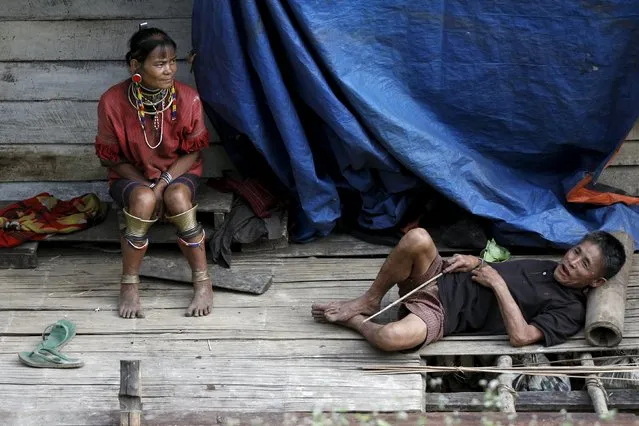
An ethnic Kayaw couple Mu Htoo and her husband Htaw Eili rest at their home at Htaykho village in the Kayah state, Myanmar September 12, 2015. (Photo by Soe Zeya Tun/Reuters)

An ethnic Kayaw couple Mu Htoo and her husband Htaw Eili rest at their home at Htaykho village in the Kayah state, Myanmar September 12, 2015. With about 30,000 members, the Kayaw are one of the smallest ethnic minorities among Myanmar's 135 groups. Their village has for decades been off-limits, as armed rebels fought the military before a recent ceasefire stopped the bloody conflict here. The rebels in the area have put down their guns and taken to the hills to grow rice and corn, but slash-and-burn cultivation methods mean they struggle to find new places to farm. (Photo by Soe Zeya Tun/Reuters)
Details
21 Oct 2015 08:03:00
A picture made available on 07 March 2016 shows visitors petting and holding a Fennec fox, native to the Sahara, in the petting room at the Little Zoo Cafe, a business built to capitalize on Thais' love for exotic animals, and food, on the outskirts of Bangkok, Thailand, 05 March 2016. (Photo by Barbara Walton/EPA)

A picture made available on 07 March 2016 shows visitors petting and holding a Fennec fox, native to the Sahara, in the petting room at the Little Zoo Cafe, a business built to capitalize on Thais' love for exotic animals, and food, on the outskirts of Bangkok, Thailand, 05 March 2016. The cafe boasts Fennec foxes, Meerkat, native to parts of Africa, Silver Fox, Raccoon and Chinchillas, along with a menu of Thai food and Cheesecake, among other sweet deserts. Nature is a faraway fantasy in the bustling exhaust-filled cement city of Bangkok, fuelling a demand to own and be close to exotic pets. The trend to be near to a species that was once wild, in a city environment, far from the natural setting, has drawn criticism but continues to grow. (Photo by Barbara Walton/EPA)
Details
13 Mar 2016 09:38:00
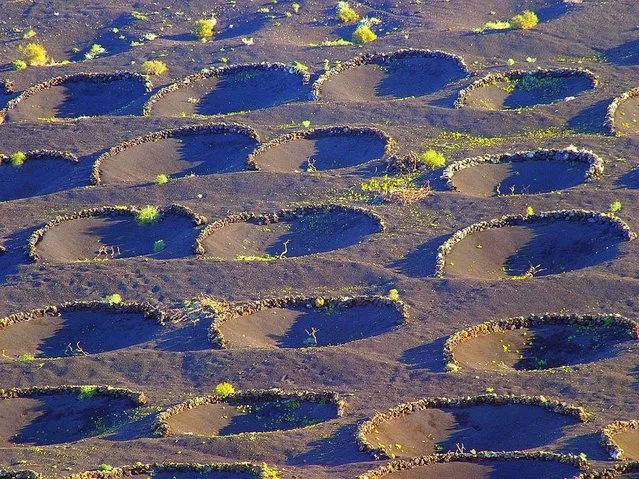
Grapes Born of Volcano In Lanzarote, Spanish

The valley of La Geria, which has been declared a 'Protected Area', is Lanzarote’s main wine-growing region, occupying about 20 square miles (52 square kilometres) and stretching on both sides of the road from Masdache to Uga and right up to the volcanic slopes. This area produces most of Lanzarote’s excellent wines, of which 75 per cent are made from the Malvasía grape, one of the oldest known grape varieties. Best known as a honey-coloured, very sweet wine with a rich flavour, already praised by Shakespeare hundreds of years ago, today the Malvasía grape produces a wide variety of quality white, red or rosé wines, from very sweet to very dry.
Details
31 Oct 2013 09:10:00
In a photo taken on August 30, 2014 a man brushes his dog as he waits to take part in a competition at a dog show in Seoul. (Photo by Ed Jones/AFP Photo)

In a photo taken on August 30, 2014 a man brushes his dog as he waits to take part in a competition at a dog show in Seoul. Some 2000 dogs took part in the three-day show organised by the Korea Kennel Federation which was celebrating its 58th anniversary. Dog ownership in South Korea is a growing industry widely reported to have passed 10 million in 2013, with private expenditure on pet supplies increasing some 14 percent per year since 2000, according to a report by the Nonghyup Economic Research Institute. (Photo by Ed Jones/AFP Photo)
Details
01 Sep 2014 09:59:00
Miners work extremely long days under the hot sun and the hours are often longer in illegal mines in Ghana, West Africa, 2014. An Australian photographer has captured the harsh reality of illegal mining under the unforgiving sun with these Ghanaian miners. Heidi Woodman travelled to Ghana, West Africa to explore the regionís booming mining business, including the growing number of illegal mines. Using Accra as her base, Heidi visited the areas of Tarkwa, Kyebi, East Akim, Kumasi, Obuasi and Takoradi to find areas with a high concentration of galamsey – illegal mining activity. (Photo by Heidi Woodman/Barcroft Images)

Miners work extremely long days under the hot sun and the hours are often longer in illegal mines in Ghana, West Africa, 2014. An Australian photographer has captured the harsh reality of illegal mining under the unforgiving sun with these Ghanaian miners. (Photo by Heidi Woodman/Barcroft Images)
Details
24 Feb 2017 00:02:00
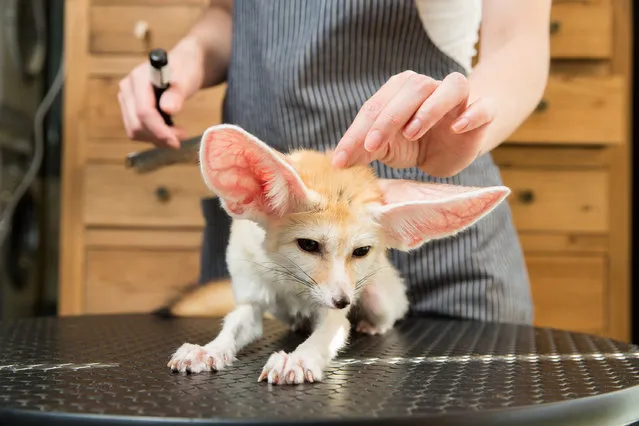
A fennec fox (Vulpes zerda) is groomed in a pet store in central Beijing. Native to the Sahara in North Africa, the species became a popular pet after being depicted as a character in Disney’s 2016 animated movie Zootopia. Individuals can cost between $2,000–$3,000. (Photo by Sean Gallagher/The Guardian)

A dramatic rise in owning exotic pets in China is fuelling global demand for threatened species. The growing trade in alligators, snakes, monkeys, crocodiles and spiders is directly linked to species loss in some of the world’s most threatened ecosystems. Here: A fennec fox (Vulpes zerda) is groomed in a pet store in central Beijing. Native to the Sahara in North Africa, the species became a popular pet after being depicted as a character in Disney’s 2016 animated movie Zootopia. Individuals can cost between $2,000–$3,000. (Photo by Sean Gallagher/The Guardian)
Details
23 Sep 2017 08:04:00
Yang Juan, an employee at Goopal Group, takes a nap in her seat after lunch, in Beijing, China, April 21, 2016. (Photo by Jason Lee/Reuters)

Yang Juan, an employee at Goopal Group, takes a nap in her seat after lunch, in Beijing, China, April 21, 2016. Office workers sleeping on the job is a common sight in China, where a surplus of cheap labour can lead to downtime at work. But in China's technology sector, where business is growing faster than many start-up firms can hire new staff, workers burn the midnight oil to meet deadlines and compete with their rivals. Some companies provide sleeping areas and beds for workers to rest during late nights. (Photo by Jason Lee/Reuters)
Details
12 May 2016 14:53:00
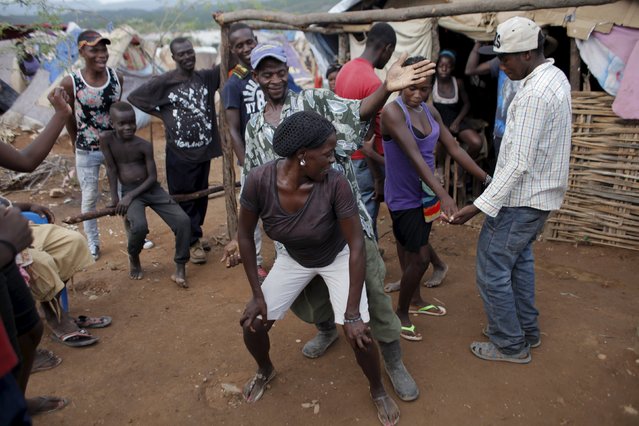
People enjoy themselves as they dance to Dominican music at a refugee camp for Haitians returning from the Dominican Republic on the outskirts of Anse-a-Pitres, Haiti, September 6, 2015. (Photo by Andres Martinez Casares/Reuters)

People enjoy themselves as they dance to Dominican music at a refugee camp for Haitians returning from the Dominican Republic on the outskirts of Anse-a-Pitres, Haiti, September 6, 2015. Dominican officials last month began implementing a controversial immigration program targeting Haitian migrants and Dominican-born people of Haitian descent. The program centers on round-ups and deportations that have triggered concerns about a slow-growing border migration crisis in the poorest country in the Americas. So far about 1,500 people have been deported at a pace of 50 to 100 per day, according to relief officials with access to records supplied by the Dominican government. (Photo by Andres Martinez Casares/Reuters)
Details
21 Sep 2015 11:29:00