Loading...
Done
The spinning vortex of Saturn's north polar storm resembles a deep red rose of giant proportions surrounded by green foliage in this false-color image from NASA's Cassini spacecraft. (Photo by NASA/JPL-Caltech/SSI)

NASA's Cassini spacecraft has provided scientists the first close-up, visible-light views of a behemoth hurricane swirling around Saturn's north pole. In high-resolution pictures and video, scientists see the hurricane's eye is about 1,250 miles (2,000 kilometers) wide, 20 times larger than the average hurricane eye on Earth. Thin, bright clouds at the outer edge of the hurricane are traveling 330 mph(150 meters per second). The hurricane swirls inside a large, mysterious, six-sided weather pattern known as the hexagon. Photo: The spinning vortex of Saturn's north polar storm resembles a deep red rose of giant proportions surrounded by green foliage in this false-color image from NASA's Cassini spacecraft. (Photo by NASA/JPL-Caltech/SSI)
Details
31 May 2015 09:11:00
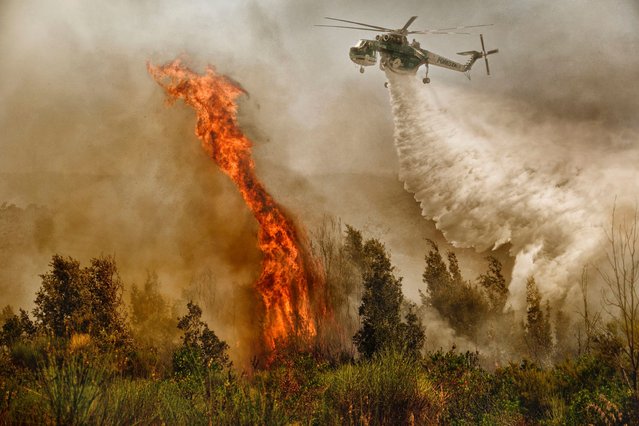
On target: Brave pilots are on a course straight into these enormous flames as they release tonnes of water onto the fire. (Photo by Antonio Grambone/Caters News Agency Ltd)

These are incredible pictures of skilled aircraft pilots flying through raging infernos to put out enormous flames. Daredevil Italian photographer Antonio Grambone, 46, jumped up close to the blaze to capture the incredible images of forest fires in the National Park of Cilento and Vallo di Diano, in the province of Salerno in Italy. At great risk to himself, Antonio captured these incredible shots making them appear like Italian masterpieces.

Photo: On target: Brave pilots are on a course straight into these enormous flames as they release tonnes of water onto the fire. (Photo by Antonio Grambone/Caters News Agency Ltd)
Details
02 Jun 2015 12:14:00
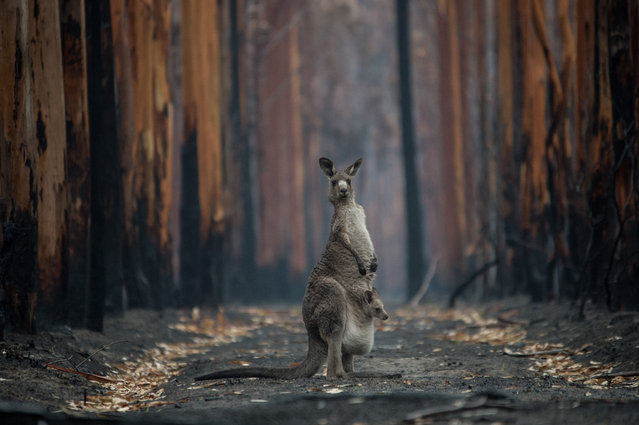
A kangaroo and joey are seen in a burnt forest on Kangaroo Island, south west of Adelaide on January 16, 2020. Australia’s continuing bushfire crisis has taken an enormous toll on wildlife, with huge numbers of mammals, birds, reptiles, insects and other species killed. (Photo by Jo-Anne McArthur/Weanimals)

A kangaroo and joey are seen in a burnt forest on Kangaroo Island, south west of Adelaide on January 16, 2020. Australia’s continuing bushfire crisis has taken an enormous toll on wildlife, with huge numbers of mammals, birds, reptiles, insects and other species killed. (Photo by Jo-Anne McArthur/Weanimals)
Details
26 Jan 2020 00:03:00
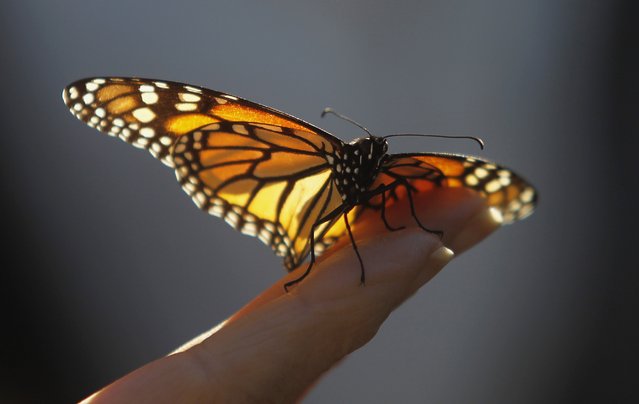
A monarch butterfly rests on a visitor's hand at the Monarch Grove Sanctuary in Pacific Grove, California December 30, 2014. Monarch butterflies may warrant U.S. Endangered Species Act protection because of farm-related habitat loss blamed for sharp declines in cross-country migrations of the orange-and-black insects, the U.S. Fish and Wildlife Service said. (Photo by Michael Fiala/Reuters)

A monarch butterfly rests on a visitor's hand at the Monarch Grove Sanctuary in Pacific Grove, California December 30, 2014. Monarch butterflies may warrant U.S. Endangered Species Act protection because of farm-related habitat loss blamed for sharp declines in cross-country migrations of the orange-and-black insects, the U.S. Fish and Wildlife Service said. (Photo by Michael Fiala/Reuters)
Details
01 Jan 2015 14:08:00
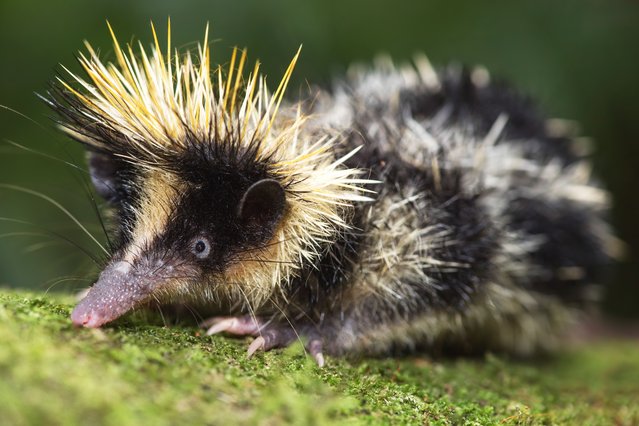
This spiky tenrec was spotted in Madagascar’s Mantadia National Park in the last decade of September 2025. Mostly nocturnal and rarely seen, it puffs out its spines when threatened. Spiky tenrecs are excellent swimmers — unlike most spiny mammals, some species of tenrec can forage in streams and rivers, using their spines for protection while hunting aquatic insects and small prey. (Photo by Dale Morris/Solent News & Photo Agency)

This spiky tenrec was spotted in Madagascar’s Mantadia National Park in the last decade of September 2025. Mostly nocturnal and rarely seen, it puffs out its spines when threatened. Spiky tenrecs are excellent swimmers — unlike most spiny mammals, some species of tenrec can forage in streams and rivers, using their spines for protection while hunting aquatic insects and small prey. (Photo by Dale Morris/Solent News & Photo Agency)
Details
05 Oct 2025 04:02:00
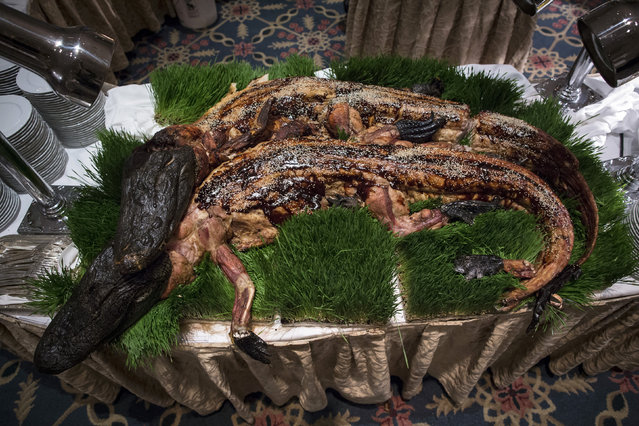
Whole cooked alligators are displayed before being served at the 110th Explorers Club Annual Dinner at the Waldorf Astoria in New York March 15, 2014. The club, which promotes the scientific exploration of land, sea, air and space featured catering by chef and exotic creator Gene Rurka. Chef Rurka prepared a variety of dishes featuring an array of insects, wildlife, animal body parts and invasive species. (Photo by Andrew Kelly/Reuters)

Whole cooked alligators are displayed before being served at the 110th Explorers Club Annual Dinner at the Waldorf Astoria in New York March 15, 2014. The club, which promotes the scientific exploration of land, sea, air and space featured catering by chef and exotic creator Gene Rurka. Chef Rurka prepared a variety of dishes featuring an array of insects, wildlife, animal body parts and invasive species. (Photo by Andrew Kelly/Reuters)
Details
20 Mar 2014 10:03:00
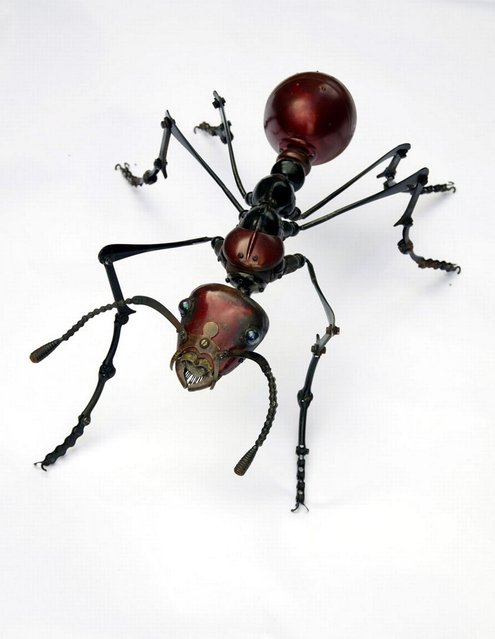
An ant by Edouard Martinet. (Photo by Edouard Martiniet/Caters News)

An amazing artist transforms scrap metal into incredible sculptures of insects, birds, fish, and other animals. Edouard Martinet from Brittany, France, creates the sculptures from all manner of salvaged parts and junk, including car and bicycle parts, typewriters, and medical equipment. Photo: An ant by Edouard Martinet. (Photo by Edouard Martiniet/Caters News)
Details
10 Dec 2013 09:18:00
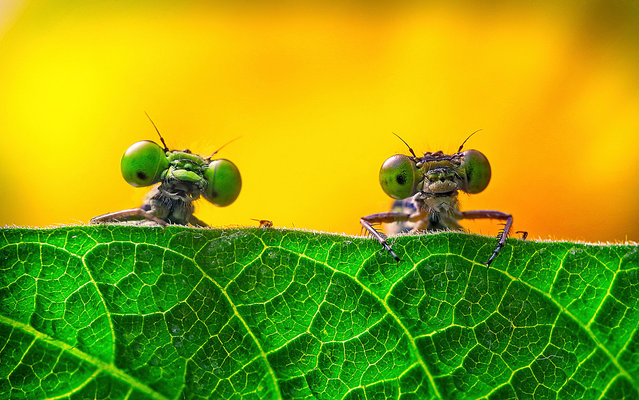
Shortlisted: “Two big eyes” by Miao Yong (Zejiang province, China). Damselflies look over the leaves. “I was photographing insects in a park near my home when suddenly I found two damselflies in the grass. They kept flying and it was very difficult to focus until suddenly they parked behind a leaf”. (Photo by Miao Yong/2017 Royal Society of Biology Photographer of the Year)

Shortlisted: “Two big eyes” by Miao Yong (Zejiang province, China). Damselflies look over the leaves. “I was photographing insects in a park near my home when suddenly I found two damselflies in the grass. They kept flying and it was very difficult to focus until suddenly they parked behind a leaf”. (Photo by Miao Yong/2017 Royal Society of Biology Photographer of the Year)
Details
16 Oct 2017 09:04:00