Loading...
Done


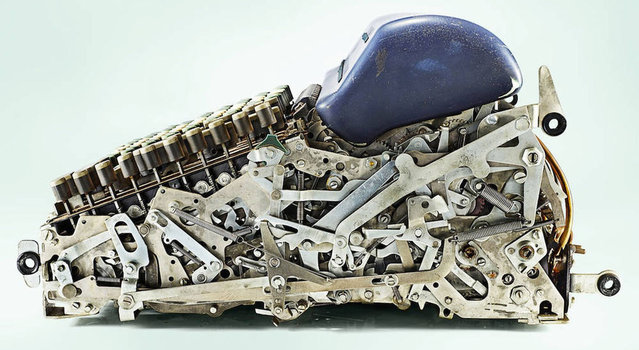
In his newest series of photos called Low Tech, Kevin Twomey artfully captures the complexity of old-style typewriters and similar machines. Despite being completely outdated, you cannot help being amazed at how complicated those “simple” devises really are. Hundreds of little parts were meticulously put together to form a machine that would perform such “basic” functions by today’s standards. Similarly, very few modern people actually think about how complicated the current technology really is. We take for granted streaming videos, GPS, and countless devises that we use every day, while in reality, these things would seem like magic to even the most prominent scientists from only half a century ago. (Photo by Kevin Twomey)
Details
21 Nov 2014 12:42:00
A British Museum representative poses for photographs next to Andy Warhol's “Mao”, left, and Jim Dine's “Drag: Johnson and Mao” which feature in “The American Dream: pop to the present” exhibition during a media photocall at the British Museum in London, Monday, March 6, 2017. (Photo by Matt Dunham/AP Photo)

A British Museum representative poses for photographs next to Andy Warhol's “Mao”, left, and Jim Dine's “Drag: Johnson and Mao” which feature in “The American Dream: pop to the present” exhibition during a media photocall at the British Museum in London, Monday, March 6, 2017. The exhibition, which opens to the public from March 9 and runs until June 18, charts modern and contemporary print making. (Photo by Matt Dunham/AP Photo)
Details
09 Mar 2017 00:00:00
In this Friday, January 9, 2015 photo, bathhouse worker Omid Riahi, 39, scrubs a man to remove dead skin, at the Ghebleh public bathhouse, in Tehran, Iran. The steamy air and curved tiled walls of Iran's famed public bathhouses, some rinsing and massaging patrons for hundreds of years, slowly may wash away as interest in them wanes. (Photo by Ebrahim Noroozi/AP Photo)

In this Friday, January 9, 2015 photo, bathhouse worker Omid Riahi, 39, scrubs a man to remove dead skin, at the Ghebleh public bathhouse, in Tehran, Iran. The steamy air and curved tiled walls of Iran's famed public bathhouses, some rinsing and massaging patrons for hundreds of years, slowly may wash away as interest in them wanes. The bathhouses, known as “hammams” in Persian, find themselves in rough financial times as modern conveniences now allow showers and baths in most homes across the Islamic Republic. (Photo by Ebrahim Noroozi/AP Photo)
Details
03 Apr 2015 12:40:00
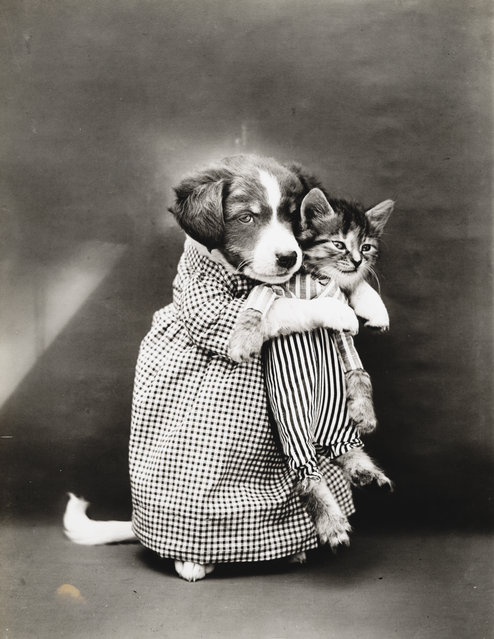
Photograph shows a puppy holding a kitten, 1914. (Photo by Harry Whittier Frees/Library of Congress)

“Harry Whittier Frees (1879–1953) was an American photographer who created novelty postcards and children's books based on his photographs of animals. He dressed the animals and posed them in human situations with props, often with captions; these can be seen as progenitors of modern lolcats”. – Wikipedia. Photo: “The nurse”. Photograph shows a puppy holding a kitten, 1914. (Photo by Harry Whittier Frees/Library of Congress)

P.S. All pictures are presented in high resolution. To see Hi-Res images – just TWICE click on any picture. In other words, click small picture – opens the BIG picture. Click BIG picture – opens VERY BIG picture (if available; this principle works anywhere on the site AvaxNews).
Details
28 Mar 2014 11:20:00
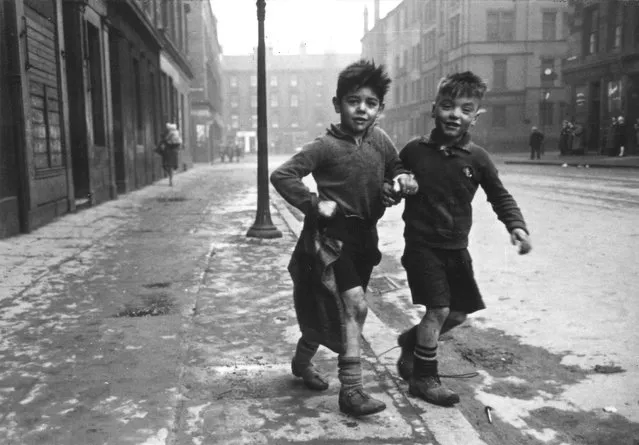
Two boys in the Gorbals area of Glasgow, UK on January 31, 1948. The Gorbals tenements were built quickly and cheaply in the 1840s, providing housing for Glasgow's burgeoning population of industrial workers. Conditions were appalling; overcrowding was standard and sewage and water facilities inadequate. The tenements housed about 40,000 people with up to eight family members sharing a single room, 30 residents sharing a toilet and 40 sharing a tap. By the time this photograph was taken 850 tenements had been demolished since 1920. Redevelopment of the area began in the late 1950s and the tenements were replaced with a modern tower block complex in the sixties. (Photo by Bert Hardy/Getty Images)

Two boys in the Gorbals area of Glasgow, UK on January 31, 1948. The Gorbals tenements were built quickly and cheaply in the 1840s, providing housing for Glasgow's burgeoning population of industrial workers. Conditions were appalling; overcrowding was standard and sewage and water facilities inadequate. The tenements housed about 40,000 people with up to eight family members sharing a single room, 30 residents sharing a toilet and 40 sharing a tap. By the time this photograph was taken 850 tenements had been demolished since 1920. Redevelopment of the area began in the late 1950s and the tenements were replaced with a modern tower block complex in the sixties. (Photo by Bert Hardy/Getty Images)
Details
09 Mar 2017 00:03:00
What the World Eats By Peter Menzel And Faith D'Aluisio Part 2

A stunning photographic collection featuring portraits of people from 30 countries and the food they eat in one day. In this fascinating study of people and their diets, 80 profiles are organized by the total number of calories each person puts away in a day. Featuring a Japanese sumo wrestler, a Massai herdswoman, world-renowned Spanish chef Ferran Adria, an American competitive eater, and more, these compulsively readable personal stories also include demographic particulars, including age, activity level, height, and weight. Essays from Harvard primatologist Richard Wrangham, journalist Michael Pollan, and others discuss the implications of our modern diets for our health and for the planet. This compelling blend of photography and investigative reportage expands our understanding of the complex relationships among individuals, culture, and food.
Details
02 May 2014 09:20:00


“A monowheel is a one-wheeled single-track vehicle similar to a unicycle. However, instead of sitting above the wheel, the rider sits either within it or next to it. The wheel is a ring, usually driven by smaller wheels pressing against its inner rim. Most are single-passenger vehicles, though multi-passenger models have been built.

Pedal-powered monowheels were built in the late 19th century; most built in the 20th century have been motorized. Some modern builders refer to these vehicles as monocycles, though that term is also sometimes used to describe motorized unicycles. Today, monowheels are generally built and used for fun and entertainment purposes, though from the 1860s through to the 1930s, they were proposed for use as serious transportation”. – Wikipedia

Photo: Cycle inventor Kerry McLean poses for the photographer 2000 in Walled Lake, Michigan. The “Monocycle” is equipped with a 40-horsepower engine, 4ft tire and is expected to reach speeds upwards of 100 mph. (Photo by Bill Pugliano/Liaison)
Details
02 Jul 2011 12:24:00
What the World Eats By Peter Menzel And Faith D'Aluisio Part 1

A stunning photographic collection featuring portraits of people from 30 countries and the food they eat in one day. In this fascinating study of people and their diets, 80 profiles are organized by the total number of calories each person puts away in a day. Featuring a Japanese sumo wrestler, a Massai herdswoman, world-renowned Spanish chef Ferran Adria, an American competitive eater, and more, these compulsively readable personal stories also include demographic particulars, including age, activity level, height, and weight. Essays from Harvard primatologist Richard Wrangham, journalist Michael Pollan, and others discuss the implications of our modern diets for our health and for the planet. This compelling blend of photography and investigative reportage expands our understanding of the complex relationships among individuals, culture, and food.
Details
23 Apr 2014 14:34:00