Loading...
Done
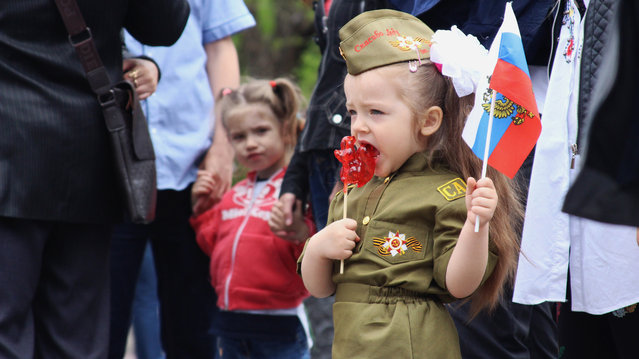
A young Crimean girl wears military-type clothes during a Victory Day celebration in Sevastopol on May 9, 2018. (Photo by Oleksandra Surgan/Radio Free Europe/Radio Liberty)

Children carrying guns and flags or wearing Soviet-style uniforms have become a common sight at Victory Day parades and other events in Russian-controlled Crimea. Russian and Ukrainian human rights activists have warned that such displays point to a growing trend of promoting Russian patriotism among kids on the Crimean peninsula, annexed from Ukraine in 2014. Here: A young Crimean girl wears military-type clothes during a Victory Day celebration in Sevastopol on May 9, 2018. (Photo by Oleksandra Surgan/Radio Free Europe/Radio Liberty)
Details
18 May 2019 00:03:00
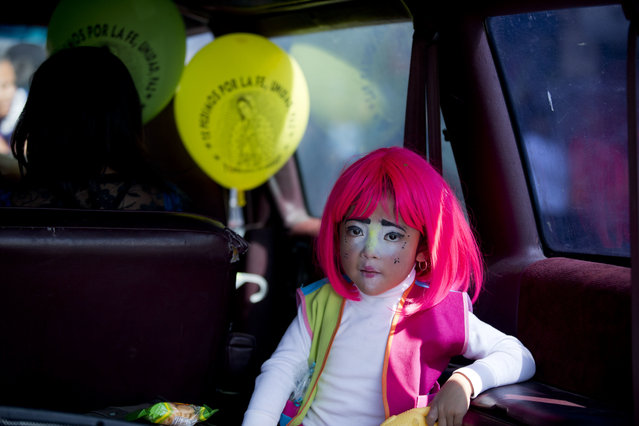
In this December 14, 2015, file photo, a young clown rides in the back of a car following a procession to the Basilica of Our Lady of Guadalupe in Mexico City. Hundreds belonging to various clown associations made their annual pilgrimage to the Basilica to pay their respects to the Virgin of Guadalupe, Mexico's patron saint. (Photo by Rebecca Blackwell/AP Photo)

As the world marks the International Day of the Girl Child, women's rights activists point to progress on a wide array of issues but say more needs to be done to protect girls from child marriage, sexual assault and other forms of exploitation. Here is a selection of pictures showing the daily lives of girls across the globe, all taken by female Associated Press photojournalists. Here: In this December 14, 2015, file photo, a young clown rides in the back of a car following a procession to the Basilica of Our Lady of Guadalupe in Mexico City. Hundreds belonging to various clown associations made their annual pilgrimage to the Basilica to pay their respects to the Virgin of Guadalupe, Mexico's patron saint. (Photo by Rebecca Blackwell/AP Photo)
Details
19 Oct 2018 00:03:00
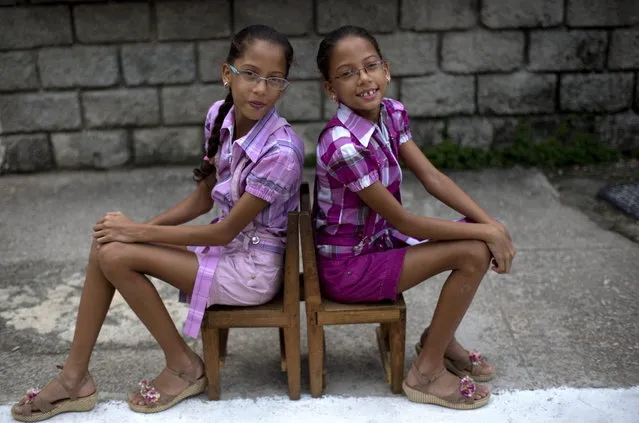
In this Sept. 29, 2013 photo, nine-year-old twin sisters Camila, left, and Carla Rodriguez pose for a portrait along their street in Havana, Cuba. 12 sets of twins live along two consecutive blocks in western Havana, ranging in age from newborns to senior citizens. “We love living on this block because we have twin friends”, said Carla. (Photo by Ramon Espinosa/AP Photo)

A street in the Cuban capital, Havana, is home to 12 sets of twins, ranging from toddlers to senior citizens. Some say it could be something in the water. Others point to a tree with mystical significance for locals. And maybe it's just chance. Photo: In this September 29, 2013 photo, nine-year-old twin sisters Camila, left, and Carla Rodriguez pose for a portrait along their street in Havana, Cuba. 12 sets of twins live along two consecutive blocks in western Havana, ranging in age from newborns to senior citizens. “We love living on this block because we have twin friends”, said Carla. (Photo by Ramon Espinosa/AP Photo)
Details
07 Oct 2013 06:44:00
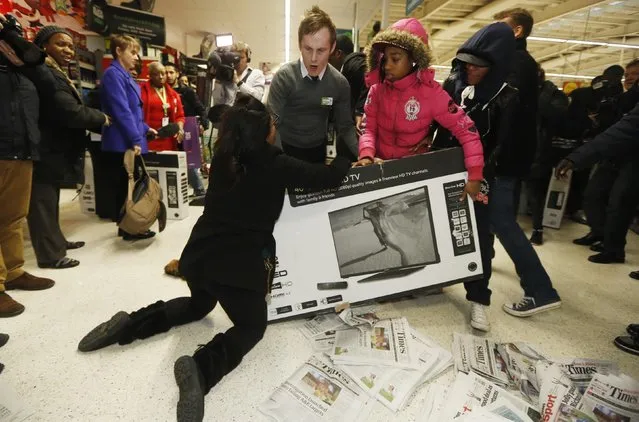
Shoppers wrestle over a television as they compete to purchase retail items on “Black Friday” at an Asda superstore in Wembley, north London November 28, 2014. Britain's high streets, malls and online sites were awash with discounts on Friday as more retailers than ever embraced U.S.-style “Black Friday” promotions, seeking to kickstart trading in the key Christmas period. (Photo by Luke MacGregor/Reuters)

Shoppers wrestle over a television as they compete to purchase retail items on “Black Friday” at an Asda superstore in Wembley, north London November 28, 2014. Britain's high streets, malls and online sites were awash with discounts on Friday as more retailers than ever embraced U.S.-style “Black Friday” promotions, seeking to kickstart trading in the key Christmas period. In the United States the Friday following the Thanksgiving Day holiday is called Black Friday because spending usually surges and indicates the point at which American retailers begin to turn a profit for the year, or go “into the black”. (Photo by Luke MacGregor/Reuters)
Details
29 Nov 2014 12:48:00
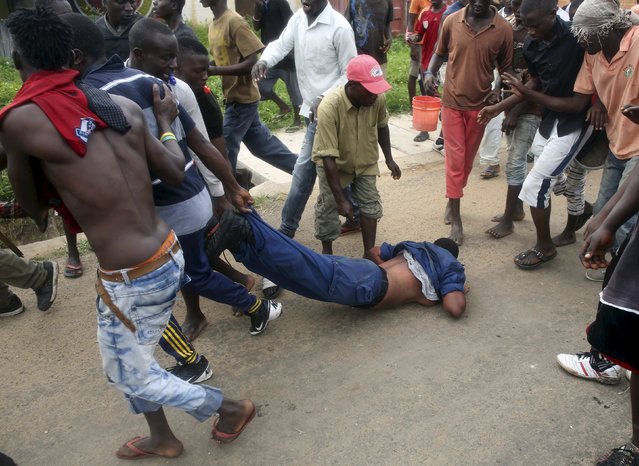
Protesters drag a female police officer accused of shooting a protester in the Buterere neighbourhood of Bujumbura, Burundi, May 12, 2015. (Photo by Goran Tomasevic/Reuters)

From house breaking in Johannesburg to hippos on the loose in Tbilisi to rioters attacking a policewoman in Burundi, Reuters photographers tell the story behind some of the most iconic pictures of the year. Here: Protesters drag a female police officer accused of shooting a protester in the Buterere neighbourhood of Bujumbura, Burundi, May 12, 2015. Goran Tomasevic: Protesters started throwing stones at a group of police, who then started to run away. The policewoman in the photo, Medikintos Inabeza, 33, got left behind and then some protesters started to push her, saying that she had shot a female protestor in the stomach with an AK47 rifle. I didn't see anything of that. There were 5 or 10 protesters pushing the policewoman at first, then others came and joined in. Up to 20 or 30 protesters were surrounding her at one point. The protesters kicked and beat her very badly; I also saw a couple of knives. I thought they were going to kill her... (Photo by Goran Tomasevic/Reuters)
Details
11 Dec 2015 08:06:00
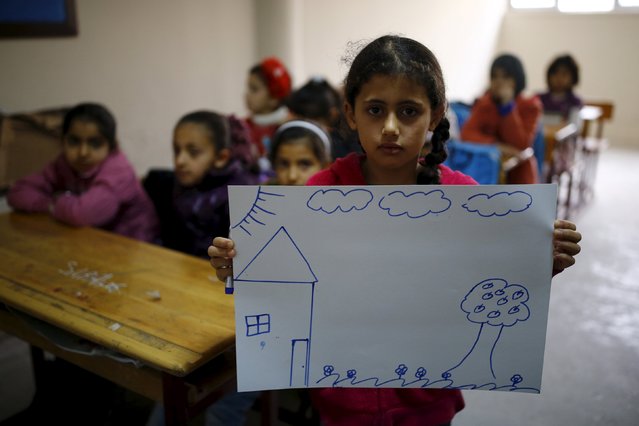
Syrian refugee girl Nur El-Huda, 9, shows a drawing of her home in Syria, in her classroom in Yayladagi refugee camp in Hatay province near the Turkish-Syrian border, Turkey, December 16, 2015. (Photo by Umit Bektas/Reuters)

Syrian refugee girl Nur El-Huda, 9, shows a drawing of her home in Syria, in her classroom in Yayladagi refugee camp in Hatay province near the Turkish-Syrian border, Turkey, December 16, 2015. Syria's conflict has left hundreds of thousands dead, pushed millions more into exile, and had a profound effect on children who lost their homes or got caught up in the bloodletting. The drawings of young refugees living in Turkey show their memories of home and hopes for its future. The pictures also point to the mental scars borne by 2.3 million Syrian refugees living in Turkey, more than half of them children. (Photo by Umit Bektas/Reuters)
Details
16 Jan 2016 08:05:00
Google's vice president Alan Eustace looks out of his spacesuit into the stratosphere prior to a record-breaking skydive over New Mexico, in this still image taken from video October 24, 2014, a handout courtesy of the Paragon Space Development Corporation. Eustace was lifted up 135,890 ft (41,420 metres) by an enormous balloon while wearing a specially designed pressurized space suit, the Paragon Space Development Corporation said. (Photo by Reuters/Paragon Space Development Corporation)

Google's vice president Alan Eustace looks out of his spacesuit into the stratosphere prior to a record-breaking skydive over New Mexico, in this still image taken from video October 24, 2014, a handout courtesy of the Paragon Space Development Corporation. Eustace was lifted up 135,890 ft (41,420 metres) by an enormous balloon while wearing a specially designed pressurized space suit, the Paragon Space Development Corporation said. Eustace remained in a free fall for approximately 4.5 minutes before landing safely nearly 70 miles (43.4 kms) from his launch point, setting a world record for the highest skydive and breaking the sound barrier in the process. Eustace landed safely on the ground just 15 minutes after he was lifted into the air. (Photo by Reuters/Paragon Space Development Corporation)
Details
26 Oct 2014 12:16:00


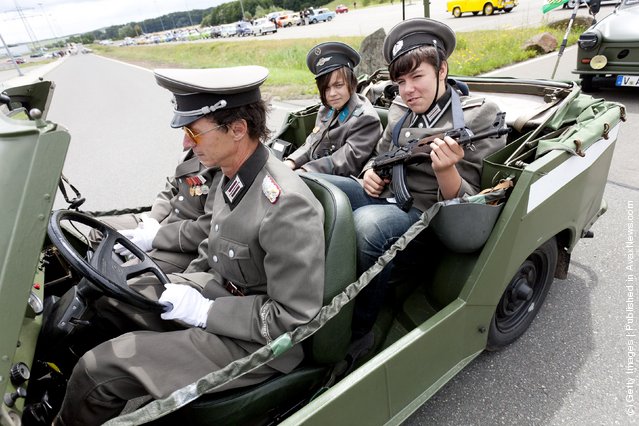
“The Trabant is a car that was produced by former East German auto maker VEB Sachsenring Automobilwerke Zwickau in Zwickau, Sachsen. It was the most common vehicle in East Germany, and was also exported to countries both inside and outside the communist bloc. The main selling points was that it had room for four adults and luggage in a compact, light and durable shell and that it was fast (when introduced) and durable. With its mediocre performance, smoky two-stroke engine, and production shortages, the Trabant is often cited as an example of the disadvantages of centralized planning; on the other hand, it is regarded with derisive affection as a symbol of the failed former East Germany and of the fall of communism (in former West Germany, as many East Germans streamed into West Berlin and West Germany in their Trabants after the opening of the Berlin Wall in 1989). It was in production without any significant changes for nearly 30 years with 3,096,099 Trabants produced in total”. – Wikipedia

Photo: Enthusiasts weared in uniforms of the former eastern german army trive in a military Trabant car as fans and owners of East German-era Trabant cars gather at the 2011 International Trabantfahrer Treffen (International Trabant Drivers Meeting) on June 26, 2011 in Zwickau, Germany. The Trabant, also known as the Trabi, was among the main cars produced in communist East Germany and built by VEB Sachsenring Automobilwerke in Zwickau for 30 years until 1989. Today the car has cult status for many followers and one company, IndiKar, is even seeking to revive the brand in a modern, electric version. (Photo by Carsten Koall/Getty Images)

Details
27 Jun 2011 12:21:00