Loading...
Done
Wooden Churches - Travelling In The Russian North By Richard Davies Part 2

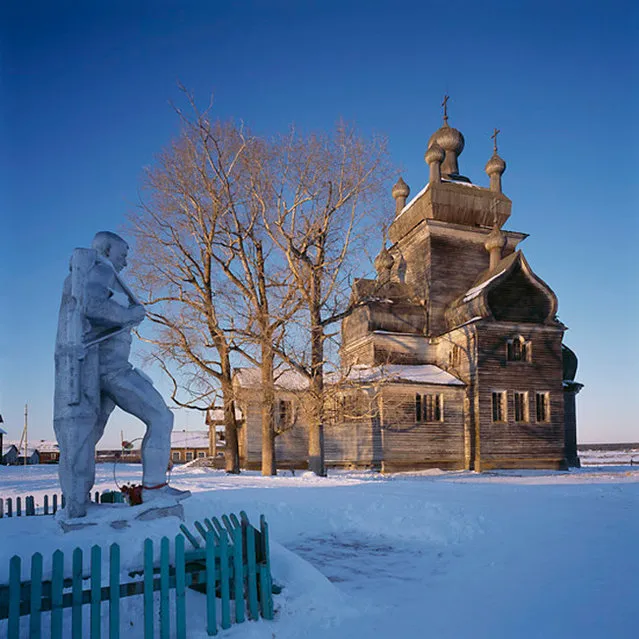
While communism, collectivism, worms, dry rot and casual looting failed to destroy the majestic wooden churches of Russia, it may be ordinary neglect that finally does them in. Dwindled now to several hundred remaining examples, these glories of vernacular architecture lie scattered amid the vastness of the world’s largest country. Just over a decade ago, Richard Davies, a British architectural photographer, struck out on a mission to record the fragile and poetic structures. Austerely beautiful and haunting, “Wooden Churches: Traveling in the Russian North” (White Sea Publishing; $132) is the result. Covering thousands of miles, Mr. Davies described how he and the writer Matilda Moreton tracked down the survivors from among the thousands of onion-domed structures built after Prince Vladimir converted to Christianity in 988.

See also: Wooden Churches Part1
Details
28 Nov 2013 12:13:00
This Thursday, January 22, 2015 photo made with a long exposure shows the glow from a Noctiluca scintillans algal bloom along the seashore in Hong Kong. The luminescence, also called Sea Sparkle, is triggered by farm pollution that can be devastating to marine life and local fisheries, according to University of Georgia oceanographer Samantha Joye. (Photo by Kin Cheung/AP Photo)

This Thursday, January 22, 2015 photo made with a long exposure shows the glow from a Noctiluca scintillans algal bloom along the seashore in Hong Kong. The luminescence, also called Sea Sparkle, is triggered by farm pollution that can be devastating to marine life and local fisheries, according to University of Georgia oceanographer Samantha Joye. Noctiluca itself does not produce neurotoxins like other similar organisms do. But its role as both prey and predator tends can eventually magnify the accumulation of toxins in the food chain, according to R. Eugene Turner at Louisiana State University. (Photo by Kin Cheung/AP Photo)
Details
23 Jan 2015 13:12:00
Matador Marco Espinola, who emigrated from the Azores two years ago, challenges a bull during an Azorean “tourada a corda” (bullfight by rope) in Brampton, Ontario August 15, 2015. (Photo by Chris Helgren/Reuters)

Matador Marco Espinola, who emigrated from the Azores two years ago, challenges a bull during an Azorean “tourada a corda” (bullfight by rope) in Brampton, Ontario August 15, 2015. Bulls in a tourada a corda are held by a rope controlled by a team of men to make sure the animal does not cause injury. Bulls are never killed, in contrast with bullfighting in Spain. The Portuguese population in Canada, numbering 429,000 in the 2011 census, mainly centers around Toronto with immigrants from the nine islands of the mid-Atlantic Azores archipelago. (Photo by Chris Helgren/Reuters)
Details
18 Aug 2015 13:39:00
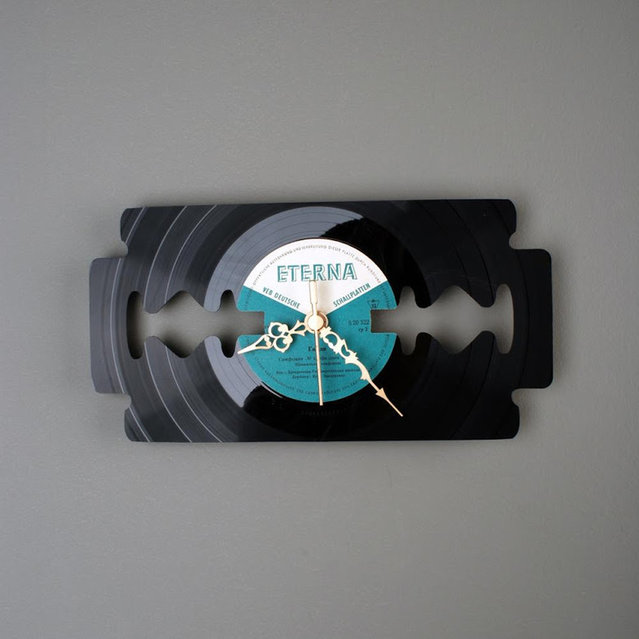
Vinyl Clock By Pavel Sidorenko Part 1

Pavel Sidorenko is an award winning Estonian designer who was born in 1980 in Tallinn and studied product design at Estonian Academy of Arts and Graduated in 2006. Not only does he incorporate pragmatic necessity, but also transmits an emotional qualities within the everyday environment. His fantastic collection of Re Vinyl designs are a result of upcycling a product fashioned from old vinyl records. Beautifully crafted and working with a range of themes from scenography to animal creatures, there is sure to be something for everyone with these stylish selection of recycled vinyl clocks!


See also:Part 2
Details
28 Feb 2014 08:55:00
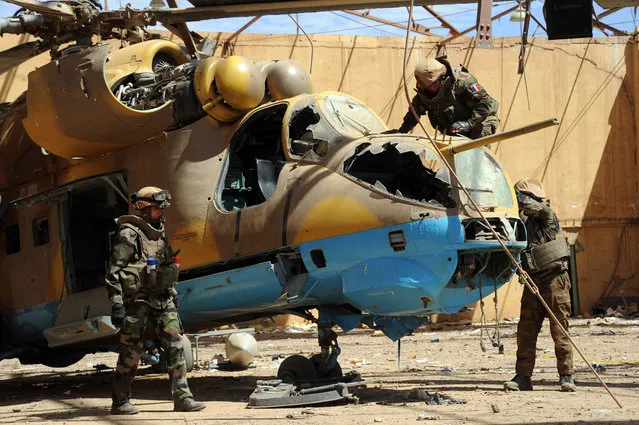
French army deminers secure a helicopter in a hangar at the Gao airport, on February 9, 2013. Two Malian soldiers and four civilians have already been killed by landmines, and French troops are still fighting off what Paris called “residual jihadists” in reclaimed territory. (Photo by Pascal Guyot/AFP Photo/The Atlantic)

French army deminers secure a helicopter in a hangar at the Gao airport, on February 9, 2013. Two Malian soldiers and four civilians have already been killed by landmines, and French troops are still fighting off what Paris called “residual jihadists” in reclaimed territory. (Photo by Pascal Guyot/AFP Photo via The Atlantic)
Details
28 Feb 2013 12:00:00
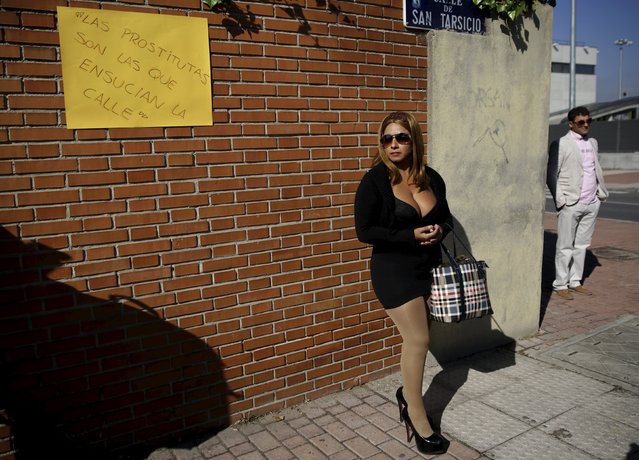
A s*x worker (C) stages a performance to denounce what they say is abuse and social stigma against them in Madrid, Spain, October 14, 2015. Placard reads "Prostitutes are the ones that make the streets dirty". (Photo by Andrea Comas/Reuters)

A s*x worker (C) stages a performance to denounce what they say is abuse and social stigma against them in Madrid, Spain, October 14, 2015. Placard reads "Prostitutes are the ones that make the streets dirty". (Photo by Andrea Comas/Reuters)
Details
17 Oct 2015 08:00:00
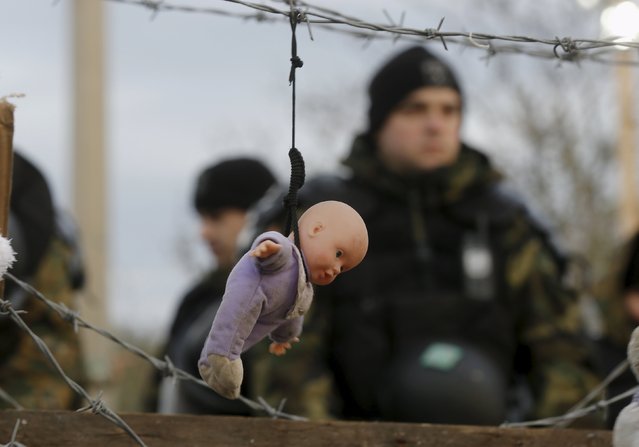
A doll, placed by stranded Iranian migrant protesters, hangs from barbed wire in front of Madedonian police at the Greek-Macedonian border near to the Greek village of Idomeni November 29, 2015. The protesters were demonstrating against what they say is the closure of the border for Iranian migrants. (Photo by Yannis Behrakis/Reuters)

A doll, placed by stranded Iranian migrant protesters, hangs from barbed wire in front of Madedonian police at the Greek-Macedonian border near to the Greek village of Idomeni November 29, 2015. The protesters were demonstrating against what they say is the closure of the border for Iranian migrants. According to the demonstrators, the hanging toys and dolls represent the outcome of being unable to return, if they are sent back to Iran. (Photo by Yannis Behrakis/Reuters)
Details
30 Nov 2015 09:48:00
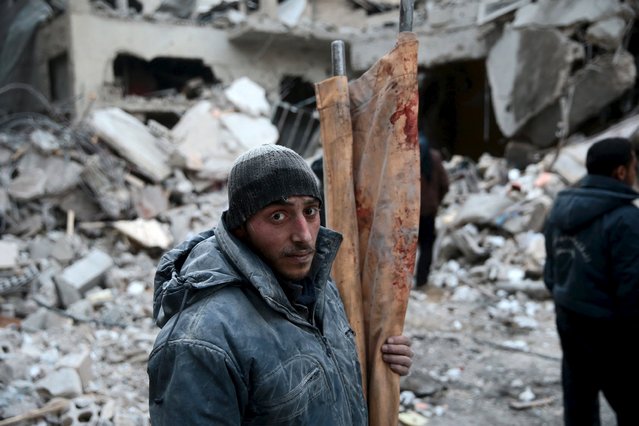
A man carries a blood stained stretcher in a site hit by what activists said were airstrikes carried out by the Russian air force in the town of Douma, eastern Ghouta in Damascus, Syria January 10, 2016. (Photo by Bassam Khabieh/Reuters)

A man carries a blood stained stretcher in a site hit by what activists said were airstrikes carried out by the Russian air force in the town of Douma, eastern Ghouta in Damascus, Syria January 10, 2016. (Photo by Bassam Khabieh/Reuters)
Details
12 Jan 2016 08:01:00