Loading...
Done
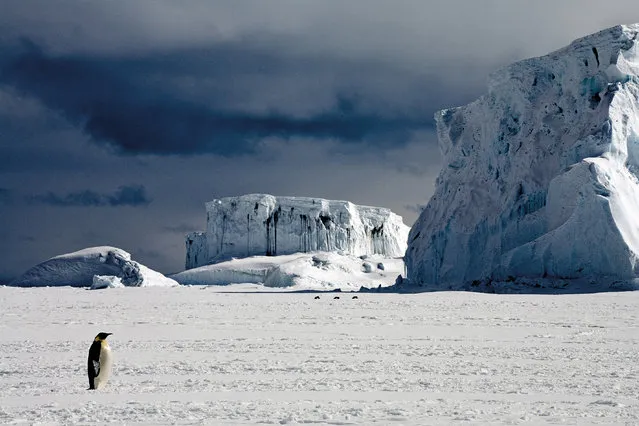
Image from Camille Seamans new book, “Melting Away”. (Photo by Camille Seaman/Barcroft Media)

Documenting the effects of climate change first hand over the past eight years, Camille Seaman fears we may be on the road to the last iceberg. Photographing the enormous frozen floats at both poles for the past eight years, the Californian adventurer has seen the receding ice shelves and experienced the changing warmer weather. Feeling that her intimate and emotional work documents a snapshot of history, Camille presents her series “The Last Iceberg” as a study of what she sees as the personality of each huge iceberg. Drawing parallels with the famous novel, “The Last of the Mohicans”, Camille, 42, wonders whether these unique, almost alien natural features will become a thing of the past or part of nature's renewal process. (Photo by Camille Seaman/Barcroft Media)
Details
02 Dec 2014 12:10:00
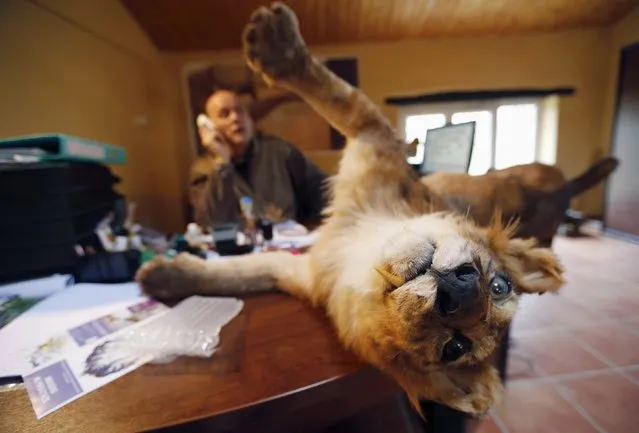
Belgian animal sculptor Emmanuel Janssens Casteels works at his desk next to a replica of a Smilodon, an extinct genus of machairodont felid, in his workshop in Prayssas December 3, 2014. Casteels' company OPHYS specializes in life-size reconstructions and the sculpting or moulding reproductions of animals and hyper-realist fossils. His reconstructions are exhibited in museums and theme parks. (Photo by Regis Duvignau/Reuters)

Belgian animal sculptor Emmanuel Janssens Casteels works at his desk next to a replica of a Smilodon, an extinct genus of machairodont felid, in his workshop in Prayssas December 3, 2014. Casteels' company OPHYS specializes in life-size reconstructions and the sculpting or moulding reproductions of animals and hyper-realist fossils. His reconstructions are exhibited in museums and theme parks. (Photo by Regis Duvignau/Reuters)
Details
05 Dec 2014 13:02:00
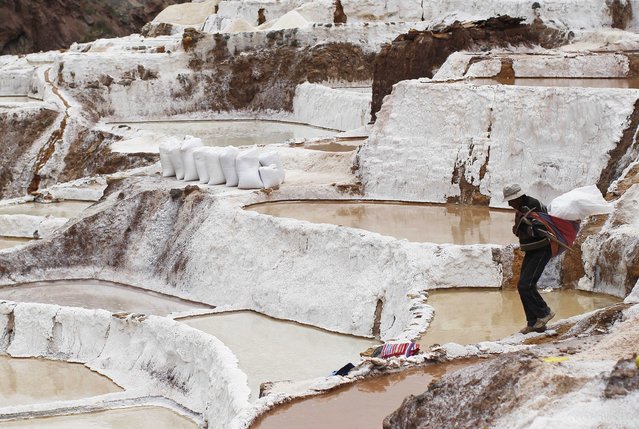
A worker carries a bag of salt after collecting it from a pond at the Maras mines in Cuzco December 3, 2014. Salt has been obtained in Maras since pre-Incan times by evaporating highly salty local subterranean stream water. The water is intricately channelled through constructions, flowing gradually down onto several hundred ancient terraced ponds. (Photo by Enrique Castro-Mendivil/Reuters)

A worker carries a bag of salt after collecting it from a pond at the Maras mines in Cuzco December 3, 2014. Salt has been obtained in Maras since pre-Incan times by evaporating highly salty local subterranean stream water. The water is intricately channelled through constructions, flowing gradually down onto several hundred ancient terraced ponds. From each pond, a local member of the mine cooperative can produce 150 to 200 kilos per month which can be sold in the markets at $0.34 per kilogram, according to miners. (Photo by Enrique Castro-Mendivil/Reuters)
Details
05 Dec 2014 13:36:00
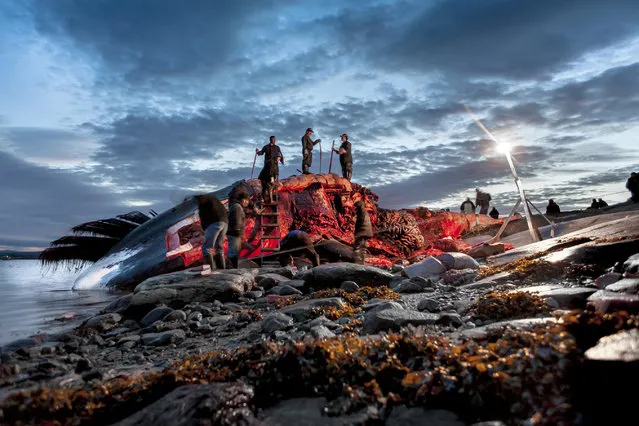
“Centuries ago, Inuit hunted the bowhead whale. At that time, whale hunting undoubtedly was part of a complex and very important ritual, if only because of the size of the catch. The position that the ancestors of today's Inuit occupied in the living world involved a relationship with the spirit that inhabited each animal but also their species”. (Photo by Robert Frechette/2014 Sony World Photography Awards)

“Centuries ago, Inuit hunted the bowhead whale. At that time, whale hunting undoubtedly was part of a complex and very important ritual, if only because of the size of the catch. The position that the ancestors of today's Inuit occupied in the living world involved a relationship with the spirit that inhabited each animal but also their species”. (Photo by Robert Frechette/2014 Sony World Photography Awards)
Details
16 Mar 2014 08:01:00
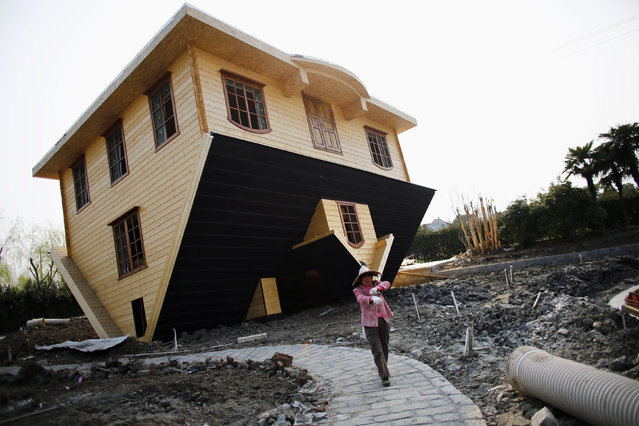
A laborer works at an upside-down house under construction at Fengjing Ancient Town, Jinshan District, south of Shanghai, March 17, 2014. Workers are putting the final touches on this eccentric tourist attraction built at the “China Folk Painting Village”. Furniture will also be placed upside down in the house, which is expected to open the public in April, according to local media. (Photo by Carlos Barria/Reuters)

A laborer works at an upside-down house under construction at Fengjing Ancient Town, Jinshan District, south of Shanghai, March 17, 2014. Workers are putting the final touches on this eccentric tourist attraction built at the “China Folk Painting Village”. Furniture will also be placed upside down in the house, which is expected to open the public in April, according to local media. (Photo by Carlos Barria/Reuters)
Details
21 Mar 2014 09:53:00
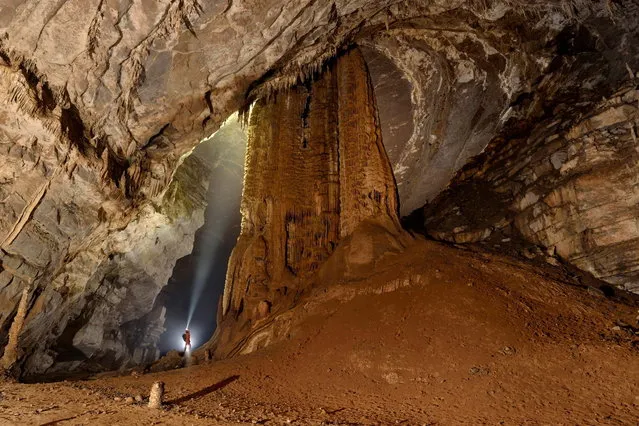
Perfectly situated in the middle of the passage this giant calcite stal boss makes a huge statement. Dwarfed by it's sheer size, Hong Meigui team member; Matt Ryan can only look up in amazement. This is one of many gigantic formations in San Wang Dong. (Photo by Robbie Shone/Caters News/ImagineChina)

“A team of expert cavers and photographers had been exploring caves in the Chongquing province of China – when they were amazed to discover the entrance to a hidden cave that was previously undiscovered. And they were stunned when they managed to enter the ginormous cave – and found that it was so large there was even a cloud inside it – a cave so large it has its own weather system. Photographer and caver Robbie Shone, from Manchester, was part of a team of 15 explorers on a month-long expedition who stumbled across the natural wonder”. – Caters News
Details
23 Mar 2014 00:03:00
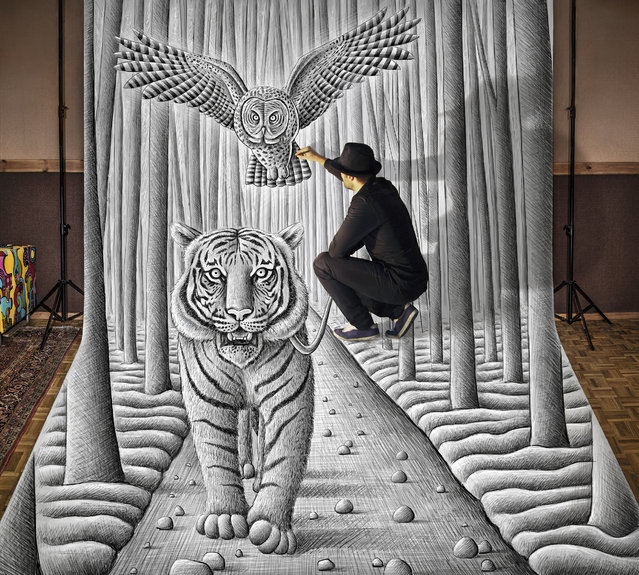
Visual artist Ben Heine at work in his studio while he creates one of his “anamorphic illusions” in Rochefort, Belgium

An arm holding a giant gun appears to explode through a wall, while elsewhere a man walks a tiger on a leash. These breathtaking pencil drawings are the work of 31-year-old artist Ben Heine, who lives and works in Rochefort, Belgium. The “anamorphic illusions”, part of the artist's “Pencil Vs Camera” series, appear slightly distorted unless viewed from the exact same perspective in which they were created. Photo: Visual artist Ben Heine at work in his studio while he creates one of his “anamorphic illusions” in Rochefort, Belgium. (Photo by Ben Heine/Barcroft Media)
Details
23 Mar 2014 11:00:00
A Pasola rider reacts after throwing his spear during the Pasola war festival at Ratenggaro village on March 22, 2014 in Sumba Island, Indonesia. The Pasola Festival is an important annual event to welcome the new harvest season, which coincides with the arrival of  “Nyale” sea worms during February or March each year. Pasola, an ancient ritual fighting game, involves two teams of men on horseback charging towards each other while trying to hit their rivals with “pasol” javelins and avoid being hit themselves. (Photo by Ulet Ifansasti/Getty Images)

A Pasola rider reacts after throwing his spear during the Pasola war festival at Ratenggaro village on March 22, 2014 in Sumba Island, Indonesia. The Pasola Festival is an important annual event to welcome the new harvest season, which coincides with the arrival of “Nyale” sea worms during February or March each year. Pasola, an ancient ritual fighting game, involves two teams of men on horseback charging towards each other while trying to hit their rivals with “pasol” javelins and avoid being hit themselves. (Photo by Ulet Ifansasti/Getty Images)
Details
25 Mar 2014 07:54:00