Loading...
Done
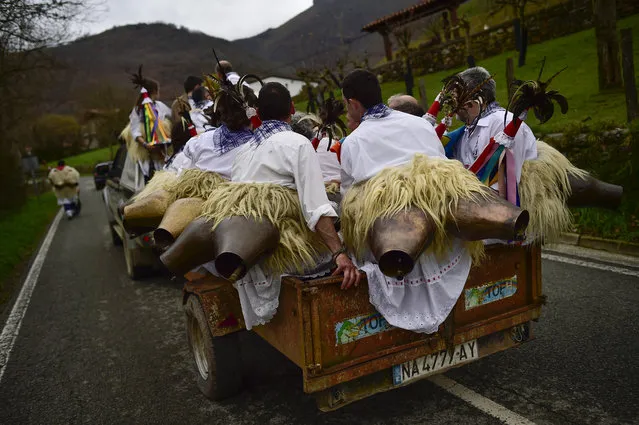
Joaldunaks return in a trailer to their town at the end of Carnival between of the Pyrenees villages of Ituren and Zubieta, northern Spain, Monday, February 1, 2016. In one of the most ancient carnivals in Europe, dating from before the Roman empire, companies of Joaldunak (cowbells) made up of residents of two towns, Ituren and Zubieta, parade the streets costumed in sandals, lace petticoats, sheepskins around the waist and shoulders, coloured neckerchiefs, conical caps with ribbons and a hyssop of horsehair in their right hands and cowbells hung across their lower back. (Photo by Alvaro Barrientos/AP Photo)

Joaldunaks return in a trailer to their town at the end of Carnival between of the Pyrenees villages of Ituren and Zubieta, northern Spain, Monday, February 1, 2016. In one of the most ancient carnivals in Europe, dating from before the Roman empire, companies of Joaldunak (cowbells) made up of residents of two towns, Ituren and Zubieta, parade the streets costumed in sandals, lace petticoats, sheepskins around the waist and shoulders, coloured neckerchiefs, conical caps with ribbons and a hyssop of horsehair in their right hands and cowbells hung across their lower back. (Photo by Alvaro Barrientos/AP Photo)
Details
02 Feb 2016 13:07:00
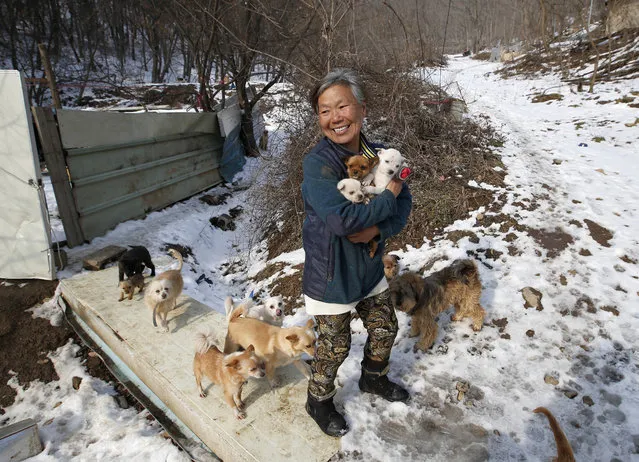
In this Wednesday, January 27, 2016 photo, Jung Myoung Sook, 61, holds her puppies she rescued at a shelter in Asan, South Korea. In the country, where dogs are considered a traditional delicacy and have only recently become popular as pets, Jung's love for her canine friends is viewed by some as odd. (Photo by Lee Jin-man/AP Photo)

In this Wednesday, January 27, 2016 photo, Jung Myoung Sook, 61, holds her puppies she rescued at a shelter in Asan, South Korea. In the country, where dogs are considered a traditional delicacy and have only recently become popular as pets, Jung's love for her canine friends is viewed by some as odd. But others see her as a champion of animal rights. (Photo by Lee Jin-man/AP Photo)
Details
03 Feb 2016 13:28:00
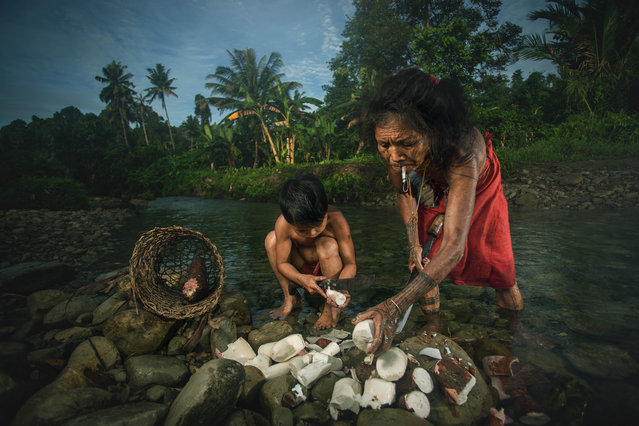
These stunning images document the everyday lives of the men, women and children of the Mentawai tribe. The Mentawai people, a native population in Indonesia, are famous for their decorative tattoos and for living a semi-nomadic life on the Mentawai Islands in West Sumatra. Shot by professional photographer Mohammed Saleh Bin Dollah, the series captures a glimpse of life on the island as the Mentawai men smoke and hunt for food and the children play in the river. (Photo by Muhamad Saleh Dollah/Barcroft Media)

These stunning images document the everyday lives of the men, women and children of the Mentawai tribe. The Mentawai people, a native population in Indonesia, are famous for their decorative tattoos and for living a semi-nomadic life on the Mentawai Islands in West Sumatra. Shot by professional photographer Mohammed Saleh Bin Dollah, the series captures a glimpse of life on the island as the Mentawai men smoke and hunt for food and the children play in the river. Here: A young boy helps a woman to prepare food taken on July 19, 2014 on the Mentawai Islands, Indonesia. (Photo by Muhamad Saleh Dollah/Barcroft Media)
Details
06 Feb 2016 13:09:00
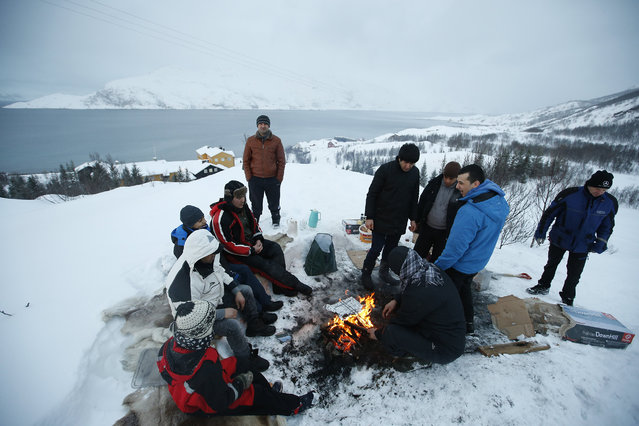
In this photo taken Tuesday, February 2, 2016, asylum seekers gather round a fire as they cook a meal overlooking the temporary Altnes camp refugee camp on the island of Seiland, northern Norway. (Photo by Alastair Grant/AP Photo)

In this photo taken Tuesday, February 2, 2016, asylum seekers gather round a fire as they cook a meal overlooking the temporary Altnes camp refugee camp on the island of Seiland, northern Norway. Waiting for their asylum claims to be processed, hundreds of people in emergency shelters in Hammerfest and neighboring towns are slowly getting used to the extreme climate and unfamiliar customs of the High North. They say they have adapted to the cold – the temperature rarely drops below minus 10 degrees C (14 F) along the coast, though it gets much colder further inland. It’s the darkness that throws them off. (Photo by Alastair Grant/AP Photo)
Details
18 Feb 2016 13:22:00
The Berenson robot strolls among visitors during the exhibition “Persona : Oddly Human” at the Quai Branly museum in Paris, France, February 23, 2016. The Berenson robot, developed in France in 2011, is the brainchild of anthropologist Denis Vidal and robotics engineer Philippe Gaussier. Its programming allows it to record reactions of museum visitors to certain pieces of art and then use the data to develop its own unique taste, which allows “Berenson” to judge whether or not it likes a certain work of art within an exhibition. (Photo by Philippe Wojazer/Reuters)

The Berenson robot strolls among visitors during the exhibition “Persona : Oddly Human” at the Quai Branly museum in Paris, France, February 23, 2016. The Berenson robot, developed in France in 2011, is the brainchild of anthropologist Denis Vidal and robotics engineer Philippe Gaussier. Its programming allows it to record reactions of museum visitors to certain pieces of art and then use the data to develop its own unique taste, which allows “Berenson” to judge whether or not it likes a certain work of art within an exhibition. (Photo by Philippe Wojazer/Reuters)
Details
25 Feb 2016 12:26:00
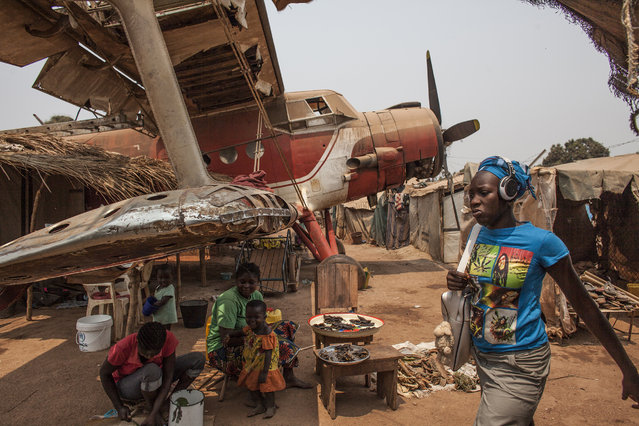
A women sell food under the wing of a plane wreckage being used as housing in M'Poko Internally Displaced Persons camp in Bangui, Central African Republic on Saturday, February 13, 2016. The M'Poko IDP camp, just outside the capitol's airport, currently houses close to 20,000 people displaced due to the ongoing conflict in Central African Republic. The camp was established in late 2013 and contained upto 70,000 people at the height of the crisis in 2014. (Photo by Jane Hahn/The Washington Post)

A women sell food under the wing of a plane wreckage being used as housing in M'Poko Internally Displaced Persons camp in Bangui, Central African Republic on Saturday, February 13, 2016. The M'Poko IDP camp, just outside the capitol's airport, currently houses close to 20,000 people displaced due to the ongoing conflict in Central African Republic. (Photo by Jane Hahn/The Washington Post)
Details
28 Feb 2016 11:09:00
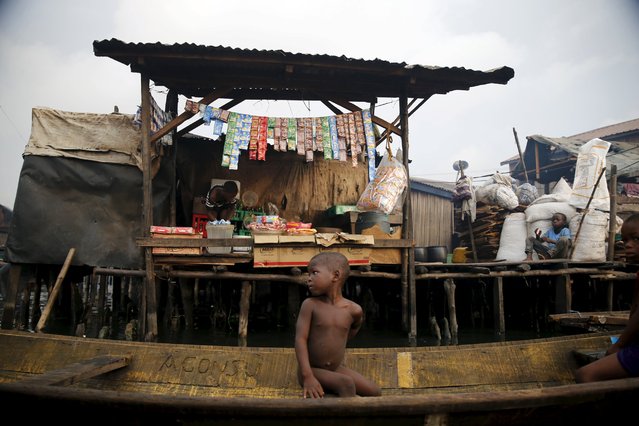
A boy sits in a canoe in front of a shed built on a raft in the Makoko fishing community on the Lagos Lagoon, Nigeria February 29, 2016. Makoko, a vast slum of houses on stilts in a Lagos lagoon, now boasts a new school – pyramid-shaped, floating and capable of withstanding the waterways' extreme weather, it is a beacon of hope for the nearly 100,000 Nigerians who live there.  (Photo by Akintunde Akinleye/Reuters)

A boy sits in a canoe in front of a shed built on a raft in the Makoko fishing community on the Lagos Lagoon, Nigeria February 29, 2016. In Makoko, a sprawling slum of Nigeria's megacity Lagos, a floating school capable of holding up to a hundred pupils has since November brought free education to the waterways known as the Venice of Lagos. It offers the chance of social mobility for youngsters who, like most of the city's 21 million inhabitants, lack a reliable electricity and water supply and whose water-based way of life is threatened by climate change as well as rapid urbanisation. (Photo by Akintunde Akinleye/Reuters)
Details
05 Mar 2016 12:01:00
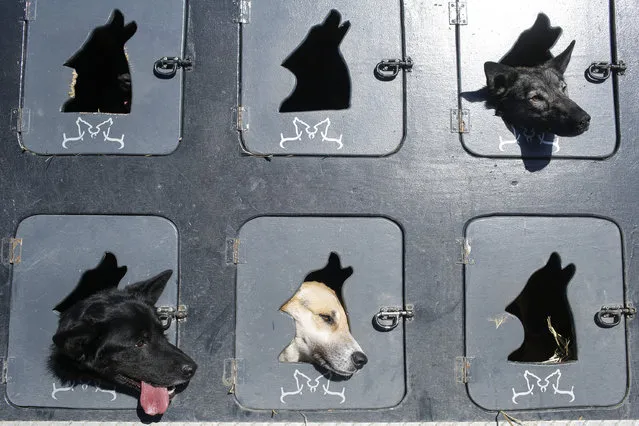
Musher Justin Savidis' dogs wait in the truck before the restart of the Iditarod Trail Sled Dog Race in Willow, Alaska March 6, 2016. Mushers and dog sled teams from around the world embark on the first leg of Alaska's grueling Iditarod Trail Sled Dog Race, starting a nearly 1,000-mile (1,609 km) journey through the state's unforgiving wilderness. (Photo by Nathaniel Wilder/Reuters)

Musher Justin Savidis' dogs wait in the truck before the restart of the Iditarod Trail Sled Dog Race in Willow, Alaska March 6, 2016. Mushers and dog sled teams from around the world embark on the first leg of Alaska's grueling Iditarod Trail Sled Dog Race, starting a nearly 1,000-mile (1,609 km) journey through the state's unforgiving wilderness. (Photo by Nathaniel Wilder/Reuters)
Details
08 Mar 2016 13:26:00