Loading...
Done
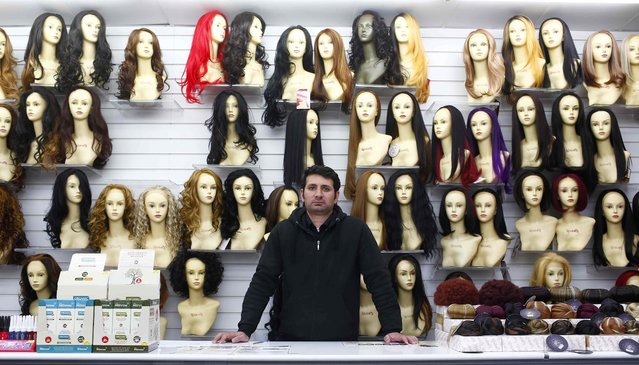
Kashir Mir, 34, poses for a photograph at his workplace, Juliet Wig Shop, in the London constituency of Brent Central, Britain, April 13, 2015. Mir, who was born in Pakistan, said: “I will vote but it's a secret. I also hope they can manage immigration better as I have been stopped and interviewed for hours returning from Pakistan. I'm an honest man, working here and paying my tax”. (Photo by Eddie Keogh/Reuters)

Kashir Mir, 34, poses for a photograph at his workplace, Juliet Wig Shop, in the London constituency of Brent Central, Britain, April 13, 2015. Mir, who was born in Pakistan, said: “I will vote but it's a secret. I also hope they can manage immigration better as I have been stopped and interviewed for hours returning from Pakistan. I'm an honest man, working here and paying my tax”. Brent, a northwest London neighbourhood that's home to Wembley football stadium, is among the most ethnically diverse areas in the United Kingdom. As the country approaches a closely fought election on May 7, Reuters photographer Eddie Keogh visited shopkeepers to get their views on the poll. (Photo by Eddie Keogh/Reuters)
Details
29 Apr 2015 06:30:00
Nguyen Manh Quan (top), 26, a civil servant, carries a girl using his throat area as he performs during a showcase of the traditional Thien Mon Dao kung fu at Du Xa Thuong village, southeast of Hanoi, Vietnam May 10, 2015. (Photo by Reuters/Kham)

Nguyen Manh Quan (top), 26, a civil servant, carries a girl using his throat area as he performs during a showcase of the traditional Thien Mon Dao kung fu at Du Xa Thuong village, southeast of Hanoi, Vietnam May 10, 2015. Thien Mon Dao, a traditional Vietnamese martial art, was formed by 18th century villagers in Du Xa Thuong village, who believed the art form could help improve health as well as fight against foreign invaders. There are currently about 3,000 practitioners including farmers, industry workers and state servants. These practitioners say they are able to bend metal against their bodies and carry heavy objects using their throats, eyes or tongues, as well as run across the surface of a river, according to Thien Mon Dao kung fu master Nguyen Khac Phan. (Photo by Reuters/Kham)
Details
11 May 2015 12:27:00
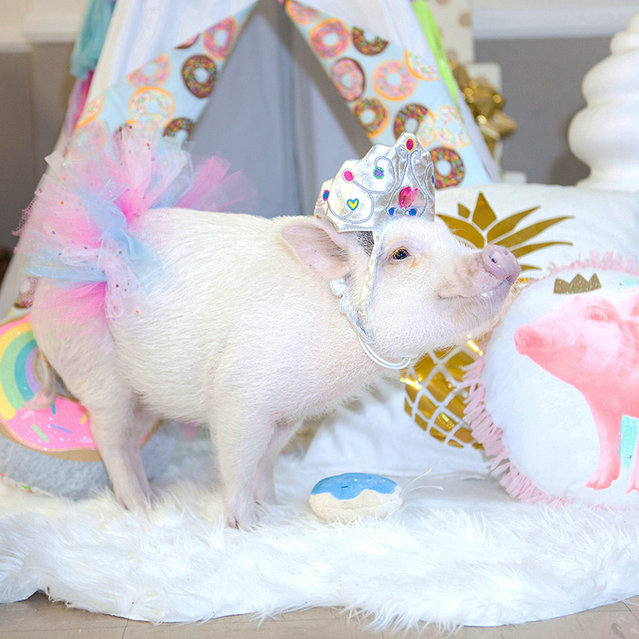
Hamlet the micro pig may already be a hit on Instagram, but its not stopped her from hogging the limelight on her birthday. Known for her adorable costume play, the miniature pig, from Pasadena, California, celebrated her first birthday in style, inviting all her furry Instagram friends to join her party. Pictured wearing a bright pink tutu and a tiara fit for a princess, Hamlet, who is named after Lady Hamlet from the Shakespeare play, shows that shes no boar when it comes to partying. Here: Hamlet enjoying his birthday party. (Photo by Caters News)

Hamlet the micro pig may already be a hit on Instagram, but its not stopped her from hogging the limelight on her birthday. Known for her adorable costume play, the miniature pig, from Pasadena, California, celebrated her first birthday in style, inviting all her furry Instagram friends to join her party. Pictured wearing a bright pink tutu and a tiara fit for a princess, Hamlet, who is named after Lady Hamlet from the Shakespeare play, shows that shes no boar when it comes to partying. Here: Hamlet enjoying his birthday party. (Photo by Caters News)
Details
31 Mar 2015 12:53:00


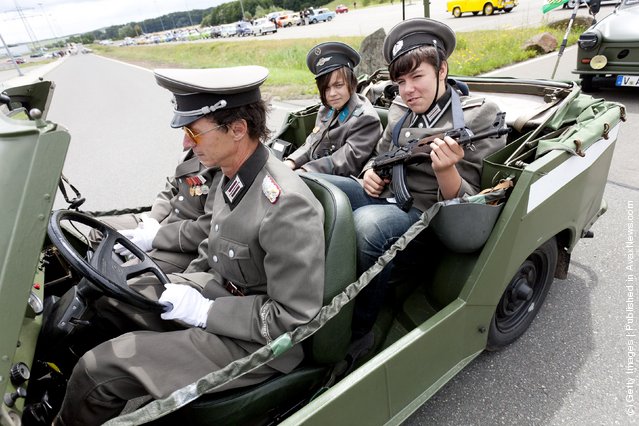
“The Trabant is a car that was produced by former East German auto maker VEB Sachsenring Automobilwerke Zwickau in Zwickau, Sachsen. It was the most common vehicle in East Germany, and was also exported to countries both inside and outside the communist bloc. The main selling points was that it had room for four adults and luggage in a compact, light and durable shell and that it was fast (when introduced) and durable. With its mediocre performance, smoky two-stroke engine, and production shortages, the Trabant is often cited as an example of the disadvantages of centralized planning; on the other hand, it is regarded with derisive affection as a symbol of the failed former East Germany and of the fall of communism (in former West Germany, as many East Germans streamed into West Berlin and West Germany in their Trabants after the opening of the Berlin Wall in 1989). It was in production without any significant changes for nearly 30 years with 3,096,099 Trabants produced in total”. – Wikipedia

Photo: Enthusiasts weared in uniforms of the former eastern german army trive in a military Trabant car as fans and owners of East German-era Trabant cars gather at the 2011 International Trabantfahrer Treffen (International Trabant Drivers Meeting) on June 26, 2011 in Zwickau, Germany. The Trabant, also known as the Trabi, was among the main cars produced in communist East Germany and built by VEB Sachsenring Automobilwerke in Zwickau for 30 years until 1989. Today the car has cult status for many followers and one company, IndiKar, is even seeking to revive the brand in a modern, electric version. (Photo by Carsten Koall/Getty Images)

Details
27 Jun 2011 12:21:00
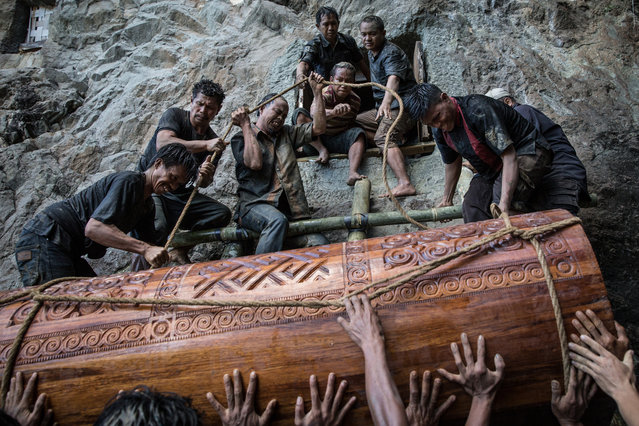
It is said that Torajans are people who “live to die”. For this Indonesian ethnic group, funerals are such extravagant events that they sometimes attract tourists. Families can postpone burials years (and the deceased are considered sick and hosted at home until the funeral) until the family can raise enough money and gather as many relatives as possible. And then it’s a jubilant multiday social event with a parade, dances and animal sacrifices. Agung Parameswara photographed these funerary practices when he traveled to South Sulawesi province, where the Torajans live. But often, their funeral isn’t the last time the dead are seen. In August, crypts are opened, coffins are slid back out and bodies delicately unsheathed. This tender ritual is known as Ma’Nene, which is customarily performed every few years. (Photo by Agung Parameswara/The Washington Post)

It is said that Torajans are people who “live to die”. For this Indonesian ethnic group, funerals are such extravagant events that they sometimes attract tourists. Families can postpone burials years (and the deceased are considered sick and hosted at home until the funeral) until the family can raise enough money and gather as many relatives as possible. And then it’s a jubilant multiday social event with a parade, dances and animal sacrifices. Agung Parameswara photographed these funerary practices when he traveled to South Sulawesi province, where the Torajans live. (Photo by Agung Parameswara/The Washington Post)
Details
06 Oct 2016 09:15:00
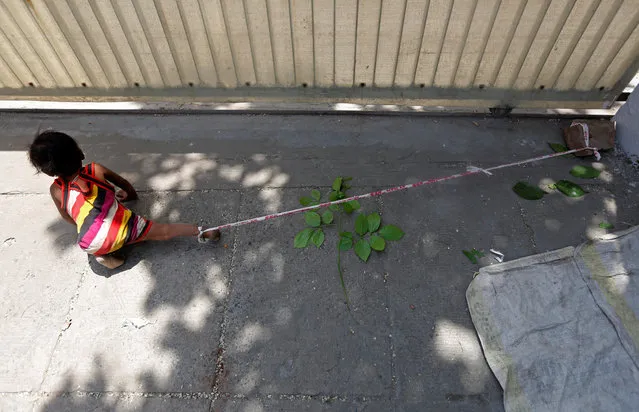
Barrier tape is tied around 15-month-old Shivani's ankle to prevent her from running away, while her mother Sarta Kalara works at a construction site nearby, in Ahmedabad, India, April 19, 2016. Kalara says she has no option but to tether her daughter Shivani to a stone despite her crying, while she and her husband work for 250 rupees ($3.8) each a shift digging holes for electricity cables in the city of Ahmedabad. There are about 40 million construction workers in India, at least one in five of them women, and the majority poor migrants who shift from site to site, building infrastructure for India's booming cities. Across the country it is not uncommon to see young children rolling in the sand and mud as their parents carry bricks or dig for new roads or luxury houses. (Photo by Amit Dave/Reuters)

Barrier tape is tied around 15-month-old Shivani's ankle to prevent her from running away, while her mother Sarta Kalara works at a construction site nearby, in Ahmedabad, India, April 19, 2016. Kalara says she has no option but to tether her daughter Shivani to a stone despite her crying, while she and her husband work for 250 rupees ($3.8) each a shift digging holes for electricity cables in the city of Ahmedabad. There are about 40 million construction workers in India, at least one in five of them women, and the majority poor migrants who shift from site to site, building infrastructure for India's booming cities. Across the country it is not uncommon to see young children rolling in the sand and mud as their parents carry bricks or dig for new roads or luxury houses. (Photo by Amit Dave/Reuters)
Details
14 Dec 2016 07:39:00
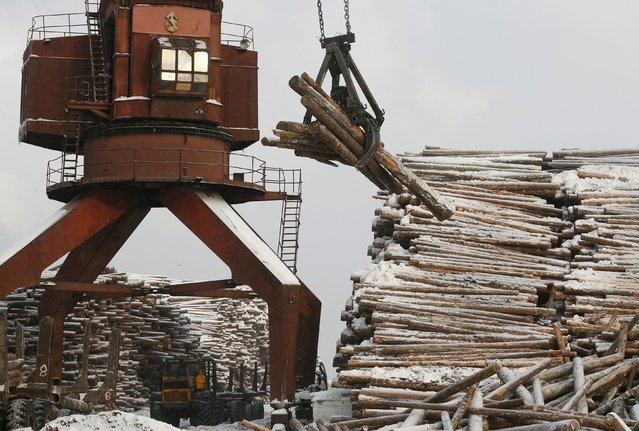
A crane loads logs at the Novoyeniseisk wood processing plant, with the air temperature at about minus 20 degrees Celsius (minus 4 degrees Fahrenheit), in the town of Lesosibirsk in Krasnoyarsk Region, Siberia, Russia, February 16, 2016. The plant exports timber to Europe, Northern Africa and Asia. The Taiga, also known as the boreal forest, on the coast of the Angara River and Yenisei River is one of the main areas for the industrial cutting of wood thanks to the high quality of the Angara pine. (Photo by Ilya Naymushin/Reuters)

A crane loads logs at the Novoyeniseisk wood processing plant, with the air temperature at about minus 20 degrees Celsius (minus 4 degrees Fahrenheit), in the town of Lesosibirsk in Krasnoyarsk Region, Siberia, Russia, February 16, 2016. The plant exports timber to Europe, Northern Africa and Asia. The Taiga, also known as the boreal forest, on the coast of the Angara River and Yenisei River is one of the main areas for the industrial cutting of wood thanks to the high quality of the Angara pine. Open air work continues all year around regardless to temperatures which can drop to minus 52 degrees Celsius (minus 61.6 degrees Fahrenheit), according to employees. (Photo by Ilya Naymushin/Reuters)
Details
18 Feb 2016 13:10:00
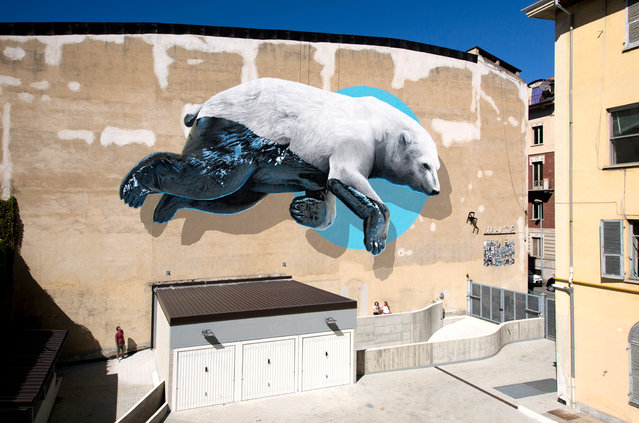
A polar bear whose bottom half is caked in oily black gunk. A whale wrapped in striped fabric: a pseudo straightjacket. These are the messes climate change leaves behind, the things we know are happening but often don’t have the opportunity to see with our own eyes. Swiss street art duo Christian Rebecchi and Pablo Togni, otherwise known as NeverCrew, met in art school when they were 15 and started making work together soon after. As a team, the artists adorn the world with eye-popping and gut-wrenching images depicting the consequences of humanity’s actions on earth. Here: “Black machine” mural painting and installation on the Colosseo theater in Turin, Italy, in September 2015. (Photo by NeverCrew/The Huffington Post)

A polar bear whose bottom half is caked in oily black gunk. A whale wrapped in striped fabric: a pseudo straightjacket. These are the messes climate change leaves behind, the things we know are happening but often don’t have the opportunity to see with our own eyes. Swiss street art duo Christian Rebecchi and Pablo Togni, otherwise known as NeverCrew, met in art school when they were 15 and started making work together soon after. As a team, the artists adorn the world with eye-popping and gut-wrenching images depicting the consequences of humanity’s actions on earth. (Photo by NeverCrew/The Huffington Post)
Details
13 Aug 2016 11:09:00