Loading...
Done
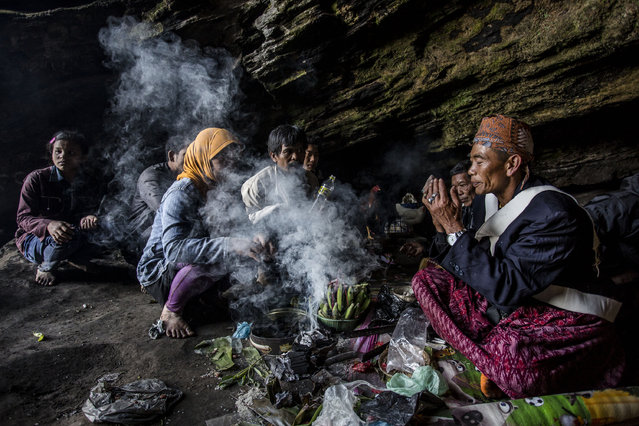
A Tenggerese shaman praying for worshippers at Widodaren cave during the Tenggerese Hindu Yadnya Kasada festival on July 31, 2015 in Probolinggo, East Java, Indonesia. The festival is the main festival of the Tenggerese people and lasts about a month. On the fourteenth day, the Tenggerese make the journey to Mount Bromo to make offerings of rice, fruits, vegetables, flowers and livestock to the mountain gods by throwing them into the volcano's caldera. (Photo by Ulet Ifansasti/Getty Images)

A Tenggerese shaman praying for worshippers at Widodaren cave during the Tenggerese Hindu Yadnya Kasada festival on July 31, 2015 in Probolinggo, East Java, Indonesia. The festival is the main festival of the Tenggerese people and lasts about a month. On the fourteenth day, the Tenggerese make the journey to Mount Bromo to make offerings of rice, fruits, vegetables, flowers and livestock to the mountain gods by throwing them into the volcano's caldera. The origin of the festival lies in the 15th century when a princess named Roro Anteng started the principality of Tengger with her husband Joko Seger, and the childless couple asked the mountain Gods for help in bearing children. The legend says the Gods granted them 24 children but on the provision that the 25th must be tossed into the volcano in sacrifice. The 25th child, Kesuma, was finally sacrificed in this way after initial refusal, and the tradition of throwing sacrifices into the caldera to appease the mountain Gods continues today. (Photo by Ulet Ifansasti/Getty Images)
Details
01 Aug 2015 12:07:00
Palestinian barber Ramadan Odwan styles and straightens the hair of a customer with fire at his salon in Rafah, in the southern Gaza Strip February 2, 2017. In Ramadan Odwan's barbershop in Gaza, hair isn't just blow-dried, it's blowtorch-dried. “People have gone crazy about it, many people are curious to go through the experience and they are not afraid”, he told Reuters. “People here love adventures”. Odwan, 37, is not the first stylist in the world to use flame to straighten hair, but his craft is unique in the Gaza Strip. In his salon in the southern Gaza town of Rafah, Odwan applied what he described as a protective liquid coating to a customer's hair – he declined to disclose its contents – before aiming for the head and pressing the button on a small blowtorch. “I control how long I apply fire, I keep it on and off for 10 seconds or 15 seconds. It is completely safe and I have not encountered any accident since I started it two months ago”, Odwan added. Odwan charges 20 shekels ($5.20) for a haircut and fire-straightening. A barber for the past 18 years, he said part of the reason he uses the technique is to show that Palestinian barbers are as “professional as those out there around the world”. (Photo by Ibraheem Abu Mustafa/Reuters)

Palestinian barber Ramadan Odwan styles and straightens the hair of a customer with fire at his salon in Rafah, in the southern Gaza Strip February 2, 2017. In Ramadan Odwan's barbershop in Gaza, hair isn't just blow-dried, it's blowtorch-dried. “People have gone crazy about it, many people are curious to go through the experience and they are not afraid”, he told Reuters. “People here love adventures”. (Photo by Ibraheem Abu Mustafa/Reuters)
Details
11 Feb 2017 00:05:00
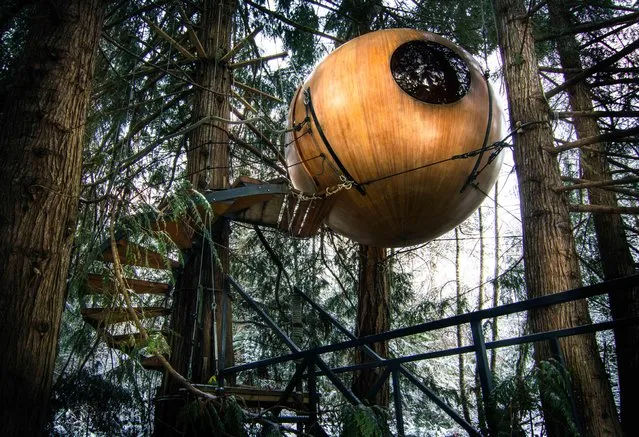
Eryn, owned by Tom Chudleigh in Canada. New global research has revealed that ‘shed-scapism’ is sweeping the world with more people than ever ditching their tools and transforming their sheds into zen dens. The research comes as the Cuprinol Shed of the Year competition joins forces with aspirational shed fan site, Cabin p*rn, to launch the first ever global category. We have a stunning suite of imagery of 9 sheds from across the world - from Norway to Slovenia, British Colombia to Colorado who have all submitted their sheds in the hopes of being crowned the first ever Global Shed of the Year. (Photo by Cuprinol/Rex Features/Shutterstock)

Eryn, owned by Tom Chudleigh in Canada. New global research has revealed that ‘shed-scapism’ is sweeping the world with more people than ever ditching their tools and transforming their sheds into zen dens. The research comes as the Cuprinol Shed of the Year competition joins forces with aspirational shed fan site, Cabin p*rn, to launch the first ever global category. We have a stunning suite of imagery of 9 sheds from across the world - from Norway to Slovenia, British Colombia to Colorado who have all submitted their sheds in the hopes of being crowned the first ever Global Shed of the Year. (Photo by Cuprinol/Rex Features/Shutterstock)
Details
15 Mar 2017 00:02:00
The carcass of a yacare caiman lies in the dried-up river bed of the Pilcomayo river in Boqueron, Paraguay, August 14, 2016. In Paraguay, alongside the Pilcomayo River, black vultures flew over a shrinking pond where a group of crocodilian reptiles known as yacare caimans sought refuge. Water from the river, which divides Paraguay and Argentina in the area of the Gran Chaco, was scarce. This is not an uncommon sight in the region of General Diaz, about 700 kilometres (435 miles) northwest of the country's capital Asuncion, where the Pilcomayo's waters form lakes and streams that give life to capybaras, birds and caimans. “The river's situation is critical. No water is forecast to enter the basin until December, as happens every year”, said Alcides Gonzalez, a resident of the area. (Photo by Jorge Adorno/Reuters)

The carcass of a yacare caiman lies in the dried-up river bed of the Pilcomayo river in Boqueron, Paraguay, August 14, 2016. In Paraguay, alongside the Pilcomayo River, black vultures flew over a shrinking pond where a group of crocodilian reptiles known as yacare caimans sought refuge. Water from the river, which divides Paraguay and Argentina in the area of the Gran Chaco, was scarce. This is not an uncommon sight in the region of General Diaz, about 700 kilometres (435 miles) northwest of the country's capital Asuncion, where the Pilcomayo's waters form lakes and streams that give life to capybaras, birds and caimans. (Photo by Jorge Adorno/Reuters)
Details
03 Nov 2016 12:40:00
Using body paint and a woodland like location, Gesine appears to have created a model to look just like a red panda, Dortmund, Germany, October, 2016. An artist brings animals to life using body paint and contorted models. At first glance, these images could be mistaken for portraits of wildlife in their natural habitat were created with paper and paint. However, they are actually the incredible works of illusion by talented body painter Gesine Marwedel, who paints models to creates realistic animals. Marwedel, 29, from Dortmund, Germany has always been fascinated by the concept of transferring her designs to human bodies and her latest project features models posing in contorted positions. One image appears to show an elegant swan in a park pond, whilst another picture shows a mother penguin and its chick in a snowy landscape. (Photo by Gesine Marwedel/Barcroft Images)

Using body paint and a woodland like location, Gesine appears to have created a model to look just like a red panda, Dortmund, Germany, October, 2016. An artist brings animals to life using body paint and contorted models. At first glance, these images could be mistaken for portraits of wildlife in their natural habitat were created with paper and paint. However, they are actually the incredible works of illusion by talented body painter Gesine Marwedel, who paints models to creates realistic animals. (Photo by Gesine Marwedel/Barcroft Images)
Details
20 Dec 2016 12:53:00
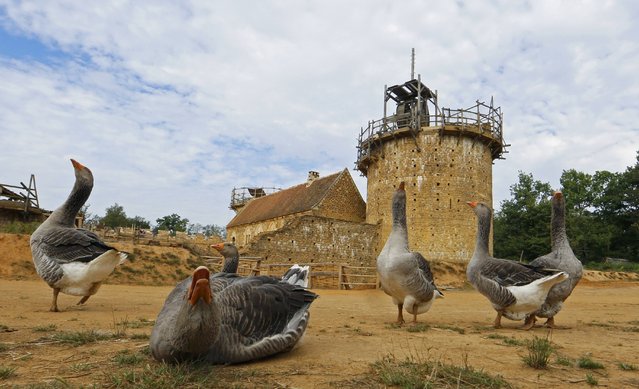
A view of the construction site of the Chateau de Guedelon near Treigny in the Burgundy region of France, September 13, 2016. Blacksmiths, stonemasons and quarry men are hard at work in a Burgundy forest building a 13th-century-style castle using the most basic tools and materials, replicating the methods used hundreds of years ago to better understand them. Forgoing all modern technology, workers use hammers to break stones and forge iron, operate wooden wheels to hoist their materials up to where they are needed, and rely on a quarry for stone, clay and sand as they build up a castle from scratch. Construction on Guedelon Castle in central France began in 1997 after an archaeological survey revealed a medieval fortress hidden inside the walls of nearby Chateau de Saint-Fargeau. Those behind the project hope to answer questions about medieval construction and provide lessons on sustainable building. (Photo by Jacky Naegelen/Reuters)

A view of the construction site of the Chateau de Guedelon near Treigny in the Burgundy region of France, September 13, 2016. Blacksmiths, stonemasons and quarry men are hard at work in a Burgundy forest building a 13th-century-style castle using the most basic tools and materials, replicating the methods used hundreds of years ago to better understand them. (Photo by Jacky Naegelen/Reuters)
Details
15 Sep 2016 09:43:00
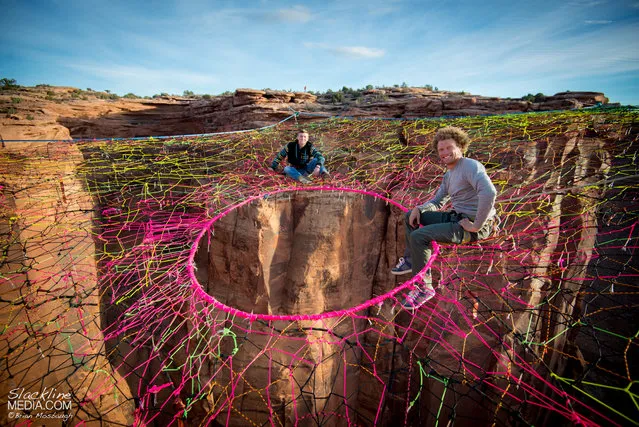
Stupefying Hand-Knitted Hammock Is Suspended

Exhilaration beyond imaginable, intense concentration on a single point, and complete freedom of soul – all these things very accurately describe the art of highlining. Highlining is a branch of a new sport called slacklining, which involves walking on special webbing secured between two points. Andi Lewis is one of the most famous slackliners in the world, particularly due to his performance during Superbowl Halftime Show in 2012. He never fails to surprise people with an amazing stunt or a project. This time he and his friends have created a completely incredible hand-knitted hammock located hundreds of feet above the ground. Just getting to this hammock requires immense skills and bravery. But once you’re finally there, you can rest a while, before mustering up the courage to go back across a narrow line with nothing but thin air beneath your feet.

Details
27 Feb 2015 18:38:00
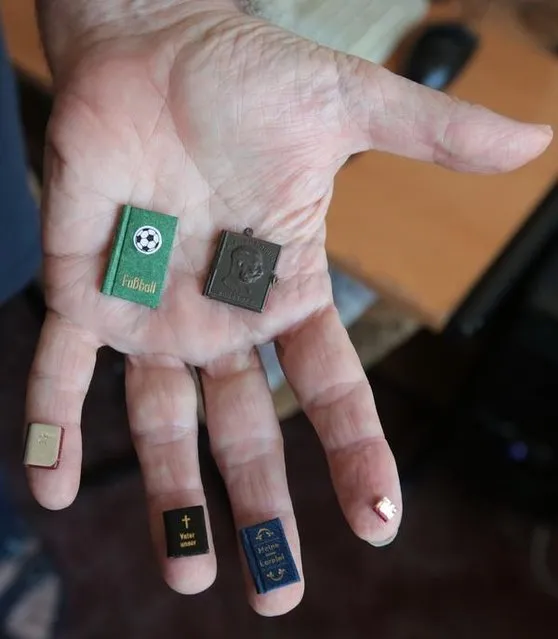
Miniature Books Collecting By Jozsef Tari

Jozsef Tari has been collecting miniature books since 1972, and is now the proud owner of over 4,500 literary works, including the world’s smallest book (2.9 x 3.2 mm).
Details
16 Aug 2015 12:27:00