Loading...
Done
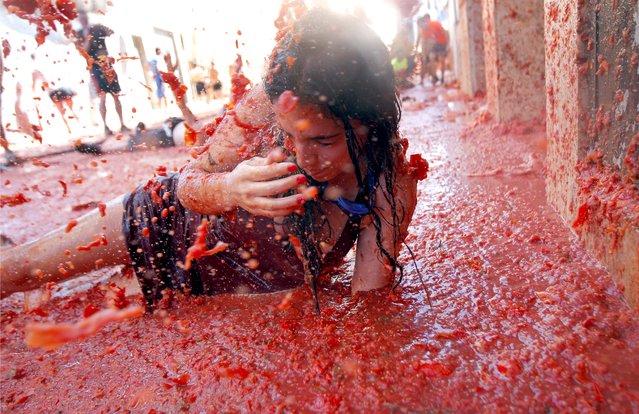
A woman lays in a puddle of tomato juice during the annual “Tomatina” tomato fight fiesta in the village of Bunol, 50 kilometers outside Valencia, Spain, Wednesday, August 27, 2014. The streets of an eastern Spanish town are awash with red pulp as thousands of people pelt each other with tomatoes in the annual “Tomatina” battle that has become a major tourist attraction. (Photo by Alberto Saiz/AP Photo)

A woman lays in a puddle of tomato juice during the annual “Tomatina” tomato fight fiesta in the village of Bunol, 50 kilometers outside Valencia, Spain, Wednesday, August 27, 2014. The streets of an eastern Spanish town are awash with red pulp as thousands of people pelt each other with tomatoes in the annual “Tomatina” battle that has become a major tourist attraction. At the annual fiesta in Bunol on Wednesday, trucks dumped 125 tons of ripe tomatoes for some 22,000 participants, many from abroad to throw during the hour-long morning festivities. (Photo by Alberto Saiz/AP Photo)
Details
28 Aug 2014 11:03:00
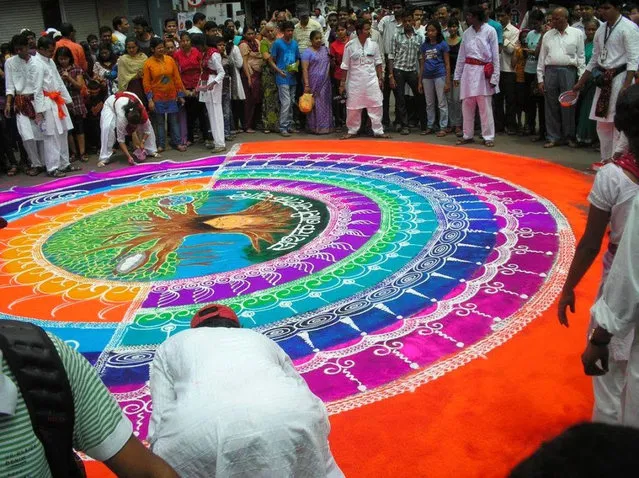
Rangoli Folk Art From India

Rangoli, also known as kolam or Muggu, is a folk art from India in which patterns are created on the floor in living rooms or courtyards using materials such as colored rice, dry flour, colored sand or flower petals. It is usually made during Diwali, Onam, Pongal and other Indian festivals. They are meant to be sacred welcoming areas for the Hindu deities. The ancient symbols have been passed down through the ages, from each generation to the next, keeping both the art form and the tradition alive. Similar practices are followed in different Indian states: in Tamil Nadu, there is Kolam in Tamil Nadu; Mandana in Rajasthan; Chaookpurna in Chhattisgarh; Alpana in West Bengal; Aripana in Bihar; Chowk pujan in Uttar Pradesh; Muggu in Andhra Pradesh and others.
Details
16 Jun 2014 10:37:00
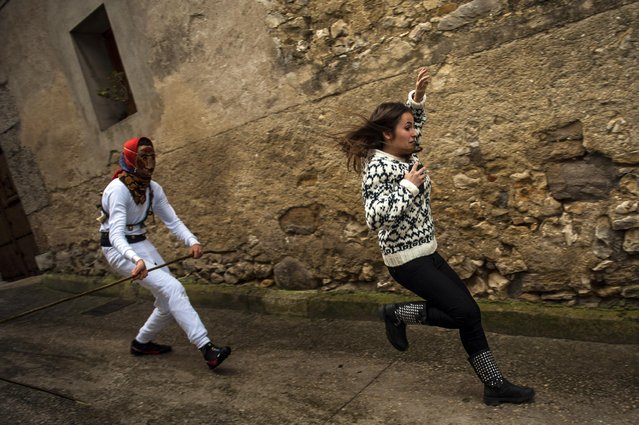
In this photo taken on Sunday, February 15, 2015 a girl runs away from a “Mamuxarro” during the carnival, in the small town of Unanu, northern Spain. While Rio de Janeiro may boast the world’s most famous carnival, the festive period of masquerades and wild and colorful costumes that precedes the Christian religious season of Lent is also a permanent and popular fixture for celebration in Spain and Portugal, with each country having its own strange and unique way of doing it. (Photo by Alvaro Barrientos/AP Photo)

In this photo taken on Sunday, February 15, 2015 a girl runs away from a “Mamuxarro” during the carnival, in the small town of Unanu, northern Spain. In the northern Spanish ancient village of Unamu, people dress up as “Mamuxarro”, folkloric figures in white with a red sash and a metal mask to cover their faces as they pursue townsfolk with sticks. According to custom, their “victims” (usually young women) must kneel and kiss the mamuxarro’s knee after he makes the sign of the cross on their forehead. (Photo by Alvaro Barrientos/AP Photo)
Details
22 Feb 2015 10:51:00
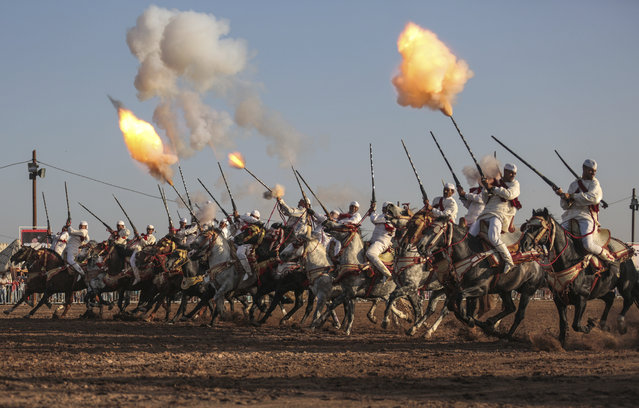
In this Thursday, August 17, 2017 photo, a troupe charges and fires their rifles during Tabourida, a traditional horse riding show also known as Fantasia, in Mansouria, near Casablanca, Morocco. (Photo by Mosa'ab Elshamy/AP Photo)

In this Thursday, August 17, 2017 photo, a troupe charges and fires their rifles during Tabourida, a traditional horse riding show also known as Fantasia, in Mansouria, near Casablanca, Morocco. Thousands gathered recently in Mansouria, a small town south of the capital Rabat, to attend one of the oldest festivals in Morocco. Nineteen horse troupes came from different parts of the kingdom to celebrate a three-day event that blends courage, skill and tradition. (Photo by Mosa'ab Elshamy/AP Photo)
Details
04 Sep 2017 07:57:00
Brtukan. “Being a girl of colour in a society where the majority of the people are white, I have had to get used to all the different ways people approach me. From being asked what kind of rap music you listen to and how you wash your hair, to getting told, “you don’t sound black”, “you’re pretty for a black girl” or “you’re not that black so it’s OK”, as if being black is such a bad thing”. (Photo by Lisa Minogue/The Guardian)

As part of FLAIR Melbourne – a Flinders Lane art festival – Melbourne’s Lisa Minogue presents stylised photographic portraits of Australian women of colour, their faces painted vibrantly to accentuate their individuality and encourage the viewer to study each face more closely. Minogue asked each woman the same question: “What do the words “coloured girl” mean to you?”. (Photo by Lisa Minogue/The Guardian)
Details
17 Aug 2016 11:16:00


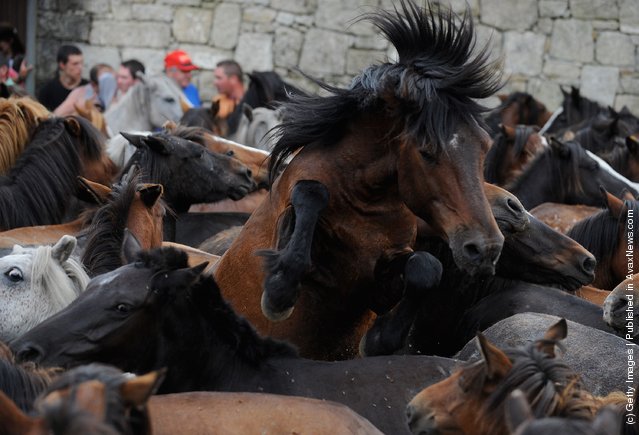
“Rapa das Bestas is the name of an operation that involves cutting the manes of the horses that are performed in the curros (enclosed which retain the horses) held in various locations in Galicia (Spain).

The best known is the Rapa das Bestas of Sabucedo, in the city hall of A Estrada, which lasts three days: the First Saturday, Sunday and Monday in July. In fact, the name given to the celebration (Rapa das Bestas of Sabucedo), while in most places speaking about curros, including curros de Valga, etc”. – Wikipedia

Photo: A wild horse leaps up during the Rapa das Bestas (shearing of the beasts) festival on July 2, 2011 in Sabucedo, Spain. Hundreds of wild horses are rounded up from the mountains and trimmed and marked in the corral. (Photo by Denis Doyle/Getty Images)
Details
03 Jul 2011 12:30:00
“The Duke and Duchess of Cambridge”, “The Queen” and “Prince Harry” outside the Summerhall arts venue in Edinburgh, Scotland, where their creator Alison Jackson is holding a live performance of her work called La Trashiata. (Photo by James Glossop/The Times/SIPA Press/News Syndication)

“The Duke and Duchess of Cambridge”, “The Queen” and “Prince Harry” outside the Summerhall arts venue in Edinburgh, Scotland, where their creator Alison Jackson is holding a live performance of her work called La Trashiata. Debuting at the Edinburgh Festival Fringe and broadcast to Odeon Cinemas in association with Hibrow Productions, “La Trashiata” will feature a roster of Alison Jackson's brilliant lookalikes singing some of opera's most famous arias. The stage will be set for uncanny doppelgangers to each take to the stage and perform their amusingly appropriate song. (Photo by James Glossop/The Times/SIPA Press/News Syndication)
Details
24 Aug 2014 09:05:00
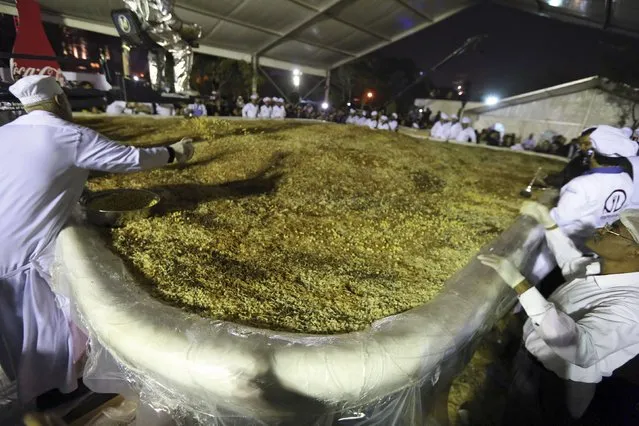
Workers prepare Koshary, a popular Egyptian dish, in an attempt to break the Guinness World Record for the world's biggest plate of Koshary, at a general garden in Zamalek, Cairo, January 17, 2015. (Photo by Mohamed Abd El Ghany/Reuters)

Workers prepare Koshary, a popular Egyptian dish, in an attempt to break the Guinness World Record for the world's biggest plate of Koshary, at a general garden in Zamalek, Cairo, January 17, 2015. Koshary is a traditional Egyptian dish dating to the 19th century in which rice, pasta and lentils are mixed together in one plate with a topping of spicey tomato sauce and some crispy fried onions. With a huge plate of koshary measuring 10 metres long and in width and of 1.2 metres in height, the plate weighed 7 tonnes, or about 7,000 kg. About 6,000 attendees turned up to the festival, earning it a place in the world record books. (Photo by Mohamed Abd El Ghany/Reuters)
Details
20 Jan 2015 12:43:00