Loading...
Done
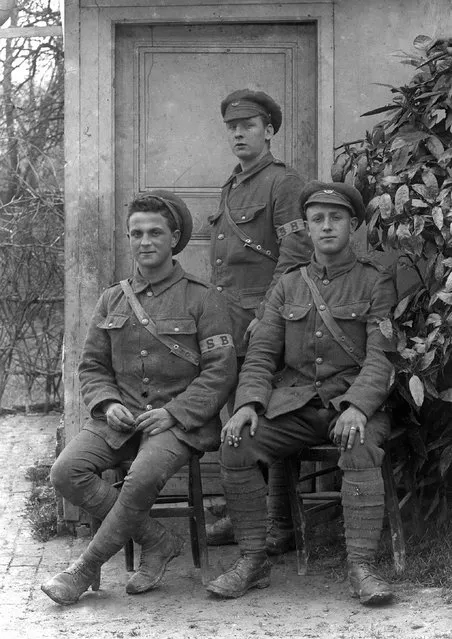
These images, scanned from old glass negatives which had surfaced in northern France, were believed to have been taken by a local amateur photographer in 1916. They showed British and a few Australian soldiers, in formal or informal poses, during or just before the most murderous battle in the history of the British Empire – Battle of the Somme. Who are these British and British Empire soldiers? The identity of the soldiers is, and may always remain, a mystery. (Property of Bernard Gardin/Dominique Zanardi/Joel Scribe/The Independent Magazine)

These images, scanned from old glass negatives which had surfaced in northern France, were believed to have been taken by a local amateur photographer in 1916. They showed British and a few Australian soldiers, in formal or informal poses, during or just before the most murderous battle in the history of the British Empire – Battle of the Somme. Who are these British and British Empire soldiers? The identity of the soldiers is, and may always remain, a mystery... (Property of Bernard Gardin/Dominique Zanardi/Joel Scribe/The Independent Magazine)
Details
04 Aug 2014 14:06:00
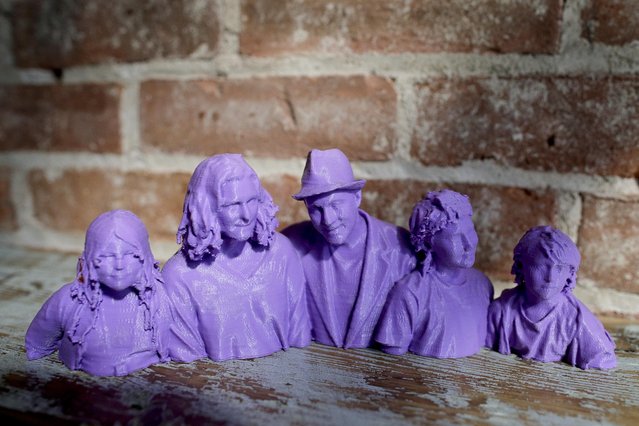
In this August 14, 2014 photo, a plastic bust statue of Kevin Micelli, center, and his family, made by a 3-D scanner and printer, sits on a shelf inside Micelli's coffee shop in New York. Micelli purchased the 3-D scanning and printing services at the Cubo toy store next door to his shop. With the old studio portrait supplanted by the selfie, 3-D scanning services provide a new reason for people to go to a store and stand stock-still in front of a camera. (Photo by Julie Jacobson/AP Photo)

“The advent of digital cameras and smartphones killed the traditional mall portrait studio, but 3-D printing has sparked a new trend. Overloaded with digital photos, statues may be moving in to fulfill our desire for portraits that stand out”. – Peter Svensson via The Associated Press. (Photo by Julie Jacobson/AP Photo)
Details
12 Oct 2014 12:28:00
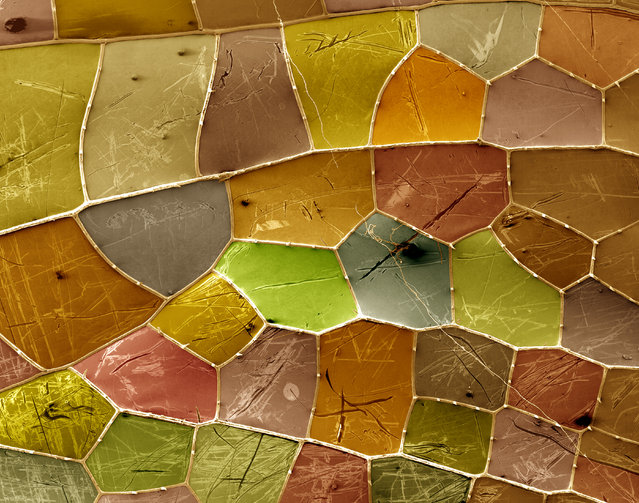
Micro or Macro? It's micro: this is an electron microscope image of the wing of a Green Darner dragonfly. (Photo by P. Kelly)

Macro or Micro? Scientists’ pictures baffle our sense of scale. It began when Stephen Young, a geography professor at Salem State University in Massachusetts, tricked his biologist colleague Paul Kelly into thinking a satellite image was one of his electron microscope scans. Can you guess whether they are close-up or very far away? (Photo by Paul Kelly)
Details
21 Apr 2014 10:24:00
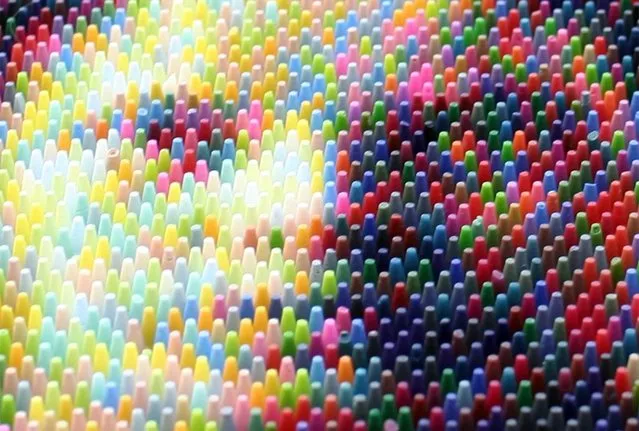
Art by Christian Faur

Christian Faur is an artist based in Granville, Ohio. Looking for a new technique, he experimented with painting with wax, but he didn’t feel the results were satisfactory.Then, at Christmas in 2005, his young daughter opened a box of 120 Crayola crayons he’d bought her, and everything clicked into place. Faur decided he would create pictures out of the crayons themselves, packing thousands of them together so they become like the colored pixels on a TV screen. He starts each work by scanning a photo into a computer and breaking the image down into colored blocks He then draws a grid that shows him exactly where to place each crayon The finished artworks are packed tightly into wooden frames. He actually makes the crayons himself, hand-casting each one in a mould.
Details
28 Jul 2012 10:03:00
The floret of a Chamomile flower up close and personal. (Photo by Oliver Meckes/Barcroft Media)

These images have been created using a colour scanning electron microscope (SEM) by the award-winning Eye of Science, comprised of snapper Oliver Meckes and biologist Nicole Ottawa. For a decade the pair, based in Reutlingen in the south of Germany, worked with an old SEM they saved from the scrapheap, but for the last five years they have used a £250,000 FEI Quanta Series Field Emission SEM. Oliver said: “Flowers are beautiful in 'normal' view, but when you look closer, some parts get very bizarre and unexpected structures appear – flowers within flowers, worlds within worlds”. Photo: The floret of a Chamomile flower up close and personal. (Photo by Oliver Meckes/Barcroft Media)
Details
26 May 2014 13:51:00
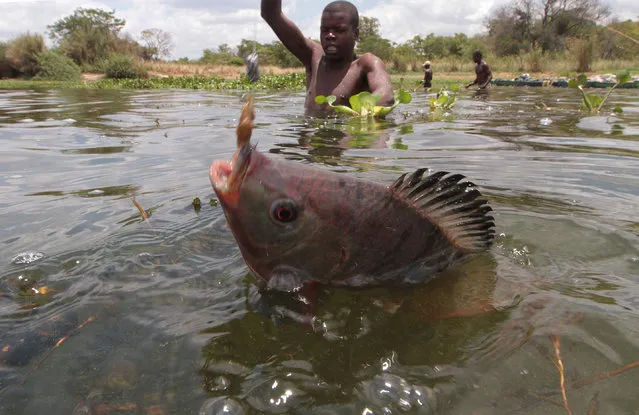
In this photo taken Wednesday, October 29, 2014, a fisherman catches a fish near the shores of Lake Chivero, west of Harare. (Photo by Tsvangirayi Mukwazhi/AP Photo)

In this photo taken Wednesday, October 29, 2014, a fisherman catches a fish near the shores of Lake Chivero, west of Harare. Illegal fishing can be hazardous in Zimbabwe, where poachers scan the banks for armed rangers and the water for crocodiles while they cast their rods. The country is in such a dire economic state that thousands of people, unable to find regular work, flock to Lake Chivero in hopes of catching fish, mostly bream, that they can sell for desperately needed income. (Photo by Tsvangirayi Mukwazhi/AP Photo)
Details
13 Nov 2014 13:55:00
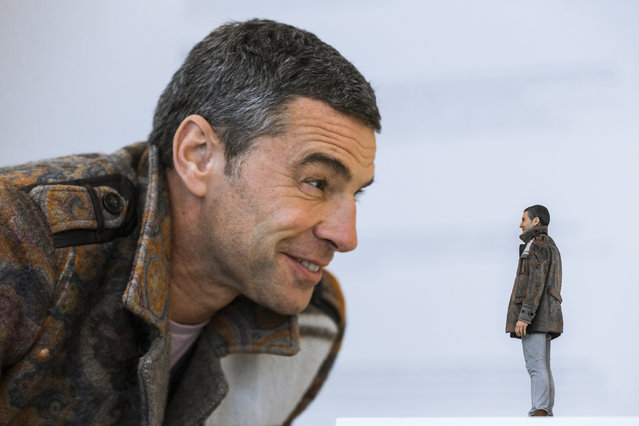
Customer Andreas Kroker looks at a 3D-printed figure of himself at the Twinkind 3D printing studio in Berlin, December 13, 2013. (Photo by Thomas Peter/Reuters)

Customer Andreas Kroker looks at a 3D-printed figure of himself at the Twinkind 3D printing studio in Berlin, December 13, 2013. A 3D-printed likeness is produced by taking a 360 degree photographic scan of a person, which is then rendered into a 3D digital model and retouched to meet the requirements for printing. The printing machine uses this digital model to produce a high-resolution solid figure. Twinkind co-founder Timo Schaedel said, people often come to the session well-groomed, with fresh hair-cuts and their best clothes, “just as they used to do in the past, when they had their portrait taken in a photo studio”. (Photo by Thomas Peter/Reuters)
Details
17 Jul 2014 11:22:00
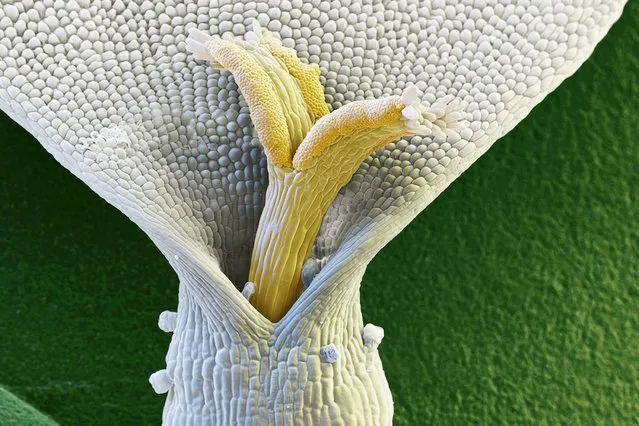
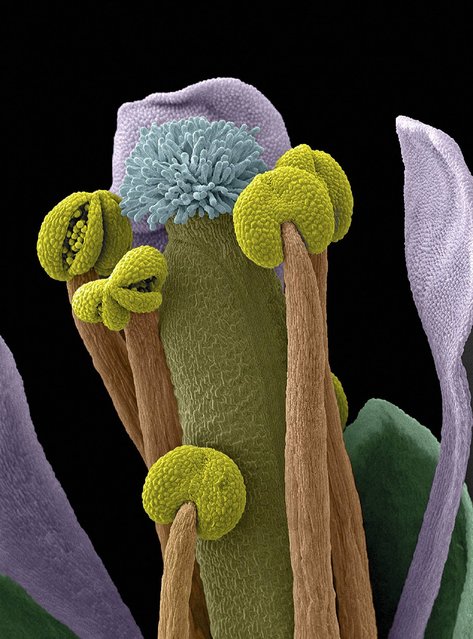
Scanning electron micrograph (SEM) of an Arabidopsis thaliana flower, also commonly known as thale cress. Some of the anthers are open, revealing pollen grains ready for dispersal. Arabidopsis was the first plant to have its entire genome sequenced and is widely used as a model organism in molecular and plant biology. Horizontal width of image is 1200 microns. Magnification 100x. (Photo by Stefan Eberhard/Wellcome Images)

Beautiful, strange and occasionally alarming pictures from the shortlist for this year’s Wellcome image awards – which celebrate the very best in science photography and imaging – from an x-ray of a bat to a micrograph of a kidney stone. The exhibition opens on 12 March at three science centres and the Museum of Science and Industry in Manchester. Photo: Scanning electron micrograph (SEM) of an Arabidopsis thaliana flower, also commonly known as thale cress. Some of the anthers are open, revealing pollen grains ready for dispersal. Arabidopsis was the first plant to have its entire genome sequenced and is widely used as a model organism in molecular and plant biology. Horizontal width of image is 1200 microns. Magnification 100x. (Photo by Stefan Eberhard/Wellcome Images)
Details
11 Mar 2014 05:58:00