Loading...
Done
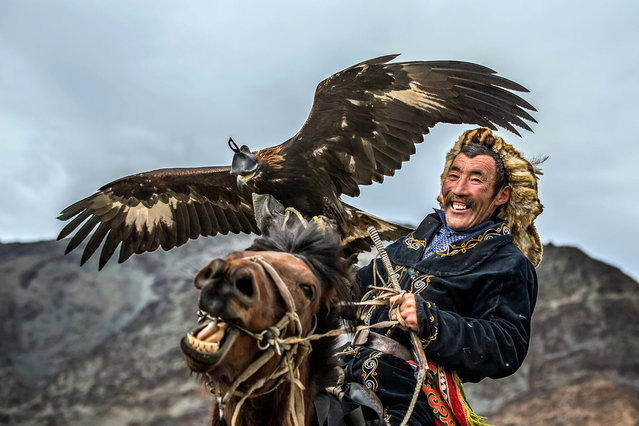
He said: "The photos were taken during the 17th Golden Eagle Festival in the Bayan-Ulgii province in Altai Mountains of Western Mongolia and the festival is just amazing”. (Photo by Batzaya Choijiljav/Caters News)

With their wings at full length, these beautiful golden eagles soar through the skies in a glorious training session to hunt their prey. Others sit on the arms of their owners and trainers. Batzaya Choijiljav, 41, from Mongolia has taken these magnificent pictures at the annual traditional Kazakhs festival, October 2015. (Photo by Batzaya Choijiljav/Caters News)
Details
06 Nov 2015 08:04:00
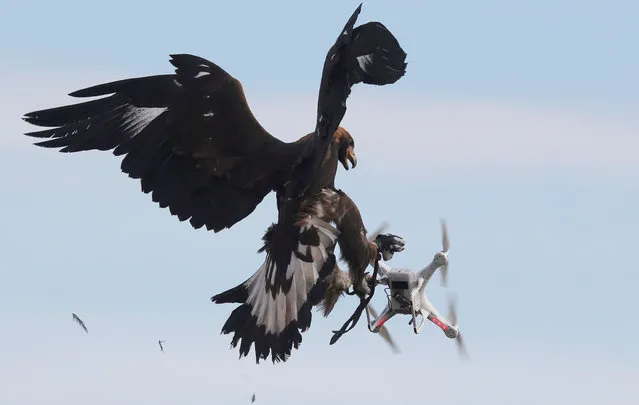
A golden eagle grabs a flying drone during a military training exercise at Mont-de-Marsan French Air Force base, Southwestern France, February 10, 2017. (Photo by Regis Duvignau/Reuters)

A golden eagle grabs a flying drone during a military training exercise at Mont-de-Marsan French Air Force base, Southwestern France, February 10, 2017. (Photo by Regis Duvignau/Reuters)
Details
12 Feb 2017 00:04:00
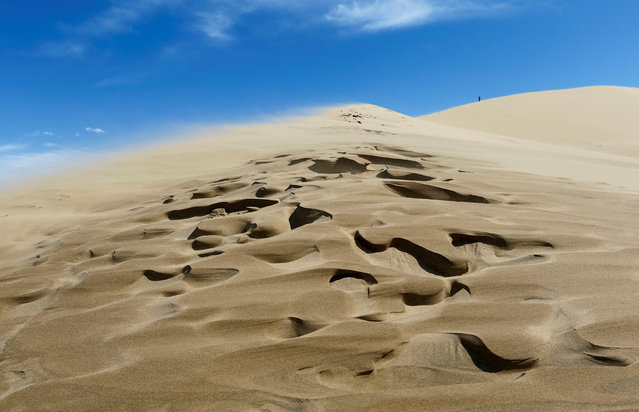
A tourist stands at an edge of the singing sand, the 150-metre-high by three-kilometre-long dune that generates a low-pitched, organ-like rumble in dry weather, in Altyn-Emel national park in Almaty region, Kazakhstan, May 12, 2016. (Photo by Shamil Zhumatov/Reuters)

A tourist stands at an edge of the singing sand, the 150-metre-high by three-kilometre-long dune that generates a low-pitched, organ-like rumble in dry weather, in Altyn-Emel national park in Almaty region, Kazakhstan, May 12, 2016. (Photo by Shamil Zhumatov/Reuters)
Details
18 Jun 2016 13:20:00
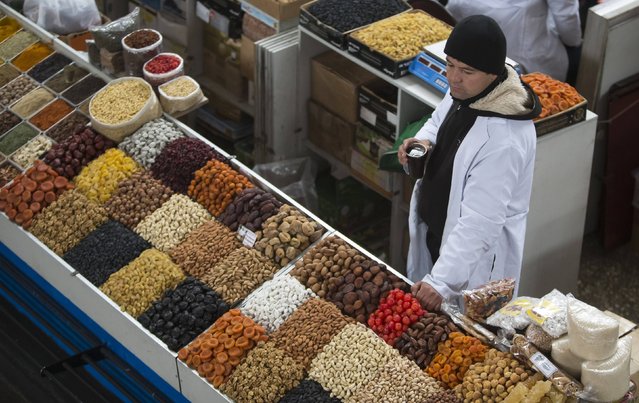
A vendor sells fruits and nuts at the Green Bazaar in Almaty January 23, 2015. Kazakhstan is spending billions of dollars of its reserves to keep devaluation of its currency gradual and reduce inflationary risks of the sort thrown up in Russia by the rouble's slide, analysts and former central bank officials say. (Photo by Shamil Zhumatov/Reuters)

A vendor sells fruits and nuts at the Green Bazaar in Almaty January 23, 2015. Kazakhstan is spending billions of dollars of its reserves to keep devaluation of its currency gradual and reduce inflationary risks of the sort thrown up in Russia by the rouble's slide, analysts and former central bank officials say. Kazakhstan, Central Asia's largest economy, is closely tied to Russia through trade and, like other ex-Soviet states, has been feeling the pain of the crisis which has driven the rouble down 50 percent against the dollar since the start of 2014. (Photo by Shamil Zhumatov/Reuters)
Details
28 Jan 2015 11:57:00
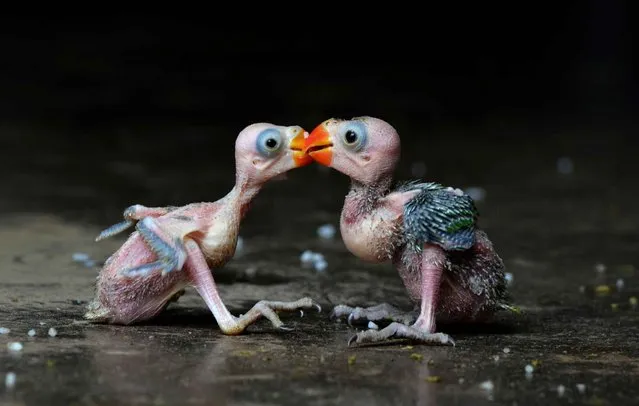
Baby Parrots meet each other after they were caught and preserved by local hunters for sale. Parrots, are among the most intelligent birds, and the ability of some species to imitate human voices enhances their popularity as pets. (Photo by Caisii Mao/NurPhoto/Sipa USA)

Wildlife are hunted down for consumption or for sale in the India eastern state of Nagaland. Hunters can make a good living, with some bred for food or to be sold as pets. These baby parrots, photographed by Caisii Mao via Sipa USA, are seen after they were caught and preserved by a local hunter and for sale at a private residence in Dimapur, India north eastern state of Nagaland on Wednesday, July 24, 2013. (Photo by Caisii Mao/NurPhoto/Sipa USA)
Details
28 Jul 2013 08:45:00
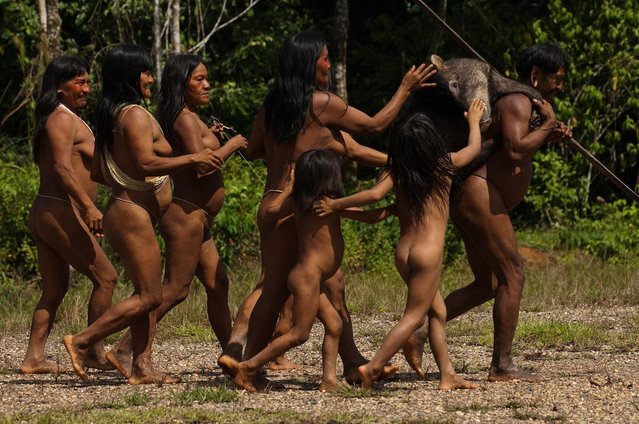
Spectacular images offering insight into the lives of the Huaorani people in the Ecuadorian Amazon have been revealed showing how they use traditional methods to hunt monkeys for food. The stunning pictures were taken by conservation photographer Pete Oxford from Torquay, Devon in the Ecuadorian Amazon. “The Huaorani Indians are a forest people highly in tune with their environment. Many are now totally acculturated since the 1950s by missionaries”, said Pete. “Today they face radical change to their culture to the proximity of oil exploration within their territory and the Yasuni National Park and Biosphere Reserve, they are vastly changed. Some still live very traditionally and for this shoot, through my Huaorani friend, a direct relative of those photographed he wanted to depict them as close to their original culture as possible. They still largely hunt with blow pipes and spears eating a lot of monkeys and peccaries”. The Huaorani are also known as the Waorani, Waodani or the Waos and are native Amerindians. Their lands are located between the Curaray and Napo rivers and speak the Huaorani language. Pete says that during his visit he was welcomed into the group and hopes that ancient cultures can be saved. Here: The tribe were seen celebrating after a hunter returned to camp with a wild pig. (Photo by Pete Oxford/Mediadrumworld.com)

Spectacular images offering insight into the lives of the Huaorani people in the Ecuadorian Amazon have been revealed showing how they use traditional methods to hunt monkeys for food. The stunning pictures were taken by conservation photographer Pete Oxford from Torquay, Devon in the Ecuadorian Amazon. Here: The tribe were seen celebrating after a hunter returned to camp with a wild pig. (Photo by Pete Oxford/Mediadrumworld.com)
Details
20 Jan 2017 07:58:00
Models present outfits made with air balloons during an international festival of air balloons design in Almaty, Kazakhstan, July 9, 2015. (Photo by Shamil Zhumatov/Reuters)

Models present outfits made with air balloons during an international festival of air balloons design in Almaty, Kazakhstan, July 9, 2015. (Photo by Shamil Zhumatov/Reuters)
Details
10 Jul 2015 12:38:00
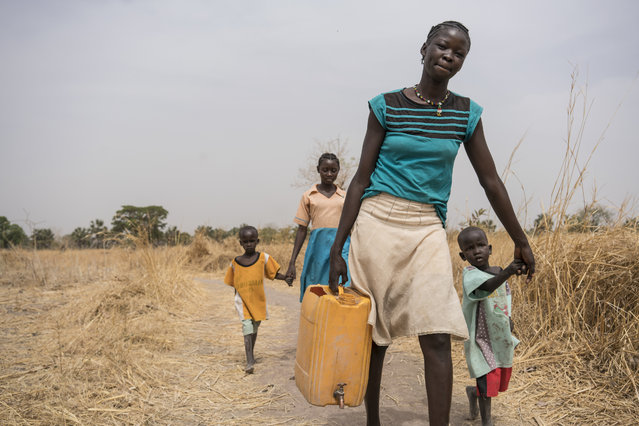
In this photo taken Sunday, March 12, 2017, a girl Abuk walks home with her brothers and friends after collecting clean water from a water point four kilometers away from her home, in Aweil, in South Sudan. As World Water Day approaches on March 22, more than 5 million people in South Sudan, do not have access to safe, clean water, compounding the problems of famine and civil war, according to the UNICEF. (Photo by Mackenzie Knowles-Coursin/UNICEF via AP Photo)

In this photo taken Sunday, March 12, 2017, a girl Abuk walks home with her brothers and friends after collecting clean water from a water point four kilometers away from her home, in Aweil, in South Sudan. As World Water Day approaches on March 22, more than 5 million people in South Sudan, do not have access to safe, clean water, compounding the problems of famine and civil war, according to the UNICEF. (Photo by Mackenzie Knowles-Coursin/UNICEF via AP Photo)
Details
21 Mar 2017 07:53:00