Loading...
Done
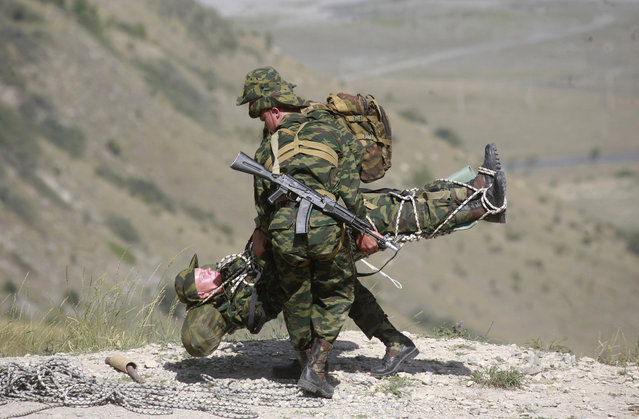
Russian soldiers from 34th motorized infantry mountain brigade, 58th Army, prepare to evacuate a fellow soldier acting as an injured person during a drill at the Darial range outside Russia's city of Vladikavkaz, July 28, 2010. (Photo by Kazbek Basayev/Reuters)

Russian soldiers from 34th motorized infantry mountain brigade, 58th Army, prepare to evacuate a fellow soldier acting as an injured person during a drill at the Darial range outside Russia's city of Vladikavkaz, July 28, 2010. (Photo by Kazbek Basayev/Reuters)
Details
03 Oct 2015 08:03:00
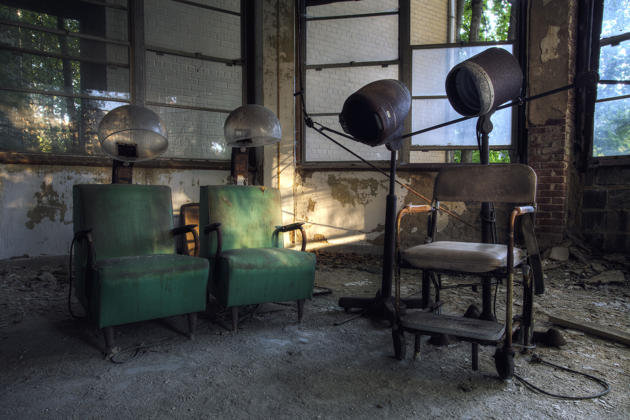
Salon equipment inside a sanatorium in New York. Daniel said: “We visited five states and several major cities, from New York City to Pittsburgh. It got pretty wild at times, so much so that in the more destitute areas, our guide carried a Glock”. (Photo by Daniel Barter/Caters News)

“These creepy pictures of abandoned asylums, prisons and schools give a sense of what life was like in institutions of 20th century America. Photographer Daniel Barter, 30, captured on film bowling alleys, theatres and hairdressing salons all completely intact. The Londoner was on travelling through Americas north eastern states when he had the chance to explore the derelict public buildings left untouched since their last inhabitants shut the doors”. – Caters News. Photo: Salon equipment inside a sanatorium in New York. (Photo by Daniel Barter/Caters News)
Details
09 May 2014 09:25:00
“Untitled #5”. “Family scenes, vacation souvenirs, everyday life, suspended anywhere between truth and fiction. It is hard to figure out whether they are spontaneous or entirely staged”. (Photo by Weronika Gęsicka/The Guardian)

In Weronika Gęsicka’s unsettling images, American archive photography gets distorted into scenes that are both nightmarish yet somehow entirely plausible. Gęsicka is a guest artist at the Circulations festival for young European photographers, Paris, until 5 March. Here: “Untitled #5”. (Photo by Weronika Gęsicka/The Guardian)
Details
23 Jan 2017 10:15:00
An inmate with a tattoo of Santa Muerte (The Saint of Death) reacts in the Topo Chico prison, during a media tour, in Monterrey, Mexico, February 17, 2016. (Photo by Daniel Becerril/Reuters)

An inmate with a tattoo of Santa Muerte (The Saint of Death) reacts in the Topo Chico prison, during a media tour, in Monterrey, Mexico, February 17, 2016. The director of a prison in northeast Mexico where 49 people died in a riot this week was accused of murder and detained, along with two others, a state prosecutor said on Saturday. (Photo by Daniel Becerril/Reuters)
Details
19 Feb 2016 12:20:00
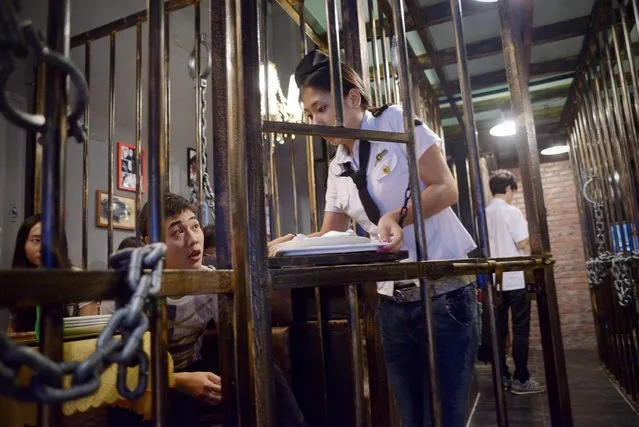
This picture taken on September 9, 2014 shows a waiteress handing over food to customers at a prison themed restaurant in Tianjin. As more themed restaurants are popular in China, a “prison style” restaurent in Tianjin is aimed at reminding people to observe the law and to be good citizens. (Photo by Wang Zhao/AFP Photo)

This picture taken on September 9, 2014 shows a waiteress handing over food to customers at a prison themed restaurant in Tianjin. As more themed restaurants are popular in China, a “prison style” restaurent in Tianjin is aimed at reminding people to observe the law and to be good citizens. (Photo by Wang Zhao/AFP Photo)
Details
14 Sep 2014 10:14:00
Miss Talavera Bruce 2017, Mayana Rosa Alves, right, takes a cigarette break with two contestants before the start of the 13th annual Miss Talavera Bruce beauty pageant at the penitentiary the pageant is named for, in Rio de Janeiro, Brazil, Tuesday, December 4, 2018. Prison authorities say they organize the annual beauty contest to encourage self-esteem, fight idleness and promote integration among the female inmates. (Photo by Silvia Izquierdo/AP Photo)

Miss Talavera Bruce 2017, Mayana Rosa Alves, right, takes a cigarette break with two contestants before the start of the 13th annual Miss Talavera Bruce beauty pageant at the penitentiary the pageant is named for, in Rio de Janeiro, Brazil, Tuesday, December 4, 2018. Prison authorities say they organize the annual beauty contest to encourage self-esteem, fight idleness and promote integration among the female inmates. (Photo by Silvia Izquierdo/AP Photo)
Details
06 Dec 2018 00:03:00
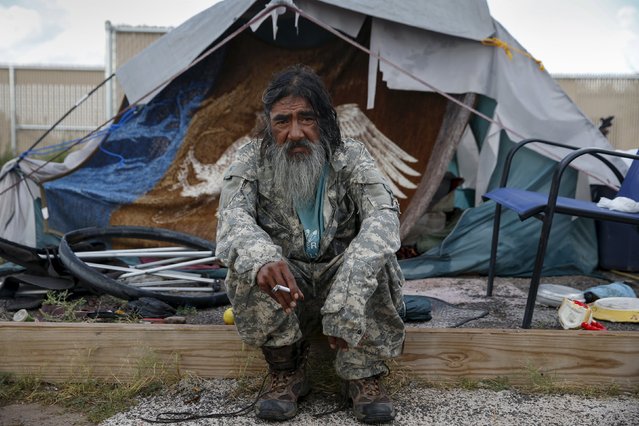
Daniel J. Wabsey, a 58-year-old war veteran, sits outside his tent at Camp Hope in Las Cruces, New Mexico October 6, 2015. “I've been traveling for 35 or 38 years. Getting inside would take a while to get used to. I just want to be able to eat, sleep and be safe. We all get along and understand in Camp Hope. We've all been there. With common sense you can survive out here”, Wabsey said. Camp Hope describe themselves as an “alternative transitional living project for the homeless”. Around 50 people live at the camp. (Photo by Shannon Stapleton/Reuters)

Daniel J. Wabsey, a 58-year-old war veteran, sits outside his tent at Camp Hope in Las Cruces, New Mexico October 6, 2015. “I've been traveling for 35 or 38 years. Getting inside would take a while to get used to. I just want to be able to eat, sleep and be safe. We all get along and understand in Camp Hope. We've all been there. With common sense you can survive out here”, Wabsey said. Camp Hope describe themselves as an “alternative transitional living project for the homeless”. Around 50 people live at the camp. (Photo by Shannon Stapleton/Reuters)
Details
19 Dec 2015 08:05:00
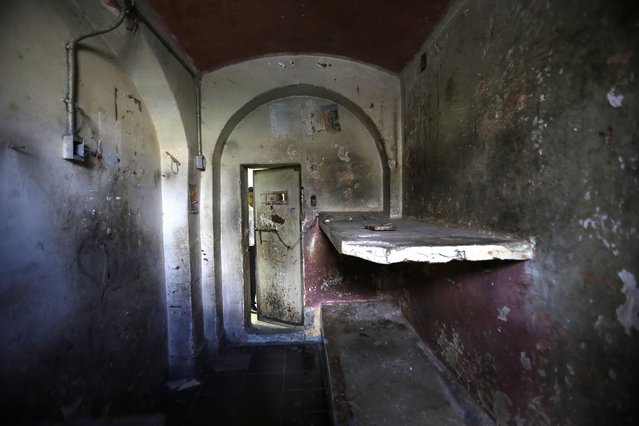
In this April 7, 2015 photo, a tourist peers through the door of a jail cell inside the now empty Garcia Moreno prison during a guided tour for the public in Quito, Ecuador. According to tour guides, this cell was nicknamed “Los Polillas”, or “The Moths”. Here, in a room designed to hold two prisoners, about 15 inmates with drug addictions were locked in overnight by the prison gangs that controlled daily life. The locked-in prisoners were also known to prostitute themselves to get access to drugs. (Photo by Dolores Ochoa/AP Photo)

In this April 7, 2015 photo, a tourist peers through the door of a jail cell inside the now empty Garcia Moreno prison during a guided tour for the public in Quito, Ecuador. According to tour guides, this cell was nicknamed “Los Polillas”, or “The Moths”. Here, in a room designed to hold two prisoners, about 15 inmates with drug addictions were locked in overnight by the prison gangs that controlled daily life. The locked-in prisoners were also known to prostitute themselves to get access to drugs. (Photo by Dolores Ochoa/AP Photo)
Details
03 May 2015 10:34:00