Loading...
Done
A Malaysian woman walks past an advertisement outside a jewellery store at a shopping mall in Kuala Lumpur on August 25, 2015. Prices of crude oil and most other commodities rebounded in Asia on August 25 but stayed under pressure following a global sell-off sparked by the faltering economy in China, the world's top user of industrial metals and energy. (Photo by Manan Vatsyayana/AFP Photo)

A Malaysian woman walks past an advertisement outside a jewellery store at a shopping mall in Kuala Lumpur on August 25, 2015. Prices of crude oil and most other commodities rebounded in Asia on August 25 but stayed under pressure following a global sell-off sparked by the faltering economy in China, the world's top user of industrial metals and energy. Gold prices remained steady, boosted by prospects of increased demand due to its status as a safe haven in times of turmoil. (Photo by Manan Vatsyayana/AFP Photo)
Details
26 Aug 2015 09:45:00
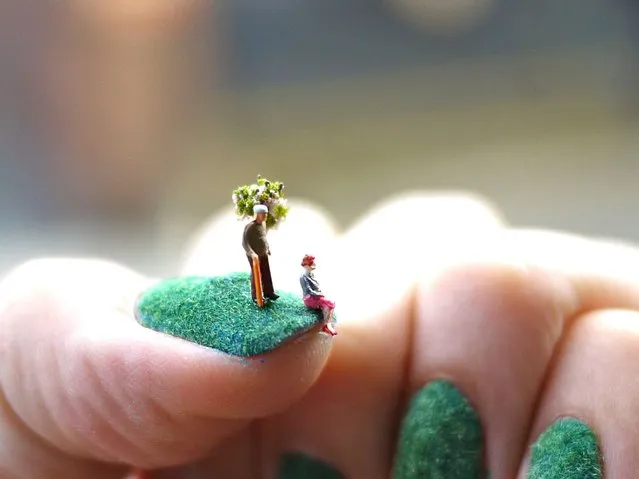
Rural idyll: The work depicts typical summer scenes. (Photo by Alice Bartlett/Flickr)

A talented nail artist has created manicure works of art with stunning detail. Alice Bartlett visited a craft and hobby shop in London to get the idea for her most intricate and flamboyant finger sculptures yet. She saw tiny figures used for model railway scenery displays and decided to use them to create rural scenes. (Photo by Alice Bartlett/Flickr)
Details
10 Aug 2014 10:28:00
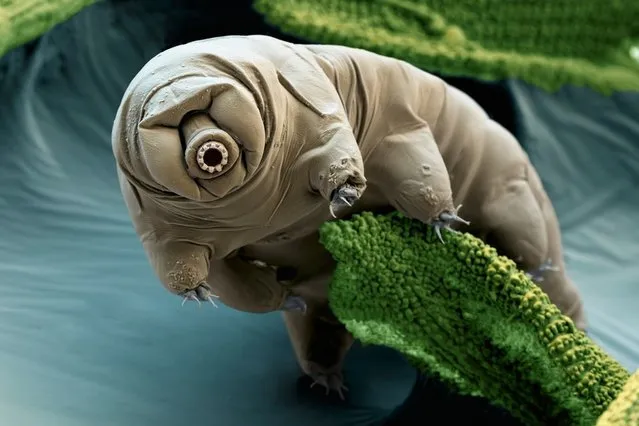
Tardigrades (commonly known as waterbears or moss piglets). (Photo by SPL/East News)

“Tardigrades (commonly known as waterbears or moss piglets) are small, water-dwelling, segmented animals with eight legs. Tardigrades were first discovered in 1773 by Johann August Ephraim Goeze, who called them kleiner Wasserbär, meaning “little water bear” in German. The name Tardigrada means “slow walker” and was given by Lazzaro Spallanzani in 1777. The name water bear comes from the way they walk, reminiscent of a bear's gait. The biggest adults may reach a body length of 1.5 millimetres (0.059 in), the smallest below 0.1 mm. Freshly hatched tardigrades may be smaller than 0.05 mm”. – Wikipedia. Photo: Tardigrades. (Photo by SPL/East News)
Details
26 Sep 2012 09:55:00
A Hindu devotee moves toward the river Brahmaputra in a prostrate manner to perform rituals during Chhath Puja festival in Guwahati, in the northeastern Indian state of Assam, India, Thursday, November 7, 2024. (Photo by Anupam Nath/AP Photo)

A Hindu devotee moves toward the river Brahmaputra in a prostrate manner to perform rituals during Chhath Puja festival in Guwahati, in the northeastern Indian state of Assam, India, Thursday, November 7, 2024. (Photo by Anupam Nath/AP Photo)
Details
03 Dec 2024 06:08:00
Dallas Cowboys cheerleaders perform before the game against the New England Patriots in Arlington, Texas on October 1, 2023. (Photo by Kevin Jairaj/USA Today Sports)

Dallas Cowboys cheerleaders perform before the game against the New England Patriots in Arlington, Texas on October 1, 2023. (Photo by Kevin Jairaj/USA Today Sports)
Details
09 Oct 2023 05:33:00
Sunrise over the River Thames and Tower Bridge in London today morning on January 28, 2024. It has been forecast that Sahara dust will be in the atmosphere. (Photo by Alister Gooding/Picture Exclusive)

Sunrise over the River Thames and Tower Bridge in London today morning on January 28, 2024. It has been forecast that Sahara dust will be in the atmosphere. (Photo by Alister Gooding/Picture Exclusive)
Details
21 Sep 2024 04:15:00
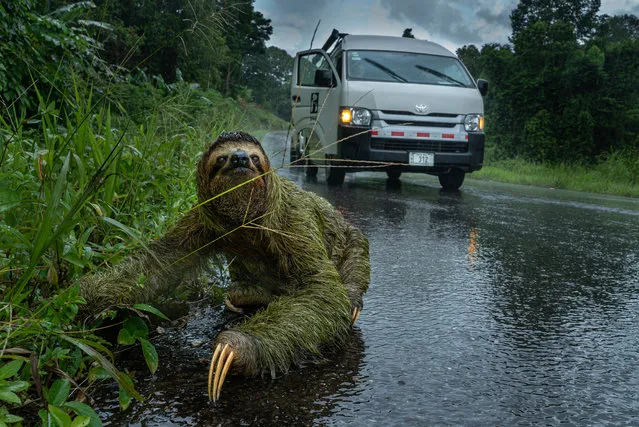
People and Nature category winner: Why did the sloth cross the road? by Andrew Whitworth (Osa Conservation and University of Glasgow), taken in Osa Peninsula, Costa Rica. “I was driving out from the Osa Peninsula, located on the southern Pacific coast of Costa Rica on a dark, stormy day. This female three-toed sloth (Bradypus variegatus) had luckily just about made it across the road, and the drivers of the Toyota on this occasion had spotted her in good time”. (Photo by Andrew Whitworth/2019 British Ecological Society Photography Competition)

People and Nature category winner: Why did the sloth cross the road? by Andrew Whitworth (Osa Conservation and University of Glasgow), taken in Osa Peninsula, Costa Rica. “I was driving out from the Osa Peninsula, located on the southern Pacific coast of Costa Rica on a dark, stormy day. This female three-toed sloth (Bradypus variegatus) had luckily just about made it across the road, and the drivers of the Toyota on this occasion had spotted her in good time”. (Photo by Andrew Whitworth/2019 British Ecological Society Photography Competition)
Details
30 Nov 2019 00:05:00
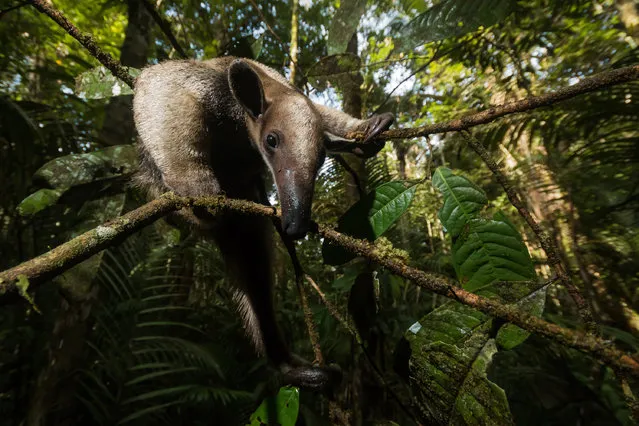
Individuals and populations student winner. Limbing in the Tropics, photographed in Manaus, Brazil. While walking in the Amazon rainforest looking for bat roosts to set up mist nets to capture bats for scientific research, a faint and almost imperceptible noise suddenly caught this photographer’s attention. An anteater was climbing with exceptional ability in a tangled mess of branches and lianas. With an unbelievable calmness, the animal watched the photographer at work and seemed to enjoy being the subject of an impromptu photography session in the most biodiverse ecosystem on Earth. (Photo by Adrià López Baucells/University of Lisbon/British Ecological Society)

Individuals and populations student winner. Limbing in the Tropics, photographed in Manaus, Brazil. While walking in the Amazon rainforest looking for bat roosts to set up mist nets to capture bats for scientific research, a faint and almost imperceptible noise suddenly caught this photographer’s attention. An anteater was climbing with exceptional ability in a tangled mess of branches and lianas. (Photo by Adrià López Baucells/University of Lisbon/British Ecological Society)
Details
05 Dec 2018 00:03:00