Loading...
Done
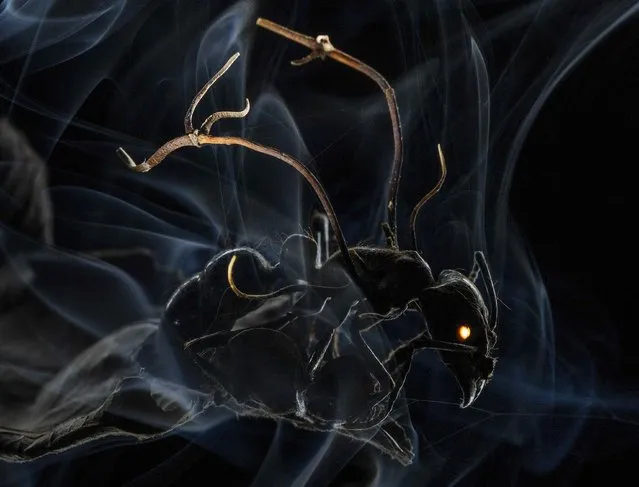
Anand Varma, a U.S. photographer working for the National Geographic, won the First Prize in the Nature Category, Stories, of the 2015 World Press Photo contest with his series of pictures, which includes this one of spores of a fungus landing on an ant, penetrating its exoskeleton and entering its brain, compelling the host to leave its normal habitat on the forest floor and scale a nearby tree, in this picture taken January 22, 2014 and released by the World Press Photo on February 12, 2015. (Photo by Anand Varma/Reuters/National Geographic/World Press Photo)

Anand Varma, a U.S. photographer working for the National Geographic, won the First Prize in the Nature Category, Stories, of the 2015 World Press Photo contest with his series of pictures, which includes this one of spores of a fungus landing on an ant, penetrating its exoskeleton and entering its brain, compelling the host to leave its normal habitat on the forest floor and scale a nearby tree, in this picture taken January 22, 2014 and released by the World Press Photo on February 12, 2015. (Photo by Anand Varma/Reuters/National Geographic/World Press Photo)
Details
15 Feb 2015 15:21:00
Vancouver Zombie Walk 2012

On August 18, 2012 the infection spreads again as the undead hordes shamble through Vancouver in search of brains. The annual Zombie Walk has been going on for years and each year gets bigger and bigger. (Photo by Gord Gallagher)
Details
02 Oct 2012 10:47:00
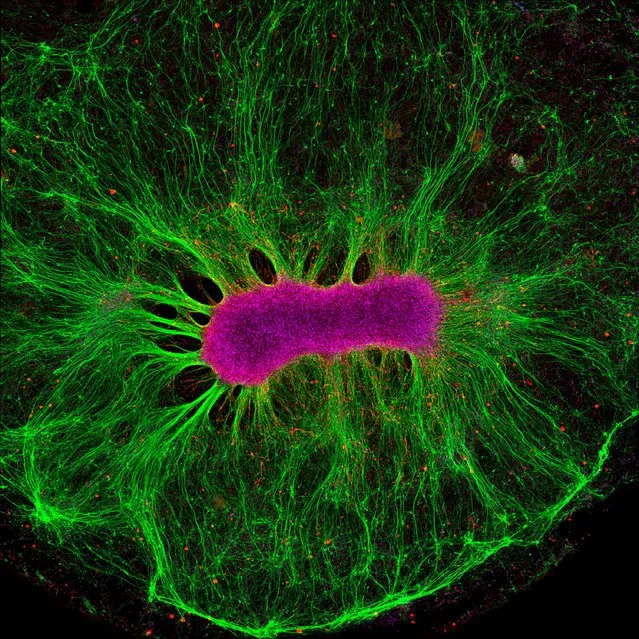
Brain-on-a-chip. Dazzling in green and magenta this image shows the nerve fibres (in green) produced by neural stem cells (in magenta) as they grow on a synthetic gel. Captured by a technique known as confocal microscopy, the image is part of research shedding light on how tinkering with the environment can affect the way in which nerve fibres grow. (Photo by Collin Edington and Iris Lee/Massachusetts Institute of Technology/Wellcome Images)

Brain-on-a-chip. Dazzling in green and magenta this image shows the nerve fibres (in green) produced by neural stem cells (in magenta) as they grow on a synthetic gel. Captured by a technique known as confocal microscopy, the image is part of research shedding light on how tinkering with the environment can affect the way in which nerve fibres grow. (Photo by Collin Edington and Iris Lee/Massachusetts Institute of Technology/Wellcome Images)
Details
17 Mar 2017 00:01:00
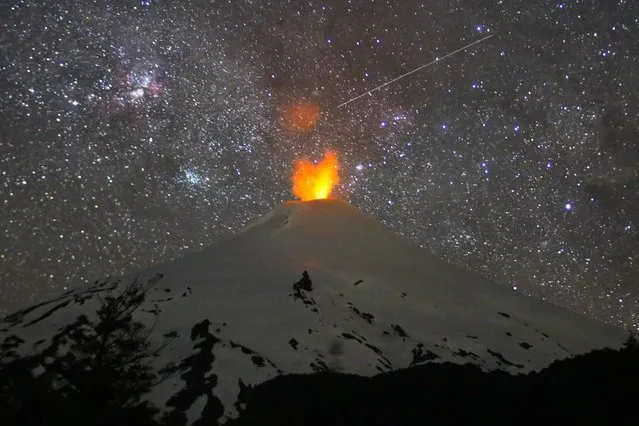
The Villarrica volcano shows signs of activity, as seen from Pucon, some 800 kilometers south of Santiago, on November 21, 2022. Villarrica volcano is among the most active in South America. (Photo by Mario Quilodran/AFP Photo)

The Villarrica volcano shows signs of activity, as seen from Pucon, some 800 kilometers south of Santiago, on November 21, 2022. Villarrica volcano is among the most active in South America. (Photo by Mario Quilodran/AFP Photo)
Details
17 Aug 2023 04:03:00
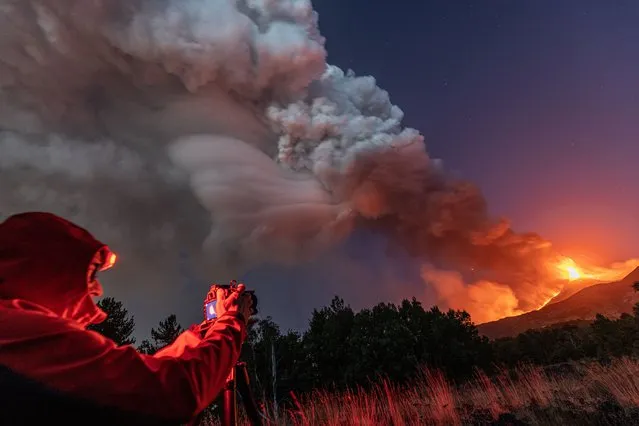
Smoke billows from the Mt Etna volcano as seen from Linguaglossa, Sicily, Monday, August 9, 2021. Europe's most active volcano remains active scattering ashes around a vastly populated area on its slopes. (Photo by Marco Restivo/Barcroft Media via Getty Images)

Smoke billows from the Mt Etna volcano as seen from Linguaglossa, Sicily on Monday, August 9, 2021. Europe's most active volcano remains active scattering ashes around a vastly populated area on its slopes. (Photo by Marco Restivo/Barcroft Media via Getty Images)
Details
10 Aug 2021 09:57:00
Revellers take part in a Zombie Walk in Asbury Park, New Jersey October 4, 2014. (Photo by Eduardo Munoz/Reuters)

Revellers take part in a Zombie Walk in Asbury Park, New Jersey October 4, 2014. Thousands of revellers met in Asbury park to attempt to break the Guinness World Record of the largest zombie gathering in the world and raise awareness for brain cancer. (Photo by Eduardo Munoz/Reuters)
Details
05 Oct 2014 11:16:00
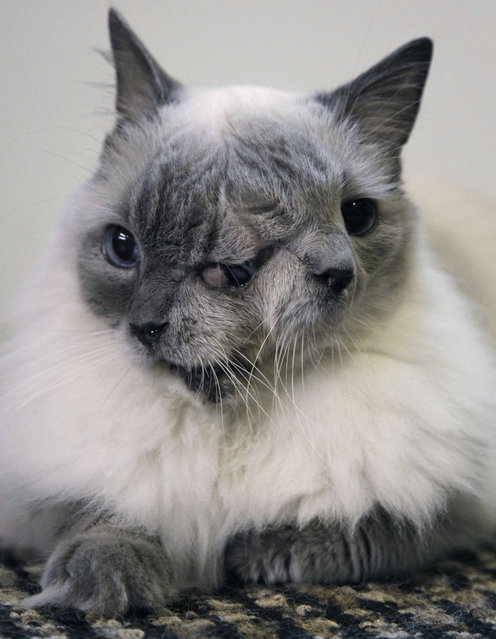
Two Faces Cat Named Frank And Louie

A Massachusetts cat with two faces has become the world’s longest surviving so called “janus” feline at 12 years of age. The cat, who is named Frank and Louie, has two mouths, two noses and three eyes. Frank and Louie have one brain, so the faces react in unison.
Details
14 Mar 2013 11:47:00


A man speaks on his mobile phone on May 31, 2011 in New York City. In a new report by 31 scientists meeting at the World Health Organization's International Agency for Research on Cancer (WHO/IARC) it was found that using a mobile phone may increase your risk for certain kinds of brain cancers. While further scientific work will be conducted, the group of scientists from 14 countries classified cell phones in the carcinogenic category 2B, which is similar to the pesticide DDT and gasoline engine exhaust. (Photo by Spencer Platt/Getty Images)
Details
01 Jun 2011 06:40:00