Loading...
Done
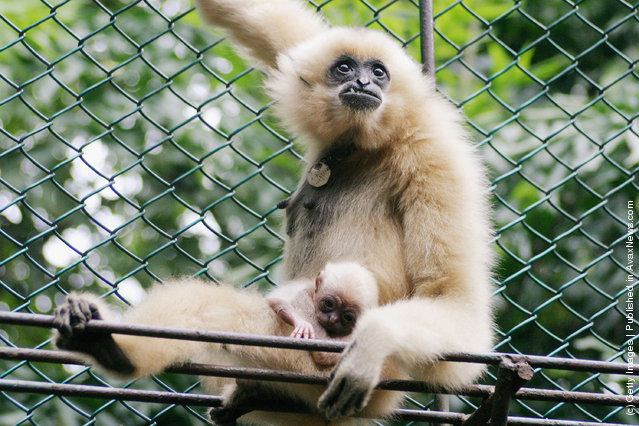
Newborn White-Cheeked Gibbon Nomascus

“Nomascus is the second most speciose genus of gibbons (family Hylobatidae). Originally this genus was a subgenus of Hylobates, and all individuals were considered one species, Hylobates concolor. Species within Nomascus are characterized by 52 chromosomes. Some species are all black, some light with a distinct black tuft of crown fur, and some by distinct, light-colored cheek patches. Nomascus is found from southern China (Yunnan) to southern Vietnam, and also on Hainan Island. One of the genus' species, Nomascus nasutus, has been deemed “the most critically endangered ape species in the world”. All of the species in this genus are endangered or critically endangered”. – Wikipedia

Photo: A newborn White-Cheeked Gibbon clings to its mother in the Nanning Zoo on April 12, 2004 in Nanning, Guangxi province, China. The White-Cheeked Gibbon's natural habitat is Southern China as well as Vietnam and Laos. They are classified as highly endangered and are on the brink of extinction due to poaching and reduction of natural rainforests. (Photo by Getty Images)
Details
12 Aug 2011 11:51:00
Incredible drone image capture colourful water lilies being harvested in An Giang Province, Vietnam, Southeast Asia on September 2020. Water lilies are an iconic symbol in the Mekong Delta and the flowers are immediately sent to market before landing on meal tables. Their stalks are edible and can be eaten raw with either fermented paste or braised sauce, or dunked into sour soup or hotpot. (Photo by Nguyen Sanh Quoc Huy/Triangle News)

Incredible drone image capture colourful water lilies being harvested in An Giang Province, Vietnam, Southeast Asia on September 2020. Water lilies are an iconic symbol in the Mekong Delta and the flowers are immediately sent to market before landing on meal tables. Their stalks are edible and can be eaten raw with either fermented paste or braised sauce, or dunked into sour soup or hotpot. (Photo by Nguyen Sanh Quoc Huy/Triangle News)
Details
25 Sep 2020 00:05:00
Revellers in Leeds, United Kingdom were excited to be out and about again on July 18, 2021. At a minute past midnight, England dropped most of its remaining Covid-19 social restrictions, such as those requiring indoor mask-wearing and limits on group gatherings. These changes come despite rising infections, pitting the country's vaccination programme against the virus's more contagious Delta variant. (Photo by Ioannis Alexopoulos/PA Wire Press Association via Getty Images)

Revellers in Leeds, United Kingdom were excited to be out and about again on July 18, 2021. At a minute past midnight, England dropped most of its remaining Covid-19 social restrictions, such as those requiring indoor mask-wearing and limits on group gatherings. These changes come despite rising infections, pitting the country's vaccination programme against the virus's more contagious Delta variant. (Photo by Ioannis Alexopoulos/PA Wire Press Association via Getty Images)
Details
19 Jul 2021 09:36:00
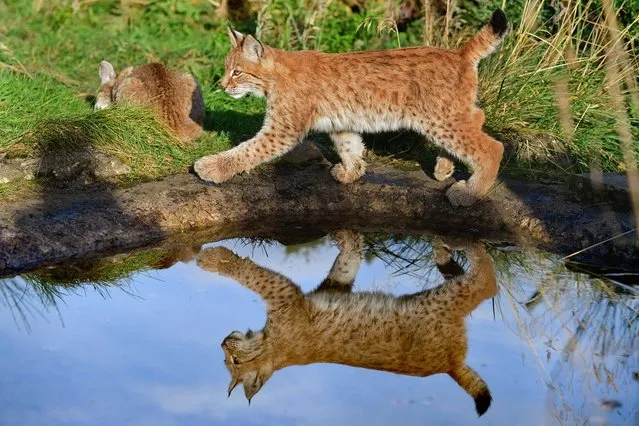
Northern Lynx kittens, explore their enclosure at the Highland Wildlife park on October 9, 2012 in Kingussie, Scotland. The feline twins are believed to be the type of lynx found historically in Scotland. The Highland Wildlife Park specialises in Scottish animal species, both past and present, and species that are well adapted to cold weather.  (Photo by Jeff J. Mitchell)

Northern Lynx kittens, explore their enclosure at the Highland Wildlife park on October 9, 2012 in Kingussie, Scotland. The feline twins are believed to be the type of lynx found historically in Scotland. The Highland Wildlife Park specialises in Scottish animal species, both past and present, and species that are well adapted to cold weather. (Photo by Jeff J. Mitchell)
Details
10 Oct 2012 09:30:00
Egrets stand on a field as an Egyptian farmer plants rice seedling in Egypt's fertile Delta in Tanta, Algharbeya governorate, 100 km from Cairo, Egypt, 22 June 2022.  Egyptian Government reduced the planting of some crops that need a massive amount of irrigation water, while the government said it will reduce the rice agriculture area in Egypt, amid fear the Renaissance Dam project in Ethiopia could affect the amount of River Nile water reaching Egypt. (Photo by Khaled Elfiqi/EPA/EFE)

Egrets stand on a field as an Egyptian farmer plants rice seedling in Egypt's fertile Delta in Tanta, Algharbeya governorate, 100 km from Cairo, Egypt, 22 June 2022. Egyptian Government reduced the planting of some crops that need a massive amount of irrigation water, while the government said it will reduce the rice agriculture area in Egypt, amid fear the Renaissance Dam project in Ethiopia could affect the amount of River Nile water reaching Egypt. (Photo by Khaled Elfiqi/EPA/EFE)
Details
23 Jul 2022 04:52:00
A prong extending from a remote-controlled robot prototype approaches the mouth of a volunteer to extract a throat swab sample, as part of a self-funded project to assist physicians in running tests on suspected COVID-19 coronavirus patients in a bid to limit human exposure to disease-carriers, at a private hospital in Egypt's Nile delta city of Tanta, on March 20, 2021. (Photo by Khaled Desouki/AFP Photo)

A prong extending from a remote-controlled robot prototype approaches the mouth of a volunteer to extract a throat swab sample, as part of a self-funded project to assist physicians in running tests on suspected COVID-19 coronavirus patients in a bid to limit human exposure to disease-carriers, at a private hospital in Egypt's Nile delta city of Tanta, on March 20, 2021. (Photo by Khaled Desouki/AFP Photo)
Details
24 Apr 2021 08:47:00
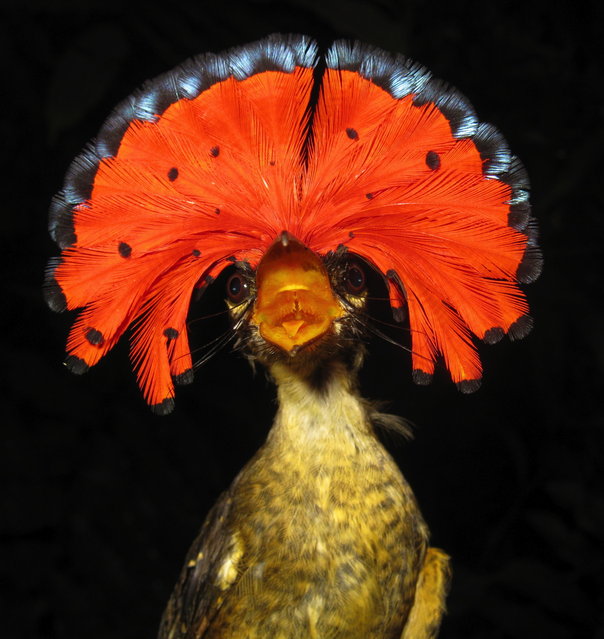
Royal Flycatcher

The Royal Flycatchers are birds in the genus Onychorhynchus in the Tityridae family. Depending on authority, it includes a single widespread, or four more localized species. The specific epithet of the type species, coronatus, and the common name of all the species in this genus, Royal Flycatcher, refer to the striking, colourful crest, which is seen displayed very rarely, except after mating, while preening, in courtship as well as being handled.
Details
02 Jun 2013 10:04:00
Waves triggered by Typhoon Hato are seen in Hong Kong, China on August 23, 2017. (Photo by Tyrone Siu/Reuters)

Waves triggered by Typhoon Hato are seen in Hong Kong, China on August 23, 2017. A powerful typhoon barreled into Hong Kong on Wednesday, forcing offices and schools to close and leaving flooded streets, shattered windows and hundreds of canceled flights in its wake. Typhoon Hato came within 60 kilometers (37 miles) of Hong Kong, close enough to be considered a direct hit under Hong Kong's storm warning system. It was headed toward the western side of mainland China's Pearl River Delta. (Photo by Tyrone Siu/Reuters)
Details
24 Aug 2017 09:15:00