Loading...
Done
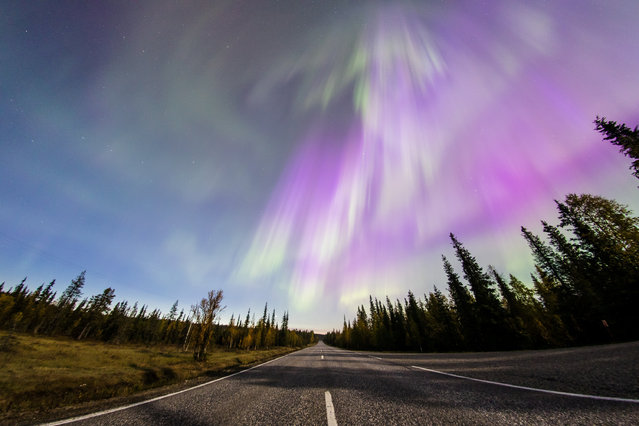
The Aurora Borealis (Northern Lights) is seen over the sky near the village of Pallas (Muonio region) of Lapland, Finland September 8, 2017. (Photo by Alexander Kuznetsov/Reuters)

The Aurora Borealis (Northern Lights) is seen over the sky near the village of Pallas (Muonio region) of Lapland, Finland September 8, 2017. (Photo by Alexander Kuznetsov/Reuters)
Details
16 Sep 2017 07:18:00
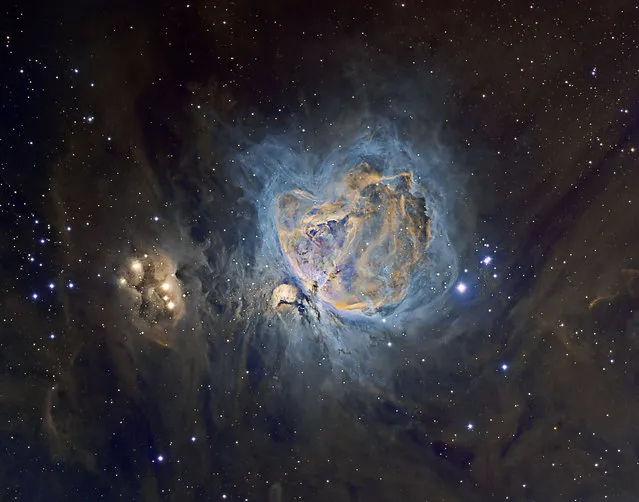
M42 Subtle V1 cropped. One of the most well-known astronomical objects in our universe is the Orion Nebula and this image depicts the wider region of the Orion Molecular Cloud Complex that is its home. This complex also includes another popular target for astrophotographers, the Horsehead Nebula, as well as Barnard’s Loop and the Running Man Nebula, which can be seen to the left of this photograph. (Photo by Patrick Gilliland)

M42 Subtle V1 cropped. One of the most well-known astronomical objects in our universe is the Orion Nebula and this image depicts the wider region of the Orion Molecular Cloud Complex that is its home. This complex also includes another popular target for astrophotographers, the Horsehead Nebula, as well as Barnard’s Loop and the Running Man Nebula, which can be seen to the left of this photograph. (Photo by Patrick Gilliland)
Details
17 Nov 2015 08:05:00
A man (bottom) suspected of shooting former Japanese prime minister Shinzo Abe is tackled to the ground by police at Yamato Saidaiji Station in the city of Nara on July 8, 2022. Shinzo Abe was shot at a campaign event on July 8, a government spokesman said, as local media reported the nation's longest-serving premier was showing no vital signs. (Photo by Yomiuri Shimbun/AFP Photo)

A man (bottom) suspected of shooting former Japanese prime minister Shinzo Abe is tackled to the ground by police at Yamato Saidaiji Station in the city of Nara on July 8, 2022. Shinzo Abe was shot at a campaign event on July 8, a government spokesman said, as local media reported the nation's longest-serving premier was showing no vital signs. (Photo by Yomiuri Shimbun/AFP Photo)
Details
13 Oct 2023 03:35:00
A chicken gingerly crosses the double yellow line of a country road near Roseburg in western Oregon, USA on July 16, 2018. (Photo by Robin Loznak/ZUMA Wire/Alamy Live News)

A chicken gingerly crosses the double yellow line of a country road near Roseburg in western Oregon, USA on July 16, 2018. (Photo by Robin Loznak/ZUMA Wire/Alamy Live News)
Details
22 Jul 2018 00:03:00
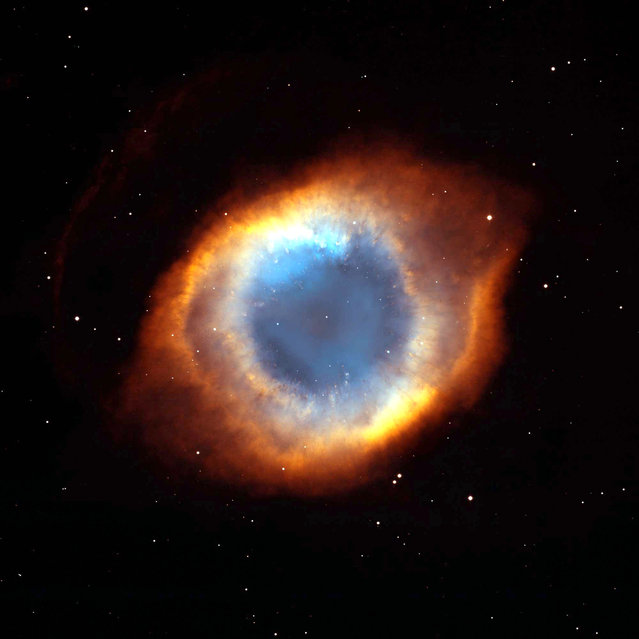
A coil-shaped Helix Nebula showing a fine web of filamentary “bicycle-spoke” features embedded in the colorful red and blue ring of gas. At 650 light-years away, the Helix is one of the nearest planetary nebulae to Earth. A planetary nebula is the glowing gas around a dying, Sun-like star. (Photo by Reuters/NASA)

A coil-shaped Helix Nebula showing a fine web of filamentary “bicycle-spoke” features embedded in the colorful red and blue ring of gas. At 650 light-years away, the Helix is one of the nearest planetary nebulae to Earth. A planetary nebula is the glowing gas around a dying, Sun-like star. (Photo by Reuters/NASA)
Details
22 Oct 2014 14:01:00
A waxworks artist retouches one of the wax figures at the unveiling of Little Mix waxwork figures at Madame Tussauds, in London, Britain, July 28, 2021. (Photo by Peter Nicholls/Reuters)

A waxworks artist retouches one of the wax figures at the unveiling of Little Mix waxwork figures at Madame Tussauds, in London, Britain, July 28, 2021. (Photo by Peter Nicholls/Reuters)
Details
15 Aug 2021 07:11:00
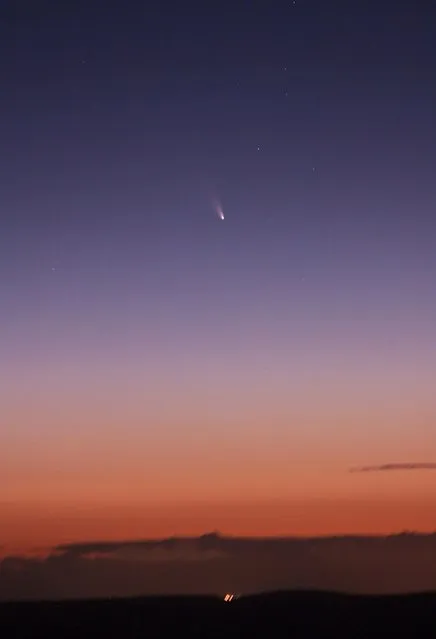
This image provided by NASA shoaws the comet PANSTARRS as seen from Mount Dale, Western Australia on March 5, 2013. According to NASA on March 10, it will make its closest approach to the sun about 28 million miles (45 million kilometers) away. As it continues its nightly trek across the sky, the comet may get lost in the sun's glare but should return and be visible to the naked eye by March 12. (Photo by AP Photo/NASA)

It’s time to start watching for Comet PANSTARRS, one of two comets to get excited about in 2013. Photo: This image provided by NASA shoaws the comet PANSTARRS as seen from Mount Dale, Western Australia on March 5, 2013. According to NASA on March 10, it will make its closest approach to the sun about 28 million miles (45 million kilometers) away. As it continues its nightly trek across the sky, the comet may get lost in the sun's glare but should return and be visible to the naked eye by March 12. (Photo by AP Photo/NASA)
Details
13 Mar 2013 08:03:00
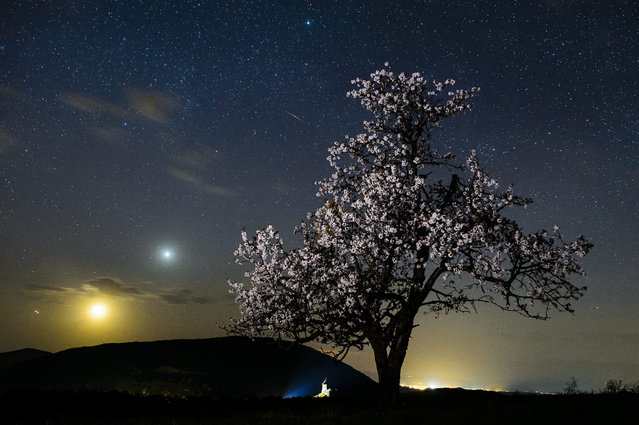
A meteorite burns up in the atmosphere as seen in this photo taken near of Salgotarjan, 109 kms northeast of Budapest, Hungary, late 21 April 2015. The Moon and Venus can be seen on the left. (Photo by Peter Komka/EPA)

A meteorite burns up in the atmosphere as seen in this photo taken near of Salgotarjan, 109 kms northeast of Budapest, Hungary, late 21 April 2015. The Moon and Venus can be seen on the left. (Photo by Peter Komka/EPA)
Details
04 May 2015 09:25:00