Loading...
Done
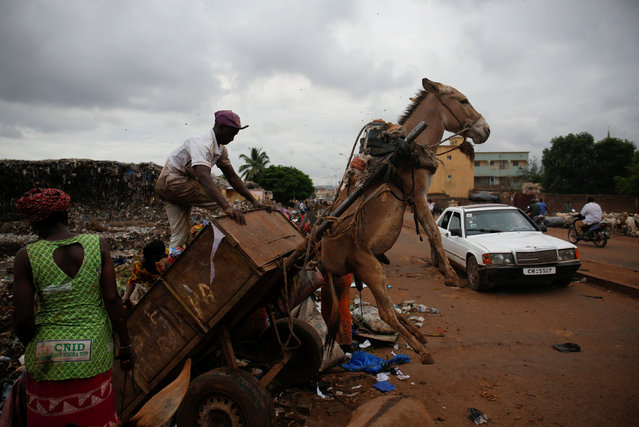
A waste picker unloads garbage at a waste transfer station in Bamako, Mali, August 19, 2018. In the Malian capital of Bamako, donkey carts driven by young men like 19-year-old Arouna Diabate play a vital role battling the fast-growing city's waste problem. Every morning before dawn, Diabate hitches his donkey to a cart and sets off on his rounds, going door-to-door to collect household garbage which he delivers to a local waste transfer station for a monthly salary of around $35. “I won't be picking up trash with a donkey cart for the rest of my life, but for now people appreciate us because we help clean up the homes of Bamako”, Diabate said. (Photo by Luc Gnago/Reuters)

A waste picker unloads garbage at a waste transfer station in Bamako, Mali, August 19, 2018. In the Malian capital of Bamako, donkey carts driven by young men like 19-year-old Arouna Diabate play a vital role battling the fast-growing city's waste problem. Every morning before dawn, Diabate hitches his donkey to a cart and sets off on his rounds, going door-to-door to collect household garbage which he delivers to a local waste transfer station for a monthly salary of around $35. “I won't be picking up trash with a donkey cart for the rest of my life, but for now people appreciate us because we help clean up the homes of Bamako”, Diabate said. (Photo by Luc Gnago/Reuters)
Details
18 Sep 2018 00:01:00
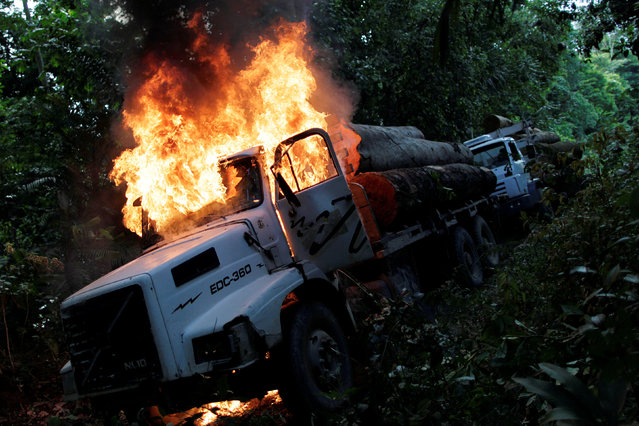
Trucks loaded with tree trunks are burned by agents of the Brazilian Institute for the Environment and Renewable Natural Resources, or Ibama, during an operation to combat illegal mining and logging, in the municipality of Novo Progresso, Para State, northern Brazil, November 11, 2016. When able to do their job, agents of the Brazilian Institute for the Environment and Renewable Natural Resources, or Ibama, are decisive, punishing illegal loggers on the spot. Nearly twice the size of India, the Amazon absorbs an estimated 2 billion tonnes of carbon dioxide per year, making its preservation vital in the fight to halt global warming. Ibama, responsible for preserving Brazil's 65 percent share of the world's largest rainforest, is one of the most important groups in that fight. But after years of surprising success, the rate of deforestation is on the rise again. Over the past four years it has risen 35 percent, as Ibama suffered from a lack of funding amid Brazil's worst recession in a century. (Photo by Ueslei Marcelino/Reuters)

Trucks loaded with tree trunks are burned by agents of the Brazilian Institute for the Environment and Renewable Natural Resources, or Ibama, during an operation to combat illegal mining and logging, in the municipality of Novo Progresso, Para State, northern Brazil, November 11, 2016. When able to do their job, agents of the Brazilian Institute for the Environment and Renewable Natural Resources, or Ibama, are decisive, punishing illegal loggers on the spot. Nearly twice the size of India, the Amazon absorbs an estimated 2 billion tonnes of carbon dioxide per year, making its preservation vital in the fight to halt global warming. (Photo by Ueslei Marcelino/Reuters)
Details
30 Nov 2016 12:36:00
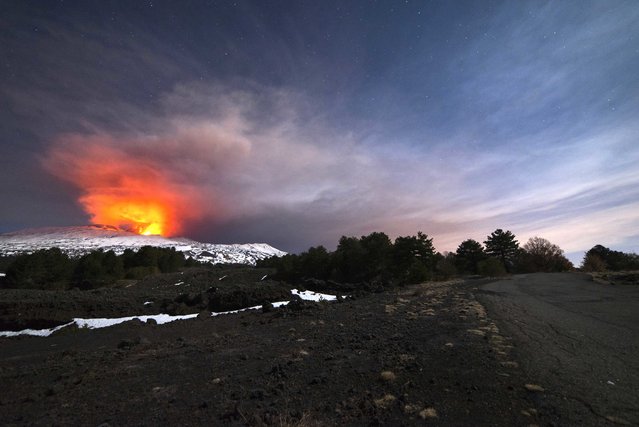
Mount Etna, Europe's most active volcano, is seen from the side of a road as it spews lava during an eruption in the early hours of Thursday, March 16, 2017. Sicily's Mount Etna volcano unleashed an explosion Thursday, hurling molten rocks and steam that rained down on tourists, journalists and a scientist who scrambled to escape the barrage. Ten people were reported injured. (Photo by Salvatore Allegra/AP Photo)

Mount Etna, Europe's most active volcano, is seen from the side of a road as it spews lava during an eruption in the early hours of Thursday, March 16, 2017. Sicily's Mount Etna volcano unleashed an explosion Thursday, hurling molten rocks and steam that rained down on tourists, journalists and a scientist who scrambled to escape the barrage. Ten people were reported injured. (Photo by Salvatore Allegra/AP Photo)
Details
18 Mar 2017 10:37:00
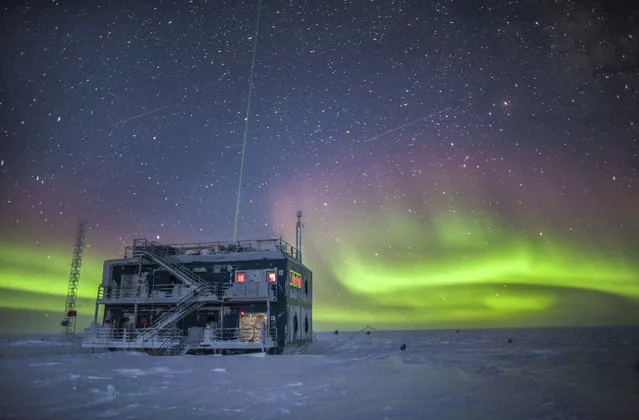
This undated photo provided by NOAA in May 2018 shows aurora australis near the South Pole Atmospheric Research Observatory in Antarctica. When a hole in the ozone formed over Antarctica, countries around the world in 1987 agreed to phase out several types of ozone-depleting chemicals called chlorofluorocarbons (CFCs). Production was banned, emissions fell and the hole shriveled. But according to a study released on Wednesday, May 16, 2018, scientists say since 2013, there’s more of a banned CFC going into the atmosphere. (Photo by Patrick Cullis/NOAA via AP Photo)

This undated photo provided by NOAA in May 2018 shows aurora australis near the South Pole Atmospheric Research Observatory in Antarctica. When a hole in the ozone formed over Antarctica, countries around the world in 1987 agreed to phase out several types of ozone-depleting chemicals called chlorofluorocarbons (CFCs). Production was banned, emissions fell and the hole shriveled. But according to a study released on Wednesday, May 16, 2018, scientists say since 2013, there’s more of a banned CFC going into the atmosphere. (Photo by Patrick Cullis/NOAA via AP Photo)
Details
15 Aug 2018 00:05:00
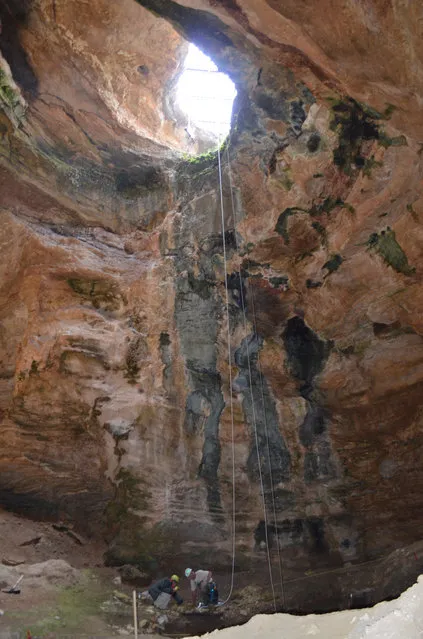
This July 2014 image provided by the Bureau of Land Management shows the interior of the Natural Trap Cave in north-central Wyoming. The cave holds the remains of tens of thousands of animals, including many now-extinct species, from the late Pleistocene period tens of thousands of years ago. Scientists have resumed digging for the first time in more than 30 years. (Photo by AP Photo/Bureau of Land Management)

This July 2014 image provided by the Bureau of Land Management shows the interior of the Natural Trap Cave in north-central Wyoming. The cave holds the remains of tens of thousands of animals, including many now-extinct species, from the late Pleistocene period tens of thousands of years ago. Scientists have resumed digging for the first time in more than 30 years. (Photo by AP Photo/Bureau of Land Management)
Details
10 Aug 2014 10:35:00
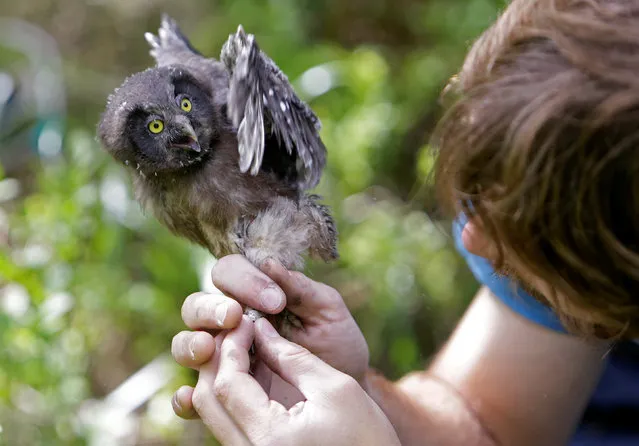
Scientist Jiri Sindelar checks a ring of a Boreal owl chick outside the “Smart Nest Box”, which allows the study of birds by using mounted cameras, in a forest near the village of Mikulov, Czech Republic, June 18, 2016. (Photo by David W. Cerny/Reuters)

Scientist Jiri Sindelar checks a ring of a Boreal owl chick outside the “Smart Nest Box”, which allows the study of birds by using mounted cameras, in a forest near the village of Mikulov, Czech Republic, June 18, 2016. (Photo by David W. Cerny/Reuters)
Details
20 Jun 2016 12:37:00
A female forest guard carries a tranquillizer gun in the Gir National Park and Wildlife Sanctuary in Sasan, in Gujarat December 2, 2014. (Photo by Anindito Mukherjee/Reuters)

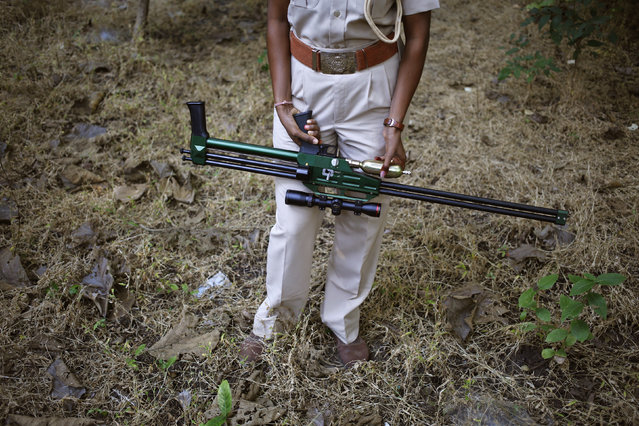
A female forest guard carries a tranquillizer gun in the Gir National Park and Wildlife Sanctuary in Sasan, in Gujarat December 2, 2014. The sanctuary, which is home to Asiatic lions in India, has an area of 1,412 sq km in which female guards were employed for the first time in India in 2007. The guards fetch a monthly salary of around $148 for working almost 12 hours a day, six days a week, said one of the female guards. (Photo by Anindito Mukherjee/Reuters)
Details
10 Dec 2014 12:37:00
Blueberry. (Photo by SPL/Barcroft Media)

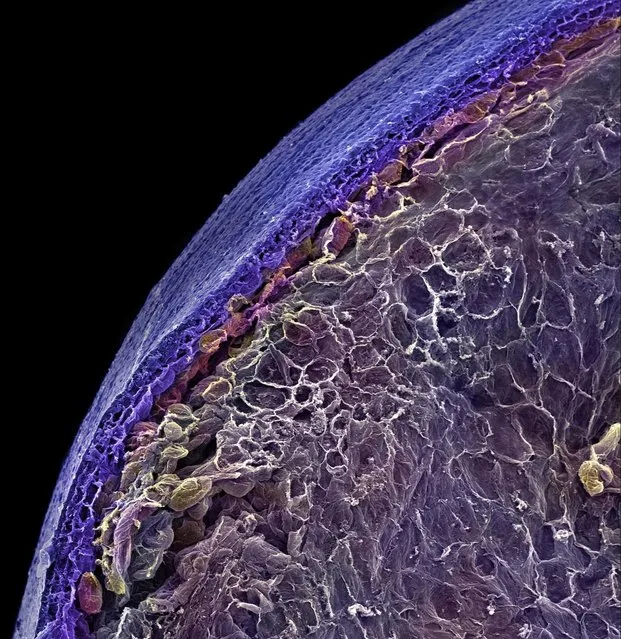
Scientists have captured these images in laboratories during research into what makes our daily food. Photo: Blueberry. (Photo by SPL/Barcroft Media)
Details
11 Oct 2013 08:10:00