Loading...
Done
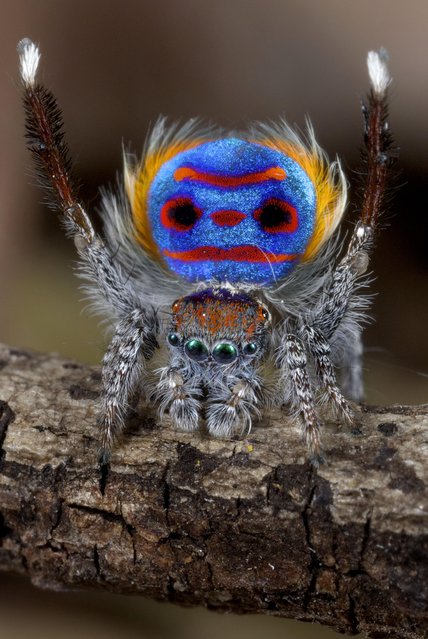
Peacock Spider Maratus Speciosus by Jurgen Otto

Maratus is a spider genus of the Salticidae family (jumping spiders). These spiders are commonly referred to as peacock spiders due to their colorful abdominal flaps that they display during courtship. In at least one species, Maratus vespertilio, the expansion of the flaps also occurs during ritualised contests between males. All described species, except M. furvus, are endemic to Australia. (Photo by Jurgen Otto)
Details
27 Feb 2014 12:20:00
Untitled installation of miniature elevators by Maurizio Cattelan

A person stands near the “Untitled” installation of miniature elevators by Maurizio Cattelan at a preview of the Postwar and Contemporary Art Evening Sale at Christie's auction house on November 4, 2011 in New York City. The 33-inch functioning elevator installation is expected to realize $400,000-$600,000 at the November 8 auction. (Photo by Mario Tama/Getty Images)
Details
05 Nov 2011 12:39:00
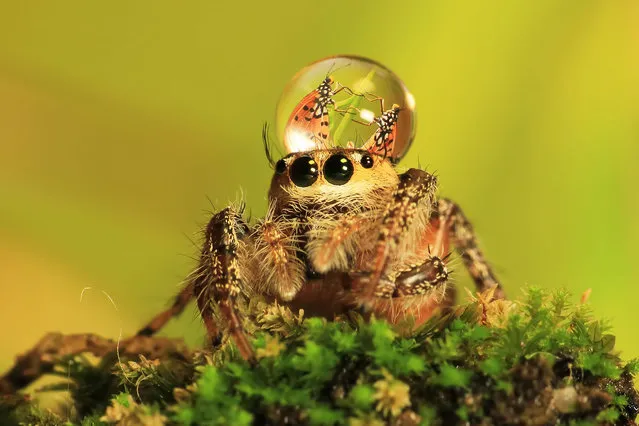
Incredible raindrops on spiders by photographer Uda Dennie

The amazing images, which show the balls of water reflecting an array of colours and even other insects, were snapped by photographer Uda Dennie in his garden. One of the massive droplets even stayed in shape for about a minute before the spider scurried off. Dennie, 33, from Batam Island, Indonesia, said: “I was really surprised to get such amazing pictures – it was really wonderful. I have a real passion for macro photography and after lots of trial and error I'm now able to produce good images – perseverance really paid off”. (Photo by Uda Dennie)
Details
28 Jul 2013 10:01:00
Model Bianca Gavrilas wears a a hand-embroidered cape made from the silk of the Golden Orb Spider in the V&A Museum's Medieval and Renaissance Gallery

Model Bianca Gavrilas wears a a hand-embroidered cape made from the silk of the Golden Orb Spider in the V&A Museum's Medieval and Renaissance Gallery on January 23, 2012 in London, England. The cape is one of two golden spider silk textiles that exist in the world, it was made in Madagascar over a period of 8 years and using the silk of silk of 1.2million spiders. (Photo by Oli Scarff/Getty Images)
Details
26 Jan 2012 12:02:00
New Zealand Fashion Week 2011 Twenty Seven Names

A model showcases designs by Twenty Seven Names in a photograph as part of New Zealand Fashion Week 2011 at a Newton Gallery on August 30, 2011 in Auckland, New Zealand. (Photo by Sandra Mu/Getty Images)
Details
30 Aug 2011 14:18:00


Senior hurricane forecaster Dr. Jack Beven studies computer models as he tracks Tropical Storm Arlene at the National Hurricane Center on June 29, 2011 in Miami, Florida. Arlene is the first named storm of the 2011 Atlantic hurricane season and is moving at 8 mph, packing sustained winds of 50 mph as it heads towards the east-central coast of Mexico. (Photo by Joe Raedle/Getty Images)
Details
30 Jun 2011 09:53:00


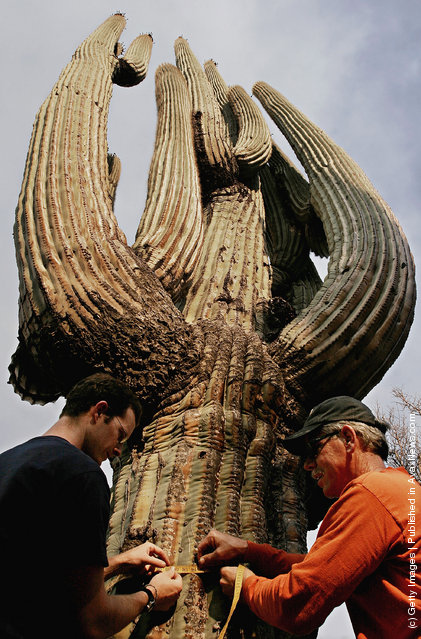
“The saguaro (scientific name Carnegiea gigantea) is a large, tree-sized cactus species in the monotypic genus Carnegiea. It is native to the Sonoran Desert in the U.S. state of Arizona, the Mexican state of Sonora, a small part of Baja California in the San Felipe Desert and an extremely small area of California, U.S. The saguaro blossom is the State Wildflower of Arizona”. – Wikipedia

Photo: Daniel Appel (L), a firefighter with Engine 84 from the Lassen National Forest in California and Mike Hallen, (R), Arizona representative of the National Register of Big Trees, measure the circumference of this Saguaro cactus called the "Grand One," in the Tonto National Forest on July 1, 2005 35 miles north of Phoenix, near Carefree, Arizona. The cactus, estimated to be more than 200 years old, measures a circumference of 7 feet, 10 inches (2.4 meters) and stands 46 feet high (14 meters). The cactus was burned in the Cave Creek Complex fire and may not survive. It was once the largest Saguaro in the world, two others have been found recently that have tied it's measurements. The fire has burned more than 214,000 acres of the Sonoran desert. (Photo by Jeff Topping/Getty Images)

Details
26 Jul 2011 12:27:00
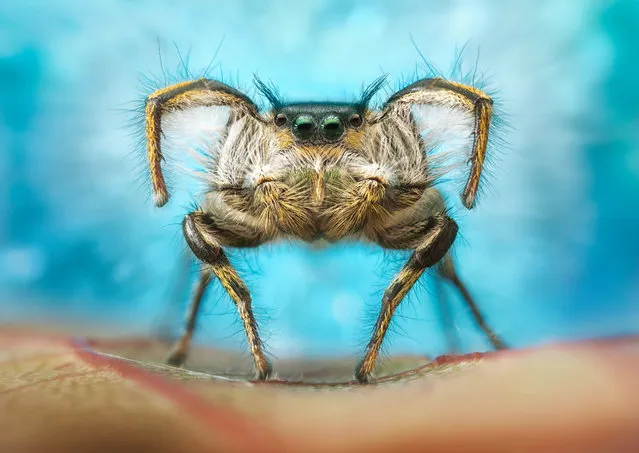
Arachnids category 3rd place: dancing spider by Raed Ammari. Male jumping spiders (in this case a Phidippus insignarius) perform a courtship dance in which they almost form a heart shape with their legs. This one was shot in Colorado. (Photo by Raed Ammari/Luminar Bug Photographer of the Year 2020)

Arachnids category 3rd place: dancing spider by Raed Ammari. Male jumping spiders (in this case a Phidippus insignarius) perform a courtship dance in which they almost form a heart shape with their legs. This one was shot in Colorado. (Photo by Raed Ammari/Luminar Bug Photographer of the Year 2020)
Details
24 Oct 2020 00:03:00