Loading...
Done


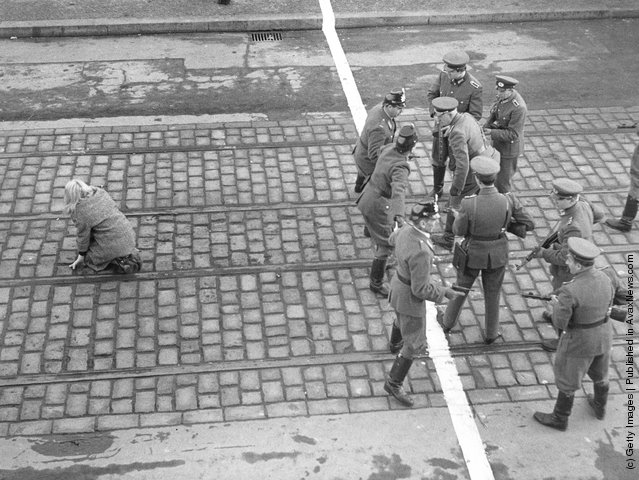
“The Berlin Wall (German: Berliner Mauer) was a barrier constructed by the German Democratic Republic (GDR, East Germany) starting on 13 August 1961, that completely cut off West Berlin from surrounding East Germany and from East Berlin. The barrier included guard towers placed along large concrete walls, which circumscribed a wide area (later known as the “death strip”) that contained anti-vehicle trenches, “fakir beds” and other defenses. The Soviet-dominated Eastern Bloc officially claimed that the wall was erected to protect its population from fascist elements conspiring to prevent the “will of the people” in building a socialist state in East Germany. However, in practice, the Wall served to prevent the massive emigration and defection that marked Germany and the communist Eastern Bloc during the post-World War II period”. – Wikipedia

Photo: West Berlin policemen and East German Volkspolizei face each other across the border in Berlin, circa 1955. (Photo by Three Lions/Hulton Archive/Getty Images)
Details
22 May 2011 10:49:00
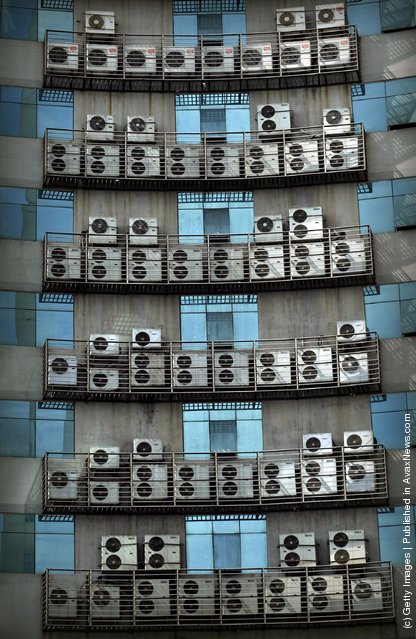
Wall Of Air Conditioners In Fuzhou

Air conditioners, more than 500 in total, hang on the wall of an office building on August 15, 2011 in Fuzhou, Fujiang Province of China. This 25-story office building was built with no central air conditioner system, each office has it own individual unit installed on the exterior creating this wall of air conditioners. (Photo by ChinaFotoPress/Getty Images)
Details
17 Aug 2011 11:12:00
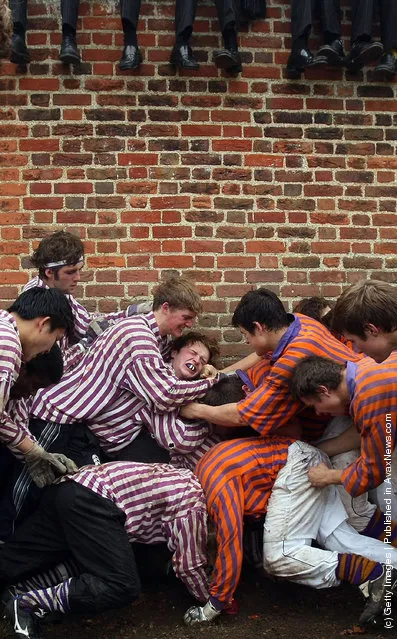
Eton Wall Game

“The Eton wall game is a game similar to football and Rugby Union, that originated from and is still played at Eton College. It is played on a strip of ground 5 metres wide and 110 metres long next to a slightly curved brick wall, erected in 1717”. – Wikipedia

Photo: The “Collegers” and the “Oppidans” of Eton College take part in the “Wall Game” as boys in their traditional school uniform watch from on top of the wall on November 17, 2007 in Eton, near Windsor, Berkshire, England. The first recorded “Wall Game” took place in 1766 with competition between the two houses at the boarding school remaining as fierce as ever on the annual St. Andrew's day event. The object of the game is to get the ball to either end of the wall and score a goal, which has not happened since 1909. As well as scoring a goal the players can win points with a “shy”, where the ball is held against the wall and touched by the hand and awarded one point. (Photo by Christopher Furlong/Getty Images)
Details
22 Sep 2011 11:01:00
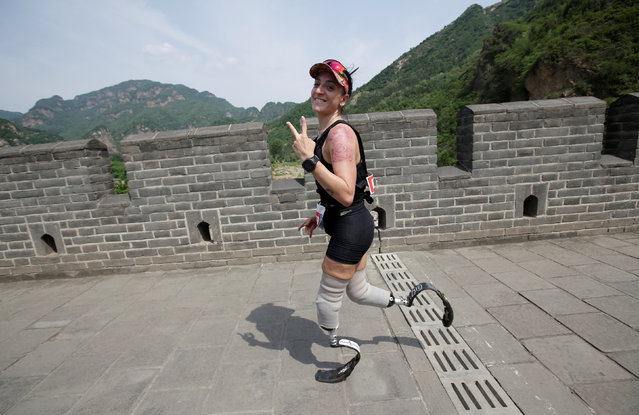
Portuguese runner Adriele Silva gestures during the Great Wall Marathon at the Huangyaguan section of the Great Wall of China, in Jixian of Tianjin, China May 19, 2018. (Photo by Jason Lee/Reuters)

Portuguese runner Adriele Silva gestures during the Great Wall Marathon at the Huangyaguan section of the Great Wall of China, in Jixian of Tianjin, China May 19, 2018. (Photo by Jason Lee/Reuters)
Details
26 May 2018 00:01:00
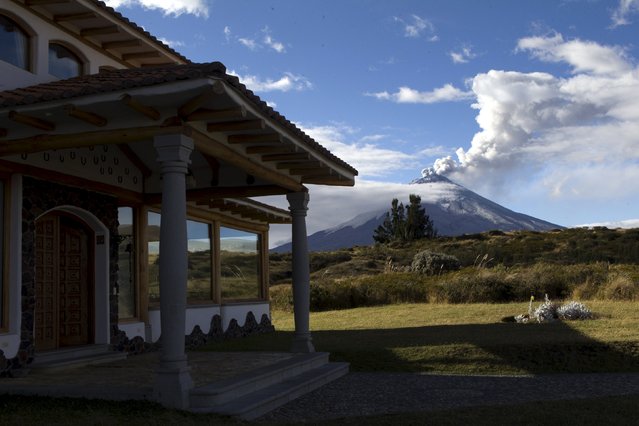
The Cotopaxi volcano, one of the world's highest active volcanoes, spews smoke as seen from El Pedregal, Ecuador, October 22, 2015. (Photo by Guillermo Granja/Reuters)

The Cotopaxi volcano, one of the world's highest active volcanoes, spews smoke as seen from El Pedregal, Ecuador, October 22, 2015. Ecuadorian authorities are monitoring activity at Cotopaxi volcano, which prompted Ecuador's President Rafael Correa to maintain a yellow alert for eruptions as bursts of ash keep spewing from the snow-encircled crater of the volcano and falling in gusts on residential communities. (Photo by Guillermo Granja/Reuters)
Details
25 Oct 2015 08:05:00
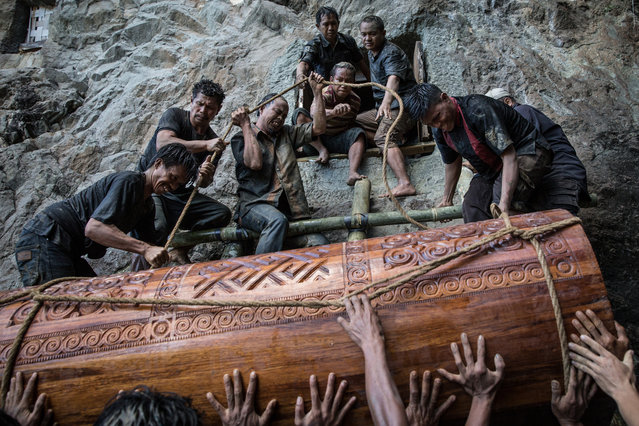
It is said that Torajans are people who “live to die”. For this Indonesian ethnic group, funerals are such extravagant events that they sometimes attract tourists. Families can postpone burials years (and the deceased are considered sick and hosted at home until the funeral) until the family can raise enough money and gather as many relatives as possible. And then it’s a jubilant multiday social event with a parade, dances and animal sacrifices. Agung Parameswara photographed these funerary practices when he traveled to South Sulawesi province, where the Torajans live. But often, their funeral isn’t the last time the dead are seen. In August, crypts are opened, coffins are slid back out and bodies delicately unsheathed. This tender ritual is known as Ma’Nene, which is customarily performed every few years. (Photo by Agung Parameswara/The Washington Post)

It is said that Torajans are people who “live to die”. For this Indonesian ethnic group, funerals are such extravagant events that they sometimes attract tourists. Families can postpone burials years (and the deceased are considered sick and hosted at home until the funeral) until the family can raise enough money and gather as many relatives as possible. And then it’s a jubilant multiday social event with a parade, dances and animal sacrifices. Agung Parameswara photographed these funerary practices when he traveled to South Sulawesi province, where the Torajans live. (Photo by Agung Parameswara/The Washington Post)
Details
06 Oct 2016 09:15:00
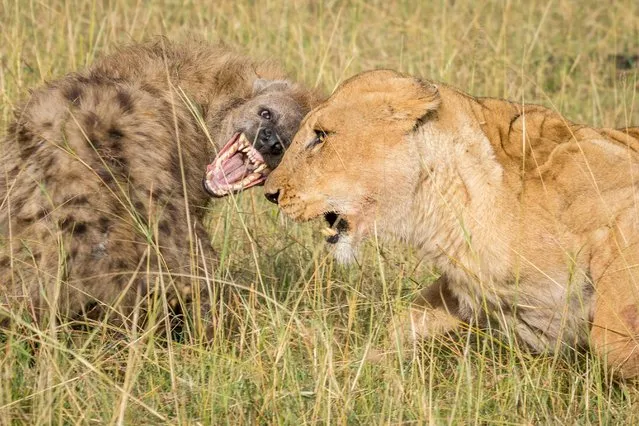
Lioness and hyena posture to one another, in Masai Mara, Kenya, August 2015. (Photo by Ingo Gerlach/Barcroft Images)

Lioness and hyena posture to one another, in Masai Mara, Kenya, August 2015. A photographer captured one of the oldest rivalries in the animal kingdom as a pair of lions went head to head with a pack of hungry hyenas. (Photo by Ingo Gerlach/Barcroft Images)
Details
18 Jan 2017 07:57:00
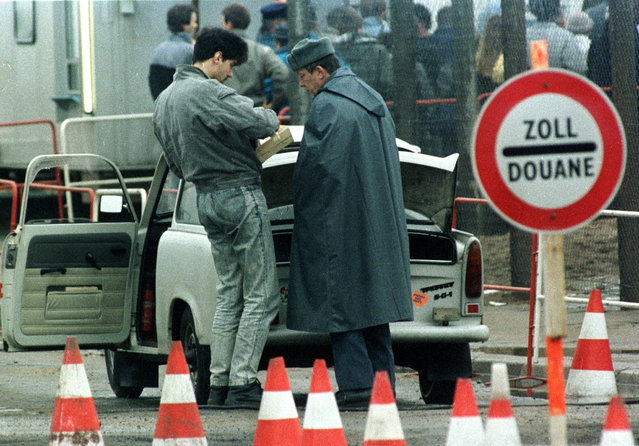
An East German civilian (L) shows an East German customs officer the contents of his Trabant (auto) at checkpoint Potsdamer Platz in East Berlin in this November 24, 1989 file picture, as East Germany enforcing stringent customs controls to avoid smuggling. (Photo by Reuters)

An East German civilian (L) shows an East German customs officer the contents of his Trabant (auto) at checkpoint Potsdamer Platz in East Berlin in this November 24, 1989 file picture, as East Germany enforcing stringent customs controls to avoid smuggling. (Photo by Reuters)
Details
04 Oct 2015 08:03:00