Loading...
Done
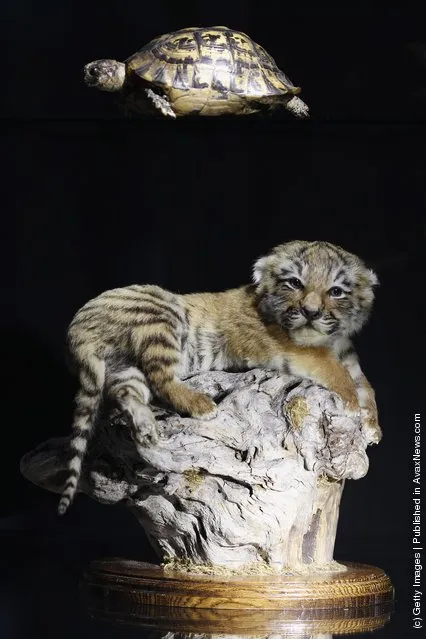
A 10 week old stuffed Tiger cub and a Tortoise

A 10 week old stuffed Tiger cub and a Tortoise are displayed in a cabinet at an “Endangered Species” exhibition at London Zoo on September 12, 2011 in London, England. The exhibition is organised by “Operation Charm”, a Metropolitan Police partnership aimed at tackling the illegal trade in endangered wildlife and runs for one month at London Zoo. Items include the tooth of a sperm whale, Ivory carvings, and a stuffed Tiger. (Photo by Dan Kitwood/Getty Images)
Details
13 Sep 2011 11:24:00
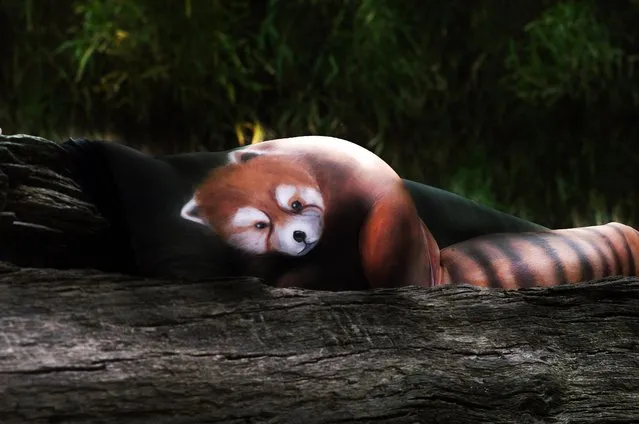
Using body paint and a woodland like location, Gesine appears to have created a model to look just like a red panda, Dortmund, Germany, October, 2016. An artist brings animals to life using body paint and contorted models. At first glance, these images could be mistaken for portraits of wildlife in their natural habitat were created with paper and paint. However, they are actually the incredible works of illusion by talented body painter Gesine Marwedel, who paints models to creates realistic animals. Marwedel, 29, from Dortmund, Germany has always been fascinated by the concept of transferring her designs to human bodies and her latest project features models posing in contorted positions. One image appears to show an elegant swan in a park pond, whilst another picture shows a mother penguin and its chick in a snowy landscape. (Photo by Gesine Marwedel/Barcroft Images)

Using body paint and a woodland like location, Gesine appears to have created a model to look just like a red panda, Dortmund, Germany, October, 2016. An artist brings animals to life using body paint and contorted models. At first glance, these images could be mistaken for portraits of wildlife in their natural habitat were created with paper and paint. However, they are actually the incredible works of illusion by talented body painter Gesine Marwedel, who paints models to creates realistic animals. (Photo by Gesine Marwedel/Barcroft Images)
Details
20 Dec 2016 12:53:00
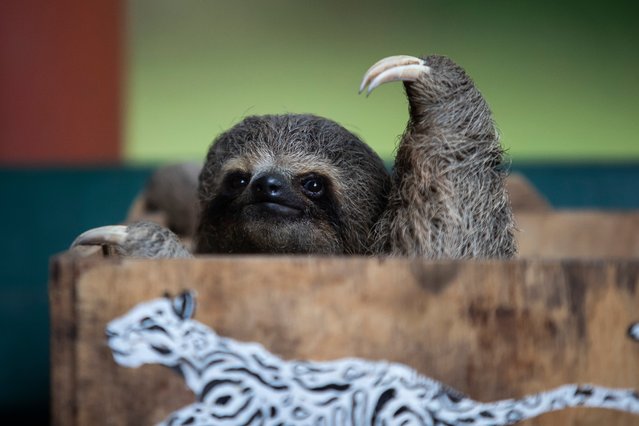
A young sloth named Gloria, that was rescued after being stolen from the wild destined for trafficking, peeks out of the box it is being taken to be released at the city's Botanical Garden in Rio de Janeiro, Brazil, Monday, March 13, 2023. Gloria was cared for by the Free Life Institute NGO that rehabilitates injured wildlife found in the surrounding Rio area and returns them, when possible, back to the wild. Those that are too injured to be released are sent to other rehab centers or sanctuaries to live out their lives in protected environments. (Photo by Bruna Prado/AP Photo)

A young sloth named Gloria, that was rescued after being stolen from the wild destined for trafficking, peeks out of the box it is being taken to be released at the city's Botanical Garden in Rio de Janeiro, Brazil, Monday, March 13, 2023. Gloria was cared for by the Free Life Institute NGO that rehabilitates injured wildlife found in the surrounding Rio area and returns them, when possible, back to the wild. Those that are too injured to be released are sent to other rehab centers or sanctuaries to live out their lives in protected environments. (Photo by Bruna Prado/AP Photo)
Details
16 Jul 2024 04:01:00
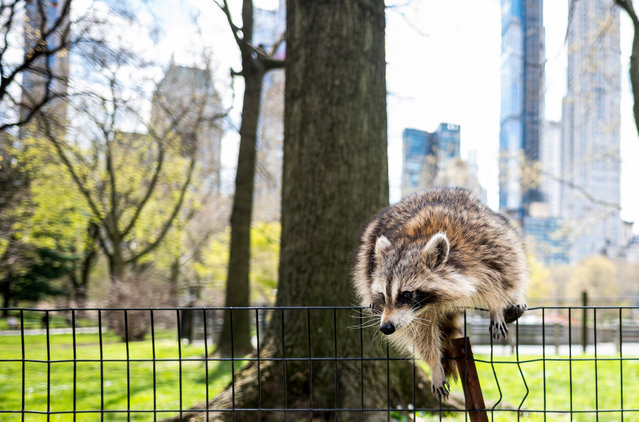
A racoon jumps over a fence in almost deserted Central Park in Manhattan on April 16, 2020 in New York City. Gone are the softball games, horse-drawn carriages and hordes of tourists. In their place, pronounced birdsong, solitary walks and renewed appreciation for Central Park's beauty during New York's coronavirus lockdown. The 843-acre (341-hectare) park – arguably the world's most famous urban green space – normally bustles with human activity as winter turns to spring, but this year due to Covid-19 it's the wildlife that is coming out to play. (Photo by Johannes Eisele/AFP Photo)

A racoon jumps over a fence in almost deserted Central Park in Manhattan on April 16, 2020 in New York City. Gone are the softball games, horse-drawn carriages and hordes of tourists. In their place, pronounced birdsong, solitary walks and renewed appreciation for Central Park's beauty during New York's coronavirus lockdown. The 843-acre (341-hectare) park – arguably the world's most famous urban green space – normally bustles with human activity as winter turns to spring, but this year due to Covid-19 it's the wildlife that is coming out to play. (Photo by Johannes Eisele/AFP Photo)
Details
14 Dec 2025 07:04:00
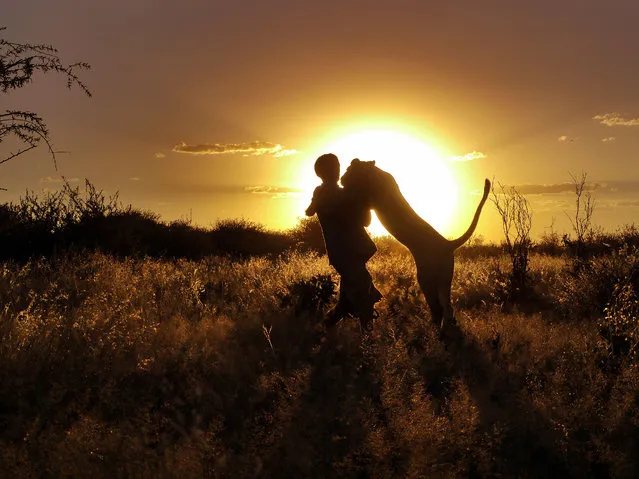
These heart-warming photograph show an incredible bond between a wild lioness and the men fighting to save her species. The picture show Sirga – a 110lb lioness – and her adopted pride Valentin Gruener (not pictured) and Mikkel Legarth. Incredibly she treats the two men just like she would other lions and with their help she can now hunt for prey on her own. (Photo by Caters News)

These heart-warming photograph show an incredible bond between a wild lioness and the men fighting to save her species. The picture show Sirga – a 110lb lioness – and her adopted pride Valentin Gruener (not pictured) and Mikkel Legarth. Incredibly she treats the two men just like she would other lions and with their help she can now hunt for prey on her own. As a cub she was driven out from a pride and rescued by German and Danish duo Valentin and Mikkel who could not stand by and watch her die. She is now a beacon for hoped success of the Modisa Wildlife Project, founded in Botswana, Africa, by Valentin and Mikkel with the hope of saving the lion population. (Photo by Caters News)
Details
27 Apr 2014 09:36:00
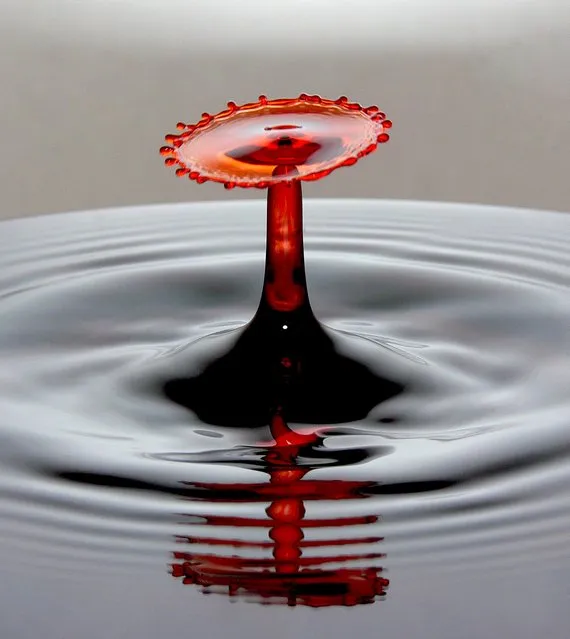
Waterdrop Sculptures by Josh Fancher

“I'm Josh Fancher, a 21 year old with an avid interest in photography, including macro, nature and wildlife, night photography, landscapes, cityscapes and architectural photography. Inspired by the beautiful and amazing water drop photography of Martin Waugh, I started doing water drop collisions in December of 2007. I use a 105mm Micro Nikkor lens for water drops, along with a pair of Nikon SB 600 flashes. I recently got a StopShot system (Nov 2009), which makes timing a lot easier. Before then, timing was manual, with an eye dropper, eye-hand coordination, and a lot of patience” – Josh Fancher. (Photo by Josh Fancher)
Details
19 Aug 2012 10:30:00
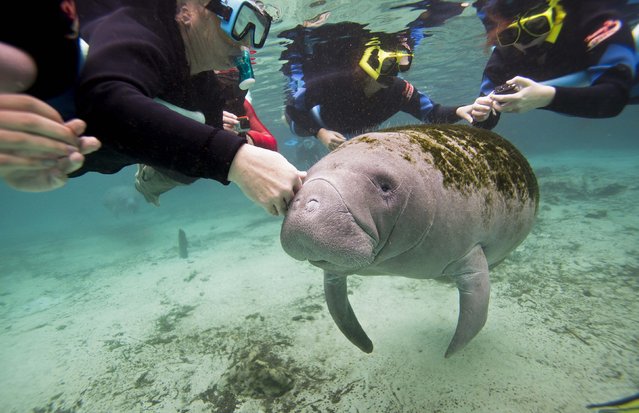
Snorkelers interact with a Florida Manatee inside of the Three Sisters Springs in Crystal River, Florida January 15, 2015. On winter days, Florida manatees flock by the hundreds to the balmy waters of Three Sisters Springs, drawing crowds of snorkelers and kayakers to the U.S. sanctuary, where people may swim with the endangered species. (Photo by Scott Audette/Reuters)

Snorkelers interact with a Florida Manatee inside of the Three Sisters Springs in Crystal River, Florida January 15, 2015. On winter days, Florida manatees flock by the hundreds to the balmy waters of Three Sisters Springs, drawing crowds of snorkelers and kayakers to the U.S. sanctuary, where people may swim with the endangered species. But as tolerant as the gentle, whiskered sea giants can be of the accidental kicks and splashes of delighted tourists, wild life regulators want to ban most canoes and paddle boards and create people-free zones to protect the wintering “sea cow”. Proposed limitations for this winter are awaiting approval by the U.S. Fish and Wildlife Service. (Photo by Scott Audette/Reuters)
Details
22 Jan 2015 13:34:00
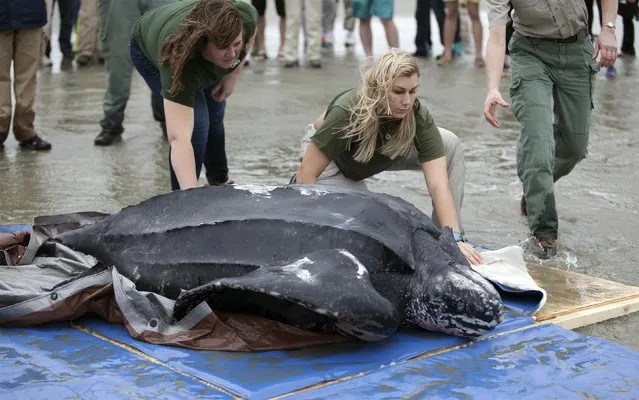
Biologists Jenna Cormany (L) and Lauryn Wright of the South Carolina Department of Natural Resources help to release a leatherback turtle in Isle of Palms, South Carolina March 12, 2015. (Photo by Randall Hill/Reuters)

Biologists Jenna Cormany (L) and Lauryn Wright of the South Carolina Department of Natural Resources help to release a leatherback turtle in Isle of Palms, South Carolina March 12, 2015. The 475-pound turtle was the first living leatherback turtle to be recovered in South Carolina and one of only a handful ever treated at rehabilitation facilities in the United States. It was found March 7 on the beach on Yawkey-South Island Reserve, a 3.5-mile-long (5.6-km-long) barrier island and wildlife preserve near Georgetown, South Carolina. (Photo by Randall Hill/Reuters)
Details
14 Mar 2015 13:32:00