Loading...
Done
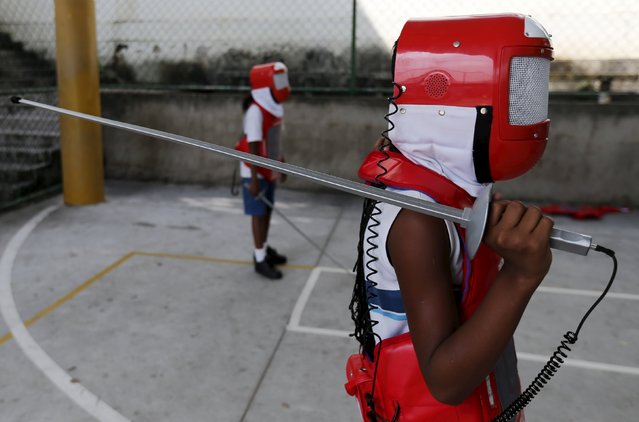
A child, from Municipal school Parana, poses during the project “Fencing School” in Rio de Janeiro, Brazil, March 30, 2016. (Photo by Sergio Moraes/Reuters)

A child, from Municipal school Parana, poses during the project “Fencing School” in Rio de Janeiro, Brazil, March 30, 2016. Children in Rio de Janeiro lift their sights and their swords to new idols, as a round of fencing workshops takes to public schools. The International Fencing Federation, together with the Brazilian and state federations, will reach 40 public schools in March and April. The aim is to whip up a following for the Olympic sport, little known in the soccer-mad nation, as Rio sets the stage for the Summer Games in August. (Photo by Sergio Moraes/Reuters)
Details
02 Apr 2016 09:25:00
A mahout decorates his elephant using chalk while preparing for the Elephant Festival at Sauraha in Chitwan, south of Kathmandu, December 26, 2014. (Photo by Navesh Chitrakar/Reuters)

A mahout (a person who rides an elephant) decorates his elephant using chalk while preparing for the Elephant Festival at Sauraha in Chitwan, south of Kathmandu, December 26, 2014. Elephants and mahouts from Chitwan will participate in the Elephant festival, which involves elephant races, elephants playing an exhibition soccer match and taking part in various other sporting activities. The event will start from 26 December and will end on 30 December, 2014. (Photo by Navesh Chitrakar/Reuters)
Details
28 Dec 2014 11:38:00
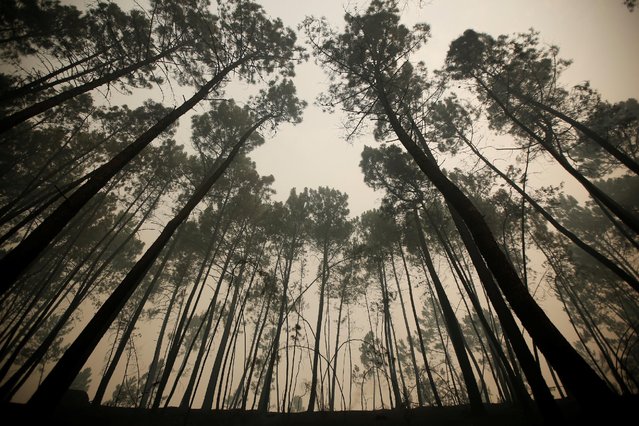
Pine trees are seen after a forest fire near Sao Pedro do Sul, Portugal August 14, 2016. (Photo by Rafael Marchante/Reuters)

Pine trees are seen after a forest fire near Sao Pedro do Sul, Portugal August 14, 2016. Deadly wildfires raging for two weeks in Portugal have destroyed a wooded area the size of 100,000 soccer fields, and the small Iberian nation alone accounts for half of all forests burned in the European Union this year. (Photo by Rafael Marchante/Reuters)
Details
17 Aug 2016 11:07:00
Kenyan women protest for the right to wear whichever clothes they want, at a demonstration in downtown Nairobi, Kenya Monday, November 17, 2014. (Photo by Ben Curtis/AP Photo)

Kenyan women protest for the right to wear whichever clothes they want, at a demonstration in downtown Nairobi, Kenya Monday, November 17, 2014. A recent incident in which a mob of men surrounded a woman and tore her clothes off, leaving her naked on the street in front of a bus stop after alleging that she was improperly dressed, is one of several such videos that have surfaced online in recent days leading to a groundswell of anger that on Monday prompted around 1000 demonstrators, including a number of men supporting the women's cause, to march through the capital and protest online using the hashtag #MyDressMyChoice. (Photo by Ben Curtis/AP Photo)
Details
18 Nov 2014 11:50:00
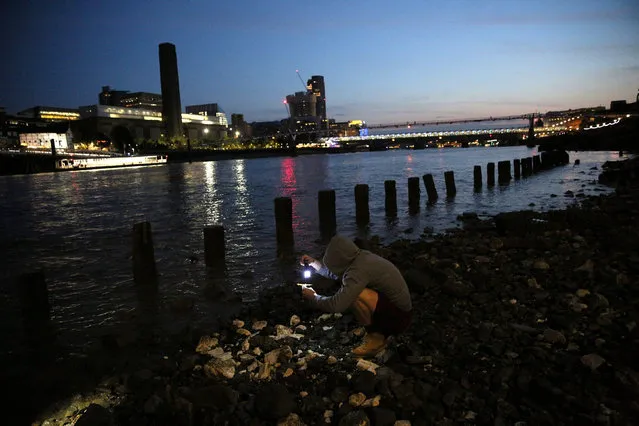
A mudlark uses a torch to look for items on the bank of the River Thames in London, Britain June 06, 2016. Mudlarking is believed to trace its origins to the 18th and 19th century, when scavengers searched the Thames' shores for items to sell. These days, history and archaeology fans are the ones hoping to find old relics such as coins, ceramics, artifacts or everyday items from across centuries. They wait for the low tide and then scour specific areas of exposed shores. "If you're in a field you could be out all day long, with the river you're restricted to about two or three hours," mudlark Nick Stevens said. While many just use the naked eye for their searches, others rely on metal detectors for which a permit from the Port of London Authority is needed. Digging also requires consent. (Photo by Neil Hall/Reuters)

A mudlark uses a torch to look for items on the bank of the River Thames in London, Britain June 06, 2016. Mudlarking is believed to trace its origins to the 18th and 19th century, when scavengers searched the Thames' shores for items to sell. These days, history and archaeology fans are the ones hoping to find old relics such as coins, ceramics, artifacts or everyday items from across centuries. their finds with the Portable Antiquities Scheme. Any item over 300 years old must be recorded. (Photo by Neil Hall/Reuters)
Details
27 Aug 2016 10:43:00
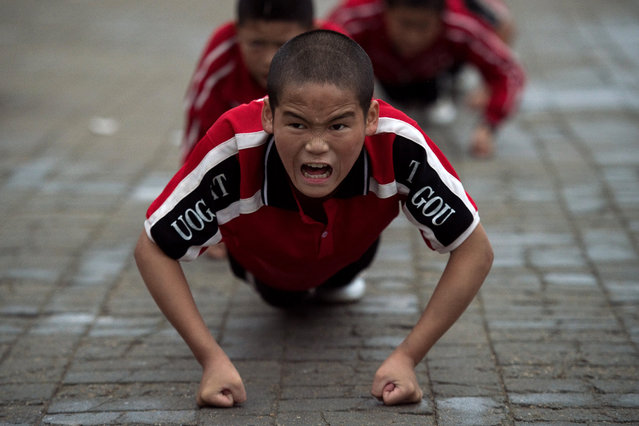
This picture taken on October 20, 2016 shows students practising wushu at the Tagou martial arts school in Dengfeng. China is investing hugely in football training and has vowed to have 50 million school- age players by 2020, as the ruling Communist party eyes “football superpower” status by 2050. Some 1,500 students from the vast Tagou martial arts school, a few miles from the cradle of Chinese kungfu, the Shaolin Temple in Henan province, have signed up for its new soccer programme, centred on a pristine green Astroturf football pitch where dozens of children play simultaneous five- a- side- games. (Photo by Nicolas Asfouri/AFP Photo)

This picture taken on October 20, 2016 shows students practising wushu at the Tagou martial arts school in Dengfeng. China is investing hugely in football training and has vowed to have 50 million school- age players by 2020, as the ruling Communist party eyes “football superpower” status by 2050. (Photo by Nicolas Asfouri/AFP Photo)
Details
01 Dec 2016 12:50:00
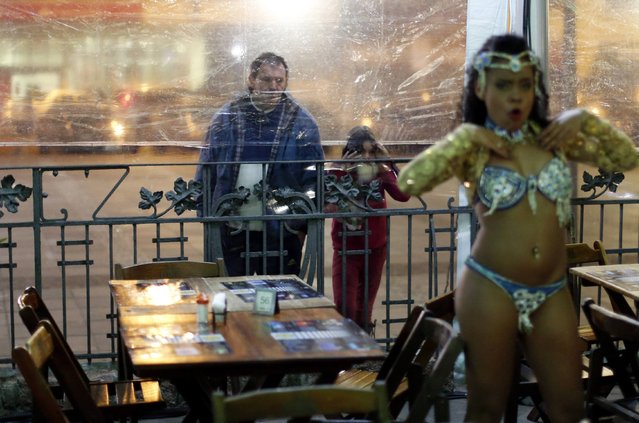
People watch from outside as a dancer performs inside a bar in Porto Alegre June 21, 2014. In a project called “On The Sidelines” Reuters photographers share pictures showing their own quirky and creative view of the 2014 World Cup in Brazil. (Photo by Marko Djurica/Reuters)

As national soccer teams and the photographers who have been covering them start to trickle home from the Brazil World Cup, it’s time to revisit the “On the Sidelines” project. This Reuters Pictures project was billed as a chance for photographers to share “their own quirky and creative view of the World Cup”. Photo: People watch from outside as a dancer performs inside a bar in Porto Alegre June 21, 2014. In a project called “On The Sidelines” Reuters photographers share pictures showing their own quirky and creative view of the 2014 World Cup in Brazil. (Photo by Marko Djurica/Reuters)
Details
09 Jul 2014 13:04:00
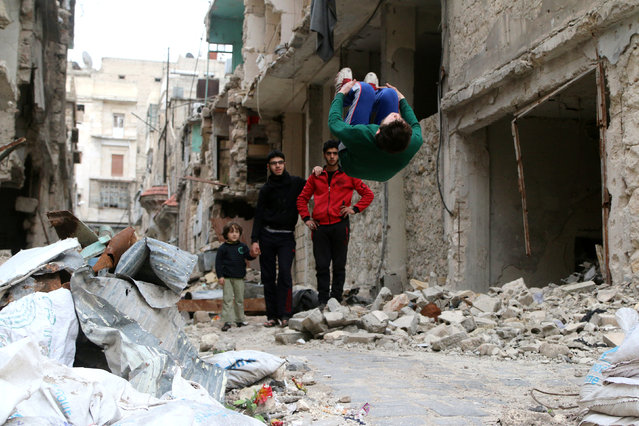
Gymnast Ahmad al-Sawas performs gymnastic moves near damaged buildings in the rebel-held Bustan al-Qasr neighbourhood of Aleppo, Syria March 26, 2016. As Syrian gymnast Ahmad al-Sawas watched his country fall apart, his Olympic dream collapsed too. The last national champion before the fighting began, he knew that supporting the anti-government side in the five-year-old civil war would prevent him from being selected for the Rio Games. “I chose to be an athlete who participates in the revolution”, said Ahmad, who trains where he can for two hours a day – be it on a mattress on a soccer field, in a local hall or somersaulting off a wall. (Photo by Abdalrhman Ismail/Reuters)

Gymnast Ahmad al-Sawas performs gymnastic moves near damaged buildings in the rebel-held Bustan al-Qasr neighbourhood of Aleppo, Syria March 26, 2016. As Syrian gymnast Ahmad al-Sawas watched his country fall apart, his Olympic dream collapsed too. The last national champion before the fighting began, he knew that supporting the anti-government side in the five-year-old civil war would prevent him from being selected for the Rio Games. (Photo by Abdalrhman Ismail/Reuters)
Details
05 Aug 2016 13:25:00