Loading...
Done
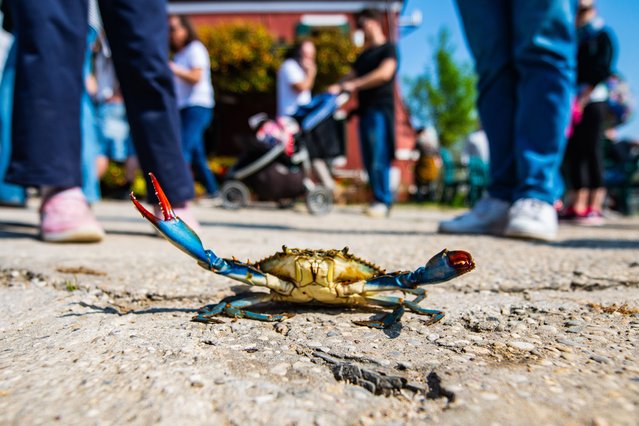
A blue crab, a highly invasive alien species, is seen at Lio Piccolo during the reforestation day on April 05, 2025 in Venice, Italy. The island of Lio Piccolo in the northern lagoon of Venice is being replanted with 16,000 new trees that will protect the salt marsh ecosystem that is fundamental to the natural health of Venice and the lagoon by WOWnature project, an Etifor initiative. (Photo by Simone Padovani/Getty Images)

A blue crab, a highly invasive alien species, is seen at Lio Piccolo during the reforestation day on April 05, 2025 in Venice, Italy. The island of Lio Piccolo in the northern lagoon of Venice is being replanted with 16,000 new trees that will protect the salt marsh ecosystem that is fundamental to the natural health of Venice and the lagoon by WOWnature project, an Etifor initiative. (Photo by Simone Padovani/Getty Images)
Details
20 Apr 2025 02:43:00
Drawing By Anne London

Anne London found her focus at the age of 19 while working for Tippi Hedren, founder of Shambala , a refuge for big cats, elephants and other species located in California. There, as she walked among the animals, she realized that the commercial art field was not for her, and she dedicated her life to bringing about awareness of the plight of endangered wildlife across the globe, and raising money for conservation efforts.
Details
29 May 2014 06:59:00
Conaster Iongimanus AKA The Icon Star Or Double Star

Iconaster longimanus, the icon star or double star, is a species of starfish in the family Goniasteridae. It is found in the west and central Indo-Pacific Ocean. The genus name comes from the Greek eikon, meaning portrait or image and possibly referring to the way the marginal plates frame the disc, and aster, meaning star. The specific name comes from the Latin longus manus and refers to the long, slender arms.
Details
14 Jul 2014 12:50:00


Emily Hasler, an English Heritage employee at Charles Darwin's home, Down House, cleans a rabbit bone in his old study on April 2, 2011 in Downe, England. Staff at the house are cleaning and preparing the property ahead of their peak visitor season. The house contains the study where Darwin wrote “On the Origin of Species”, as well as family rooms and an extensive garden that inspired the renowned scientist. (Photo by Oli Scarff/Getty Images)
Details
03 Apr 2011 07:17:00
Mikki Yao with an Asian Elephant. (Photo by Sean Lee-Davies/Caters News)

These poignant portraits look to shine awareness on the plight of some of the world’s most endangered ecosystems and species of wildlife. The images combine animals, art and celebrity, with Asia's top models posing with the likes of rhinos, giraffes, leopards and marine life. Here: Mikki Yao with an Asian Elephant. (Photo by Sean Lee-Davies/Caters News)
Details
30 Nov 2015 08:04:00
Impossible Animals By Jan Oliehoek. Part1

We’re showcasing photo-manipulation by Jan Oliehoek, a Dutch artist with a love for animals, photography and Photoshop. Oliehoek loves creating animal species that somehow never made it into our biology books, such as felines with rodent heads, lambs with the body of a squirrel, zebra rhinos and hippo-frogs! He’s currently having two of his pictures featured in Crazy Photography, an upcoming title from Vivays Publishing
Details
23 May 2013 11:34:00


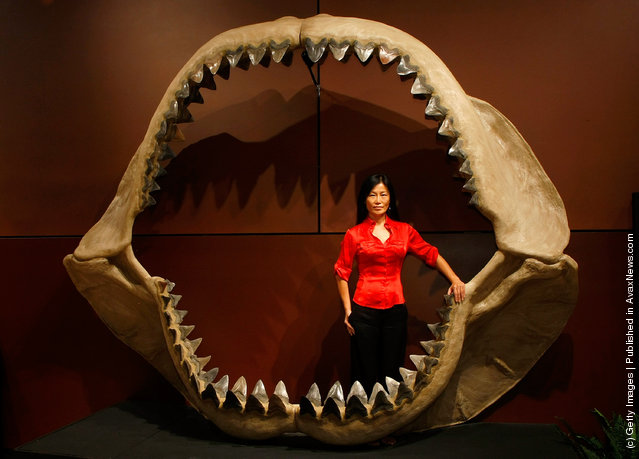
Enya Kim from the Natural History department at auctioneers Bonhams & Butterfields stands in front of one of the world's largest set of shark jaws comprised of about 180 fossil teeth from the prehistoric species, Carcharocles megalodon, which grew to the size of a school bus, at the Venetian Resort Hotel Casino September 30, 2009 in Las Vegas, Nevada. (Photo by Ethan Miller/Getty Images)
Details
19 Apr 2011 10:05:00
An artist's impression of a growing supermassive black hole located in the early Universe is seen in this NASA handout illustration released on June 15, 2011. Using the deepest X-ray image ever taken, astronomers found the first direct evidence that massive black holes were common in the early universe. This discovery from NASA's Chandra X-Ray Observatory shows that very young black holes grew more aggressively than previously thought, in tandem with the growth of their host galaxies. (Photo by Reuters/NASA/Chandra X-Ray Observatory/A.Hobart)

An artist's impression of a growing supermassive black hole located in the early Universe is seen in this NASA handout illustration released on June 15, 2011. Using the deepest X-ray image ever taken, astronomers found the first direct evidence that massive black holes were common in the early universe. This discovery from NASA's Chandra X-Ray Observatory shows that very young black holes grew more aggressively than previously thought, in tandem with the growth of their host galaxies. (Photo by Reuters/NASA/Chandra X-Ray Observatory/A.Hobart)
Details
11 Feb 2016 12:57:00