Loading...
Done
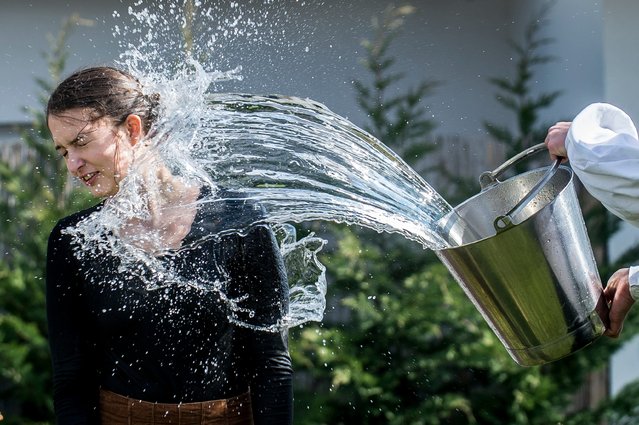
Members of the Mayossa folk dance group pour water on a young woman in Kiskunmajsa, Hungary on April 2, 2018. According to an old Hungarian tradition, celebrated for several hundred years, young men pour water on young women, who in exchange present their sprinklers with beautifully colored eggs on Easter Monday. (Photo by Sandor Ujvari/EPA/EFE/Rex Features/Shutterstock)

Members of the Mayossa folk dance group pour water on a young woman in Kiskunmajsa, Hungary on April 2, 2018. According to an old Hungarian tradition, celebrated for several hundred years, young men pour water on young women, who in exchange present their sprinklers with beautifully colored eggs on Easter Monday. (Photo by Sandor Ujvari/EPA/EFE/Rex Features/Shutterstock)
Details
08 Apr 2018 07:48:00
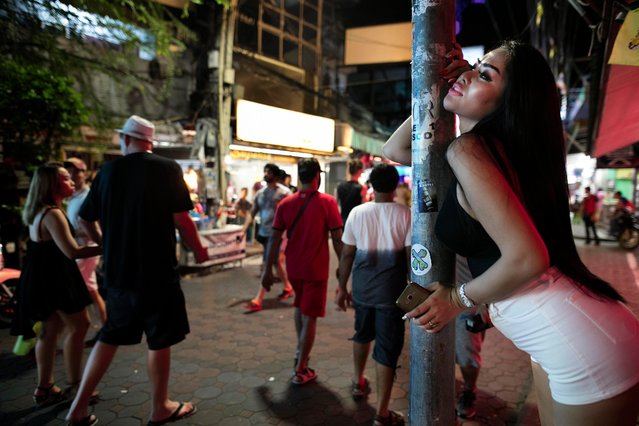
A bar girl shows off her sexual desires along the Walking Street where bars and s*x scenes are a commonplace July 31, 2016 in Pattaya, Thailand. Thailand's first female minister of tourism would like the s*x trade that is a huge business in the country to be banned. Tourists flock to Thailand for many sights including beautiful beaches but also for s*x tourism. Cities like Bangkok and Pattaya are well known as hubs of the Southeast Asian s*x trade, despite the fact that prostitution has been illegal in Thailand since 1960. (Photo by Paula Bronstein/Getty Images)

A bar girl shows off her sexual desires along the Walking Street where bars and sеx scenes are a commonplace July 31, 2016 in Pattaya, Thailand. Thailand's first female minister of tourism would like the sеx trade that is a huge business in the country to be banned. Tourists flock to Thailand for many sights including beautiful beaches but also for sеx tourism. Cities like Bangkok and Pattaya are well known as hubs of the Southeast Asian sеx trade, despite the fact that prostitution has been illegal in Thailand since 1960. (Photo by Paula Bronstein/Getty Images)
Details
06 May 2018 00:01:00
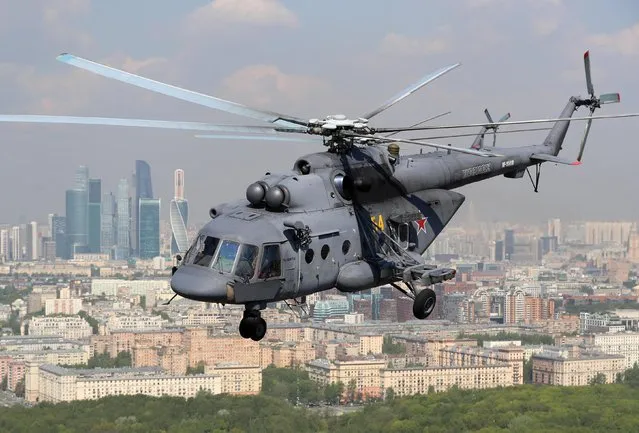
Mil Mi-8 combat helicopter flies over Moscow, Russia on May 7, 2019 during the dress rehearsal of a Victory Day air show marking the 74th anniversary of the victory over Nazi Germany in the 1941-1945 Great Patriotic War, the Eastern Front of World War II. (Photo by Sergei Savostyanov/TASS)

Mil Mi-8 combat helicopter flies over Moscow, Russia on May 7, 2019 during the dress rehearsal of a Victory Day air show marking the 74th anniversary of the victory over Nazi Germany in the 1941-1945 Great Patriotic War, the Eastern Front of World War II. (Photo by Sergei Savostyanov/TASS)
Details
09 May 2019 00:07:00
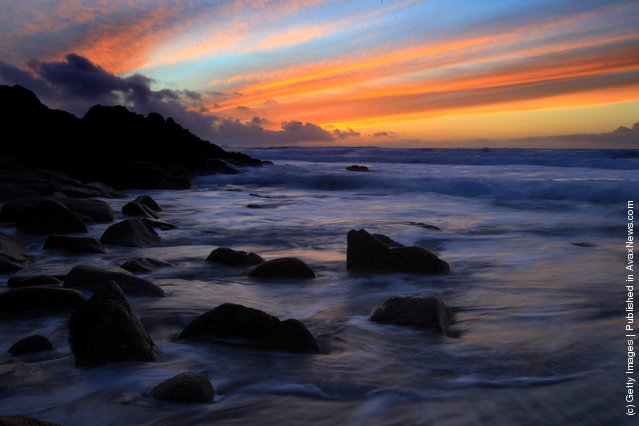
Beautiful Sunset in Cornwall

The sun sets over the sea looking towards Lands End viewed from Gwenver beach near Sennen Cove on February 7, 2011 in Cornwall, England. (Photo by Matt Cardy/Getty Images)
Details
22 Sep 2011 12:34:00
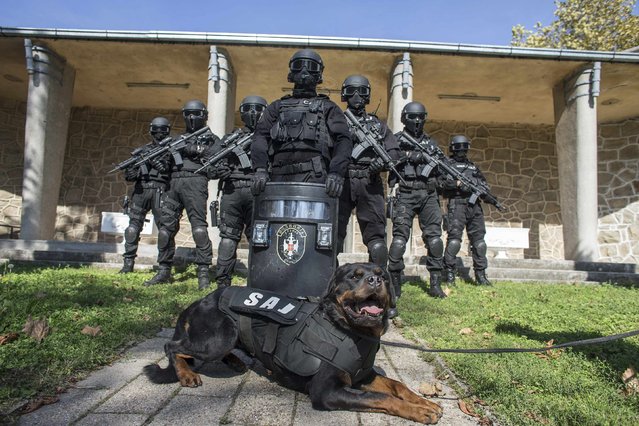
Serbian police officers of the Special Anti-Terrorist Unit pose for a picture in their base outside Belgrade October 8, 2014. (Photo by Marko Djurica/Reuters)

Serbian police officers of the Special Anti-Terrorist Unit pose for a picture in their base outside Belgrade October 8, 2014. When the killing of an unarmed black teenager by a white policeman in Ferguson, Missouri, in August sparked sometimes violent protests, the response of police in camouflage gear and armoured vehicles wielding stun grenades and assault rifles seemed more like a combat operation than a public order measure. Some U.S. police departments have recently acquired U.S. military-surplus hardware from wars abroad, but there are many law enforcers around the world whose rules of engagement also allow the use of lethal force with relatively few restrictions. But for every regulation that gives police wide scope to use firearms, there is another code that sharply limits their use. In Serbia, police may use measures ranging from batons to special vehicles, water cannon and tear gas on groups of people who have gathered illegally and are behaving in a way that is violent or could cause violence, but they may use firearms only when life is endangered. (Photo by Marko Djurica/Reuters)
Details
27 Nov 2014 14:53:00
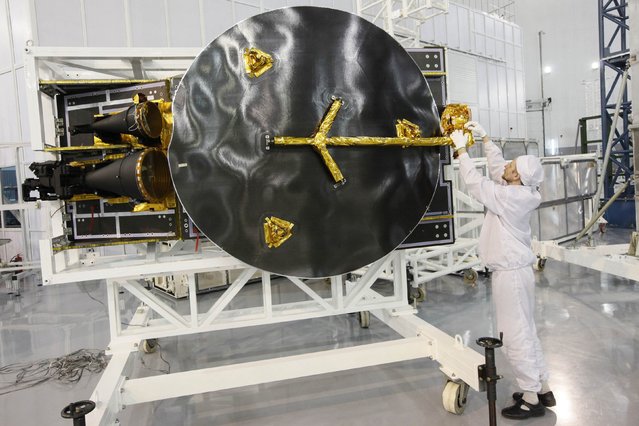
Engineer Mikhail Venin works on an antenna for the Express AM8 new generation geostationary telecommunications heavy satellite at the large-sized transformed mechanical systems centre of the Reshetnev Information Satellite Systems company in the Siberian town of Zheleznogorsk April 2, 2014. (Photo by Ilya Naymushin/Reuters)

Engineer Mikhail Venin works on an antenna for the Express AM8 new generation geostationary telecommunications heavy satellite at the large-sized transformed mechanical systems centre of the Reshetnev Information Satellite Systems company in the Siberian town of Zheleznogorsk April 2, 2014. The Express AM6 is a new generation satellite providing services including Russian governmental and presidential mobile communication, digital television and broadcasting, according to the Reshetnev company representatives. (Photo by Ilya Naymushin/Reuters)
Details
05 May 2014 09:18:00
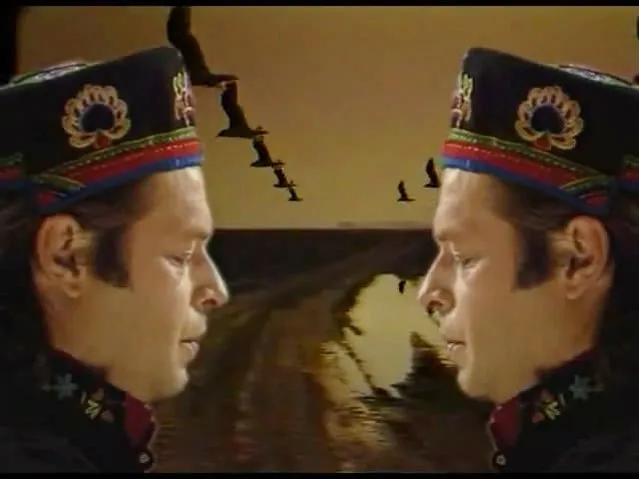
Moscow october by «Aquarium»

“Aquarium or Akvarium (Russian: Аквариум) is a Russian rock group, formed in Leningrad in 1972 by Boris Grebenshchikov (Борис Гребенщиков), then a student of Applied Mathematics at Leningrad State University, and Anatoly (George) Gunitsky, then a playwright and absurdist poet”. – Wikipedia
Details
16 Jun 2012 14:02:00
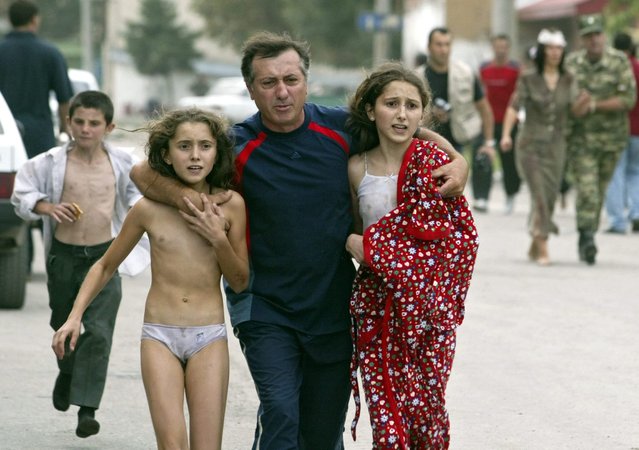
A man assists two young hostages who managed to escape from the school building after special forces entered the school in Beslan, North Ossetia, Friday 03 September 2004. Streams of hostages fled the besieged school in Beslan in southern Russia Friday amid intensive shooting and a series of powerful explosions that signalled a bloody end to the three-day stand-off with terrorists. (Photo by Yuri Kochetkov/EPA)

On September 1, 2004, Chechen militants stormed an elementary school in the town of Beslan in the Russian republic of North Ossetia. They took 1,100 teachers, children, and their relatives hostage, demanding the withdrawal of federal forces from Chechnya as a condition for their release. On September 3, 2004, Russian security forces stormed the building, resulting in a battle in which more than 330 hostages died, including 186 children. Here: A man assists two young hostages who managed to escape from the school building after special forces entered the school in Beslan, North Ossetia, Friday 03 September 2004. (Photo by Yuri Kochetkov/EPA)
Details
25 Sep 2017 06:41:00