Loading...
Done
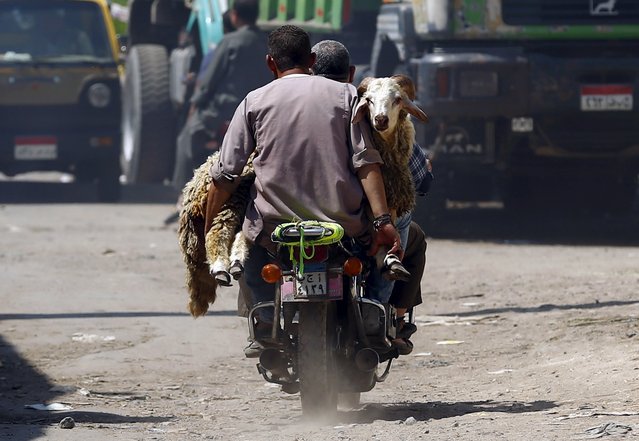
Men transport a sheep on their motorcycle after buying it at an old cattle market named “Al Emam Market” ahead of the Muslim festival Eid al-Adha in Cairo, Egypt, September 19, 2015. Muslims across the world are preparing to celebrate the annual festival of Eid al-Adha or the Festival of Sacrifice, which marks the end of the annual hajj pilgrimage, by slaughtering goats, sheep. (Photo by Amr Abdallah Dalsh/Reuters)

Men transport a sheep on their motorcycle after buying it at an old cattle market named “Al Emam Market” ahead of the Muslim festival Eid al-Adha in Cairo, Egypt, September 19, 2015. Muslims across the world are preparing to celebrate the annual festival of Eid al-Adha or the Festival of Sacrifice, which marks the end of the annual hajj pilgrimage, by slaughtering goats, sheep, cows and camels in commemoration of the Prophet Abraham's readiness to sacrifice his son to show obedience to Allah. (Photo by Amr Abdallah Dalsh/Reuters)
Details
22 Sep 2015 08:05:00
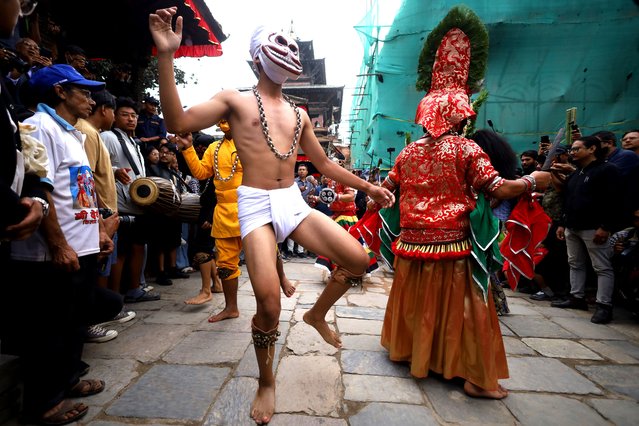
Masked dancers perform a ritualistic dance at Kathmandu Durbar Square during the procession of erecting a sacred pole locally called “Ya: Shi”, marking the formal start of Indra Jatra dedicated to rain god Indra in Kathmandu, Nepal, on September 15, 2024. The festival lasts for eight days with singing, mask dancing, and other rituals. Indra Jatra festival falls on the fourth day of the waxing moon in the month of Bhadra as per the lunar calendar. Legends say that the Indra Jatra festival observes the victory of the gods over the demons to release Jayanta, the son of Lord Indra. Indra, the god of rain, is worshiped in this festival primarily celebrated by the Newar communities following both Hinduism and Buddhism. (Photo by Subaas Shrestha/NurPhoto/Rex Features/Shutterstock)

Masked dancers perform a ritualistic dance at Kathmandu Durbar Square during the procession of erecting a sacred pole locally called “Ya: Shi”, marking the formal start of Indra Jatra dedicated to rain god Indra in Kathmandu, Nepal, on September 15, 2024. (Photo by Subaas Shrestha/NurPhoto/Rex Features/Shutterstock)
Details
24 Sep 2024 03:27:00
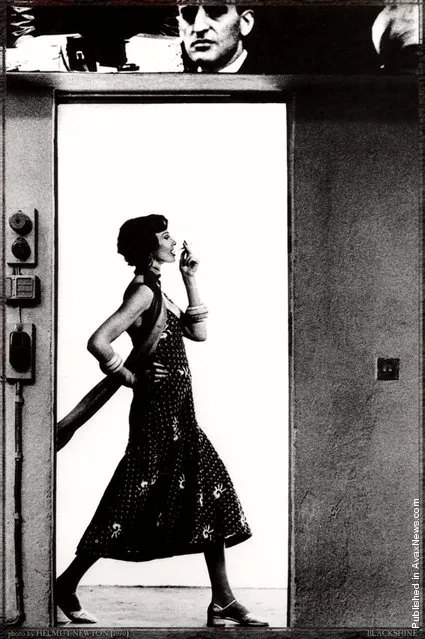
Photographers: Helmut Newton

“Newton was born in Berlin, the son of Klara “Claire” (Marquis) and Max Neustädter, a button factory owner. His family was Jewish. Newton attended the Heinrich-von-Treitschke-Realgymnasium and the American School in Berlin. Interested in photography from the age of 12 when he purchased his first camera, he worked for the German photographer Yva (Elsie Neulander Simon) from 1936. The increasingly oppressive restrictions placed on Jews by the Nuremberg laws meant that his father lost control of the factory in which he manufactured buttons and buckles; he was briefly interned in a concentration camp on “Kristallnacht”, November 9, 1938, which finally compelled the family to leave Germany. Newton's parents fled to South America. He was issued with a passport just after turning 18, and left Germany on December 5, 1938. At Trieste he boarded the “Conte Rosso” (along with about 200 others escaping the Nazis) intending to journey to China. After arriving in Singapore he found he was able to remain there, first and briefly as a photographer for the Straits Times and then as a portrait photographer”. – Wikipedia

Photo: Sigourney Weaver by Helmut Newton, 1995.

Details
08 Apr 2012 13:49:00
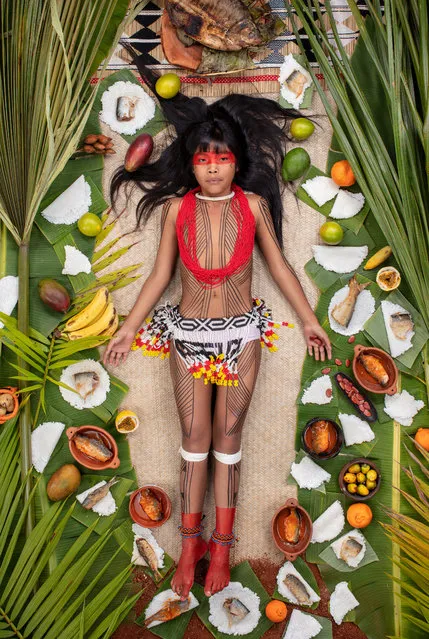
Kawakanih Yawalapiti, 9, Upper Xingu region of Mato Grosso, Brazil, 2018: Kawakanih lives with her tribe, the Yawalapiti, in Xingu national park, a preserve in the Amazon basin of Brazil. The Yawalapiti collect seeds to preserve species unique to their ecosystem, which lies between the rain forest and savannah. Kawakanih’s diet is simple, consisting mainly of fish, cassava, porridge, fruit and nuts. “It takes five minutes to catch dinner”, says Kawakanih. “When you’re hungry, you just go to the river with your net”. (Photo by Gregg Segal/The Guardian)

Photographer Gregg Segal travelled the world to document children and the food they eat in a week. Partly inspired by the increasing problems of childhood obesity, he tracked traditional regional diets as yet unaffected by globalisation, and ironically, found that the healthiest diets were often eaten by the least well off. (Photo by Gregg Segal/The Guardian)
Details
03 Jul 2019 00:03:00
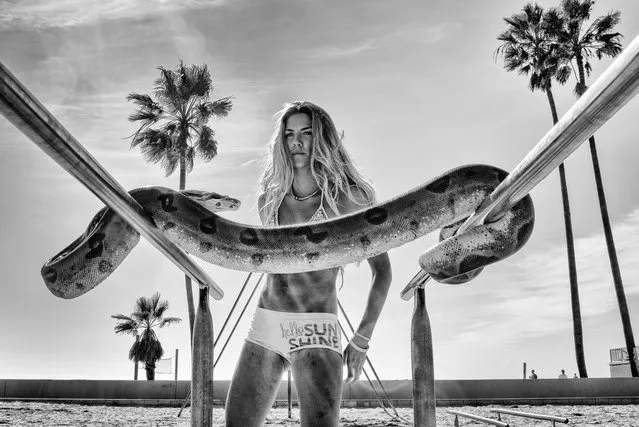
Jenna carefully watches two giant boa constrictors that their owner, a street performer she barely knows, entrusted to her. She is careful to keep the one snake wrapped around exercise bars to prevent a wound in the animal’s mouth from touching the sand and getting infected. Jenna is a single mom on disability. She suffers from failed back surgery syndrome, acquired from a violent car accident she had as a teenager. She and her young son Jackson can be found most afternoons on the beach. Originally from South Carolina, Jenna came to Venice in 2010 and describes herself as “an open-minded Christian who loves everyone for who they are”. Nowadays Jenna sometimes has trouble reconciling her inclusive progressive values with her family’s conservative political stance, especially in today’s toxic political climate. (Photo by Dotan Saguy)

Over the past three years, Los Angeles-based photographer Dotan Saguy has spent hundreds of hours documenting the diverse culture, people and pageantry of the iconic Venice Beach boardwalk. He was irresistibly drawn to the free-spirited, anti-materialistic and inclusive nature of the world-famous location, which he found to be a breath of fresh air in contrast to Los Angeles’s sometimes homogenized, celebrity-obsessed culture. (Photo by Dotan Saguy)
Details
01 Aug 2018 00:03:00
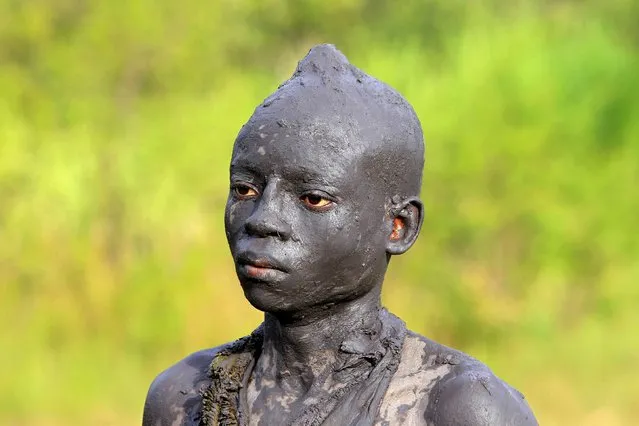
A Bukusu youth stands covered in mud in preparation for a circumcision ritual in Kenya's western region of Bungoma August 9, 2014. (Photo by Noor Khamis/Reuters)

A Bukusu youth stands covered in mud in preparation for a circumcision ritual in Kenya's western region of Bungoma August 9, 2014. Circumcision rituals, which take place in August, are celebrated amongst some Kenyan tribes as an annual rite of passage into adulthood. (Photo by Noor Khamis/Reuters)
Details
19 Sep 2014 09:27:00
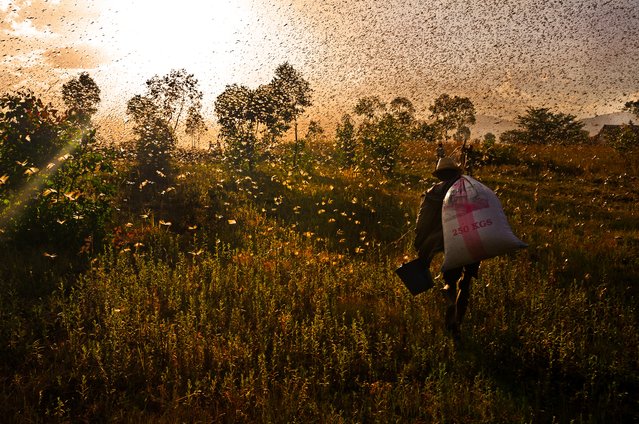
“Locusts & Men”. Oppression, interaction, collaboration. In the life cycle of nature nothing is lost, but the coexistence of different species is sometimes difficult. In Madagascar periodically returns the archaic antagonism between man and the migratory locust, in a circle of life where the two species are looking for space and food for their survival. Photo location: Madagascar, 2013. (Photo and caption by Michele Martinelli/National Geographic Photo Contest)

“Locusts & Men”. Oppression, interaction, collaboration. In the life cycle of nature nothing is lost, but the coexistence of different species is sometimes difficult. In Madagascar periodically returns the archaic antagonism between man and the migratory locust, in a circle of life where the two species are looking for space and food for their survival. At the end of the day a man walks home carrying on his shoulders the heavy bag which contains the locusts captured during the day. The insects provide nutritious meals for the man and his family. Photo location: Madagascar, 2013. (Photo and caption by Michele Martinelli/National Geographic Photo Contest)

ATTENTION! All pictures are presented in high resolution. To see Hi-Res images – just TWICE click on any picture. In other words, click small picture – opens the BIG picture. Click BIG picture – opens VERY BIG picture.
Details
03 Dec 2013 10:59:00
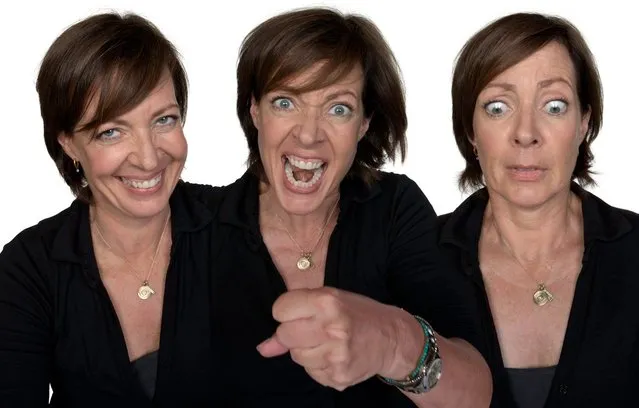
In Character By Howard Schatz Part 1

Photographer Howard Schatz had an idea: place actors in a series of roles and dramatic situations to reveal the essence of their characters. Such was the premise behind his book, In Character: Actors Acting, which captures some of Hollywood’s most emotive stars in the act of, well, making faces. Luckily for us, he continued the tradition for Vanity Fair. Here are some of the best.
Details
04 Jan 2014 14:38:00