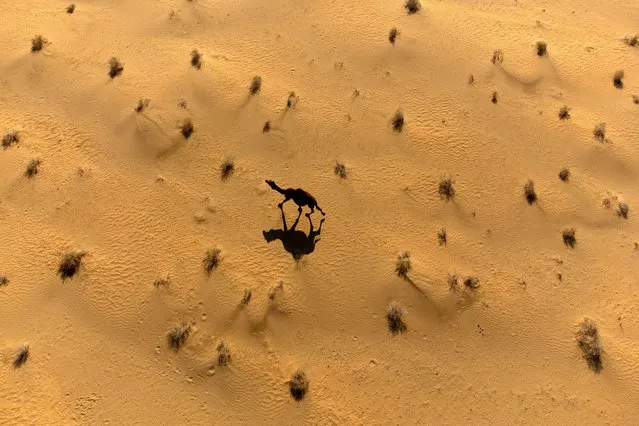
This aerial photograph taken on January 27, 2024 shows a camel in the desert of Samawa in Iraq's southern province of al-Muthanna. (Photo by Hussein Faleh/AFP Photo)
Filipino boys play basketball at an improvised court hooked on multi-layered tombs at a public cemetery in Navotas, north of Manila, Philippines on Thursday Oct. 31, 2013. Filipinos are expected to flock to cemeteries on November 1 to remember their dead as they observe All Saints Day in this predominantly Roman Catholic country. (Photo by Aaron Favila/AP Photo)
A giant panda cub falls from the stage while 23 giant pandas born in 2016 seen on a display at the Chengdu Research Base of Giant Panda Breeding in Chengdu, Sichuan province, China, September 29, 2016. (Photo by Rex Features)
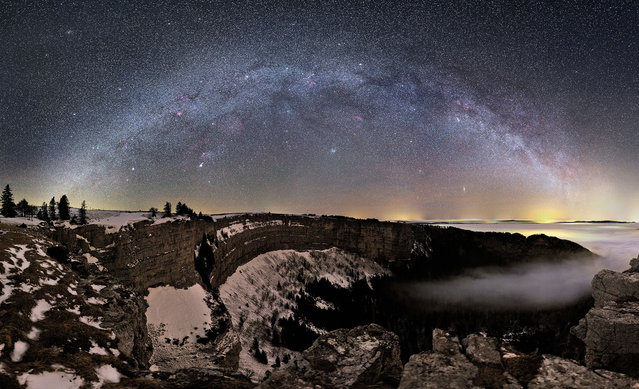
The Milky Way is the galaxy in which Earth is contained. This name derives from its appearance as a dim “milky” glowing band arching across the night sky, in which the naked eye cannot distinguish individual stars. The term “Milky Way” is a translation of the Classical Latin via lactea, from the Hellenistic Greek γαλαξίας κύκλος (pr. galaxías kýklos, “milky circle”). The Milky Way appears like a band because it is a disk-shaped structure being viewed from inside. The fact that this faint band of light is made up of stars was proven in 1610 when Galileo Galilei used his telescope to resolve it into individual stars. In the 1920s, observations by astronomer Edwin Hubble showed that the Milky Way is just one of many galaxies.
American photographer Doug Perrine, 60, snapped the shots last year while the False Killer Whale was out hunting for food. (Photo by Doug Perrine/Iber-Press)
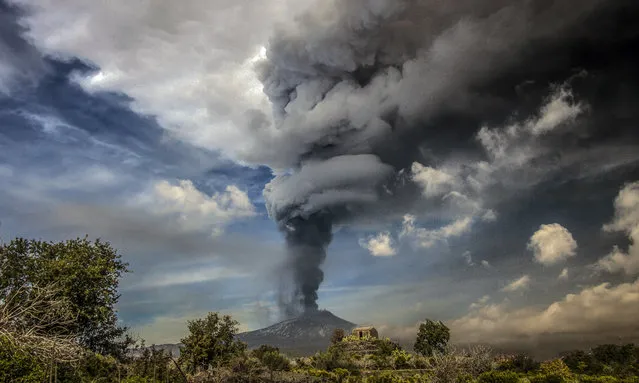
Smoke plumes rise from Mount Etna, one of the most active volcanoes in the world in Sicily, Italy on June 28, 2016. (Photo by Etna Walk/Rex Feature/Shutterstock)