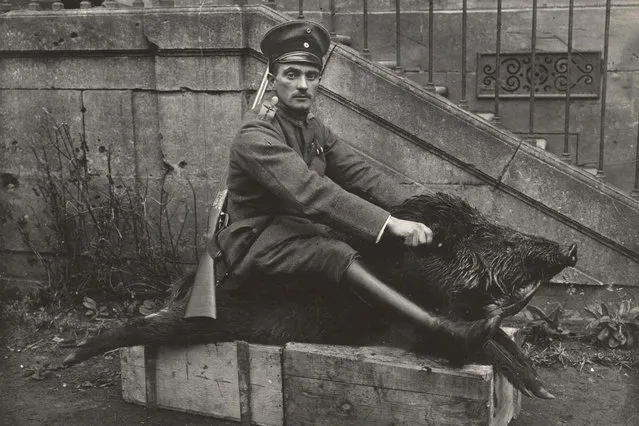
A German Air Force Officer sits astride a dead boar outside a house where he is stationed near the Western Front, in this 1918 handout picture. This picture is part of a previously unpublished set of World War One (WWI) images from a private collection. The pictures offer an unusual view of varied and contrasting aspects of the conflict, from high tech artillery to mobile pigeon lofts, and from officers partying in their headquarters to the grim reality of life and death in the trenches. The year 2014 marks the centenary of the start of the war. (Photo by Reuters/Archive of Modern Conflict London)
As the sun sets on the Malecon in Havana on Friday January 23, 2015, Surenis Angulo de la Paz, 24, center, dances as group of locals play music around her. Behind her is Fidel Lopez, 55. (Photo by Sarah L. Voisin/The Washington Post)
Peruvian shamans holding a figure of a Nino Jesus (Child Jesus) and a snake perform a ritual at the Rimac river to fight the negative effects of the Nino weather phenomena over Nature, in Lima, October 1, 2015. (Photo by Mariana Bazo/Reuters)
A visitor looks at a creation by Russian artist Irina Nakhova presented at the Russia's pavilion during the 56th International Art Exhibition (Biennale d'Arte) titled “All the Worlds Futures” on May 5, 2015 in Venice. (Photo by Gabriel Bouys/AFP Photo)
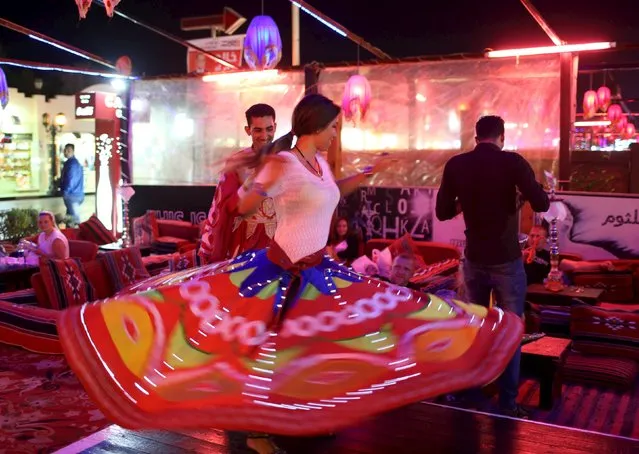
A dancer lets a Russian tourist practice the traditional tannoura dance at a cafe in the Red Sea resort of Sharm el-Sheikh, Egypt November 10, 2015. The fallout from the crash of a Russian Metrojet passenger plane in Egypt's Sinai Peninsula could slash tourism income from Sharm al-Sheikh by half, the head of the region's travel agents' association said on Tuesday. Several airlines have suspended flights to the Red Sea resort since the Oct. 31 crash, which investigators and Western governments believe was likely to have been caused by a bomb. Thousands of Russian and British tourists have been flown home. (Photo by Asmaa Waguih/Reuters)
Photo: Vladimir Ilyich Lenin (1870 – 1924) lying in state in the Kremlin. (Photo by Hulton Archive/Getty Images). 1924
Important! For the same article in Russian language click here.
Something quite intriguing is happening within Russian-speaking internet during the last few – should you type a fully academic inquiry (at least, according to Russian academic requirements) in national search engines for "Lenin's mausoleum" – the first thing you get (even in top 10 searches) is website pages talking about black magic and occult. Website authors view this construction differently, but unconditionally agree on one thing: the mausoleum of the "leader of the world proletariat” – the essence of a magical artifact, a sort of “energy vampire”. It was built with a certain purpose: to drain the energy out of miserable Soviet citizens on one hand; and to poison the anthroposphere of one-sixth part of the earth with its vibes (the exact territory that was occupied by the former Soviet Union), depriving the Russian people of will to resist on the other hand. Complete nonsense? No doubt. Nevertheless, an intriguing one. Well, probably because some oddities do exist in mausoleum's history. These oddities are the thing we are going to discuss this time. First, let me refresh you memory on the subject.
Runner English Gardner poses for a portrait at the U.S. Olympic Committee Media Summit in Beverly Hills, Los Angeles, California March 8, 2016. “My musical inspiration when I'm training is usually a lot of upbeat music”, said Gardner. (Photo by Lucy Nicholson/Reuters)