Loading...
Done
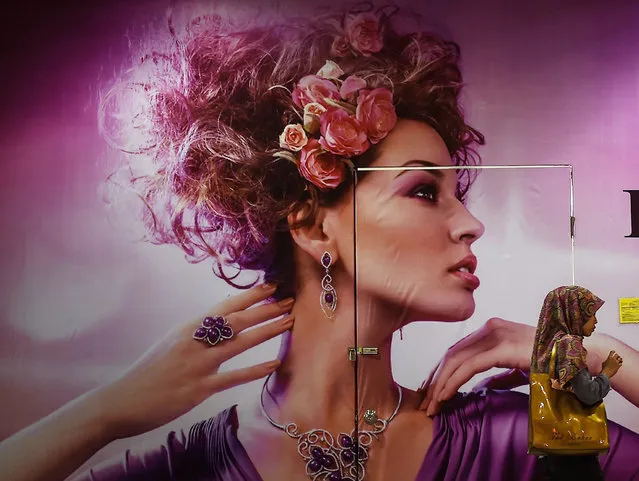
A Malaysian woman walks past an advertisement outside a jewellery store at a shopping mall in Kuala Lumpur on August 25, 2015. Prices of crude oil and most other commodities rebounded in Asia on August 25 but stayed under pressure following a global sell-off sparked by the faltering economy in China, the world's top user of industrial metals and energy. (Photo by Manan Vatsyayana/AFP Photo)

A Malaysian woman walks past an advertisement outside a jewellery store at a shopping mall in Kuala Lumpur on August 25, 2015. Prices of crude oil and most other commodities rebounded in Asia on August 25 but stayed under pressure following a global sell-off sparked by the faltering economy in China, the world's top user of industrial metals and energy. Gold prices remained steady, boosted by prospects of increased demand due to its status as a safe haven in times of turmoil. (Photo by Manan Vatsyayana/AFP Photo)
Details
26 Aug 2015 09:45:00
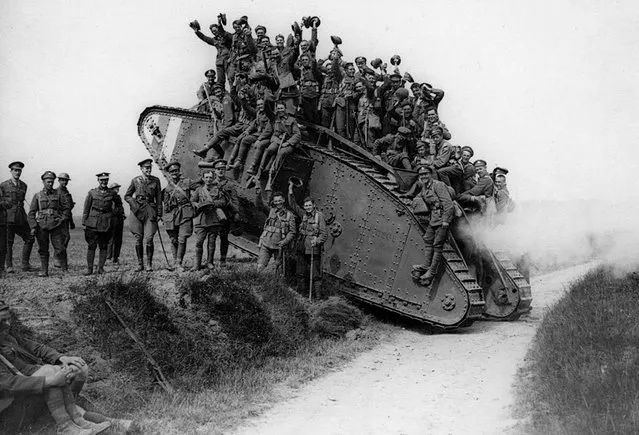
These black-and-white photos are taken from the new book “Armoured Warfare in the First World War 1916 – 1918” by Anthony Tucker-Jones and published by Pen & Sword Military. “Interestingly the British, French and Germans took completely different approaches with varying results”. The British military produced “Little Willie” in Autumn 1915 weighing 18 tonnes, which had a crew of two plus four gunners. “Inspired by a tracked artillery tractor “Little Willie” was referred to as a water tank – hence the name tank – to ensure secrecy”, said Anthony. “This led to the strange looking Mark I with its peculiar rhomboid shape, designed to cross trenches with guns in sponsons on either side. The Germans saw the tank as unchivalrous and were slow to grasp its utility. They favoured the Stormtrooper (specialist soldiers used to infiltrate enemy trenches) and artillery, not the tank”, said Anthony. “However, they didn’t hesitate to make use of captured British tanks. Although the tank helped secure victory and German soldiers dubbed it “Germany’s Downfall” the country was ultimately brought to its knees by the Allies blockade”. Here: British troops hitch a ride on a Mark IV after the massed tank fleet spearheading attack at Cambrai on November 20, 1917. (Photo by Anthony Tucker-Jones/Mediadrumworld.com)

These black-and-white photos are taken from the new book “Armoured Warfare in the First World War 1916 – 1918” by Anthony Tucker-Jones and published by Pen & Sword Military. Here: British troops hitch a ride on a Mark IV after the massed tank fleet spearheading attack at Cambrai on November 20, 1917. (Photo by Anthony Tucker-Jones/Mediadrumworld.com)
Details
23 Feb 2017 00:02:00
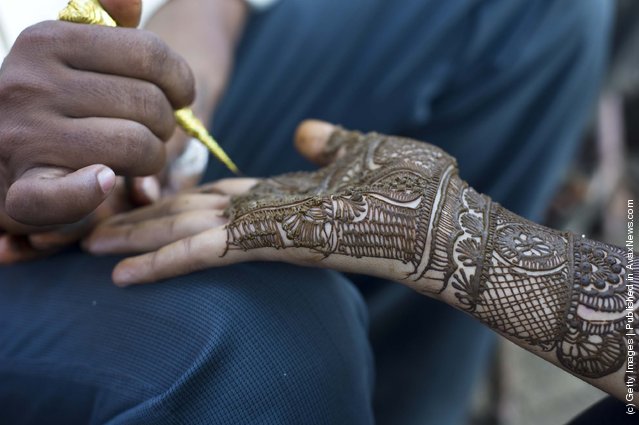
Application of henna or “Mehndi”  to a girls hand in a market in Jaipur, India

“Mehndi or menhdi is the application of henna as a temporary form of skin decoration in India, as well as by expatriate communities from the country. The word mehndi is derived from the Sanskrit word mendhikā. The use of mehndi and turmeric is described in the earliest Vedic ritual books. Haldi (Staining oneself with turmeric paste) as well as mehndi are important Vedic customs as a symbolic representation of the Outer and the Inner Sun. Vedic customs are meant to awaken the “inner light” and so the gold of the inner Sun has an important symbolic function”. – Wikipedia

Photo: Application of henna or “Mehndi” to a girls hand in a market on October 18, 2010 in Jaipur, India. (Photo by Simon de Trey-White/Getty Images)
Details
23 Nov 2011 13:33:00
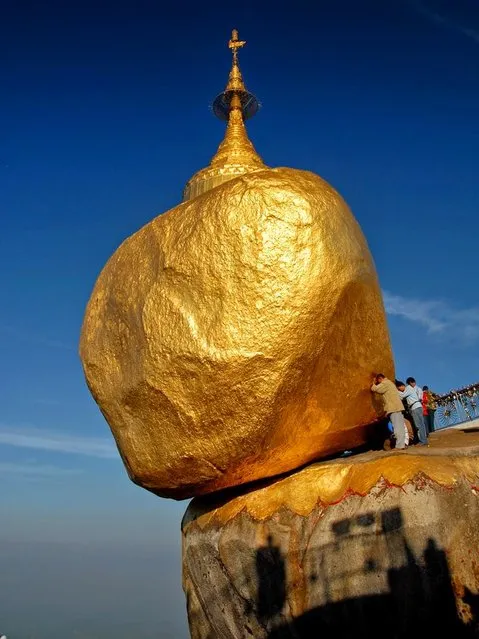
 Kyaiktiyo Pagoda AKA  Golden Rock In Burma

Kyaiktiyo Pagoda, also known as Golden Rock is a well-known Buddhist pilgrimage site in Mon State, Burma. It is a small pagoda (7.3 metres (24 ft)) built on the top of a granite boulder covered with gold leaves pasted on by devotees. According to legend, the Golden Rock itself is precariously perched on a strand of the Buddha's hair. The balancing rock seems to defy gravity, as it perpetually appears to be on the verge of rolling down the hill. The rock and the pagoda are at the top of Mt. Kyaiktiyo. It is the third most important Buddhist pilgrimage site in Burma after the Shwedagon Pagoda and the Mahamuni Pagoda. A glimpse of the "gravity defying" Golden Rock is believed to be enough of an inspiration for any person to turn to Buddhism.
Details
04 Jun 2015 11:42:00
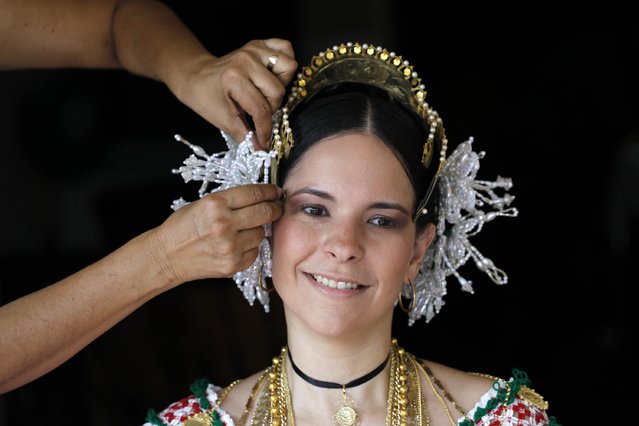
A woman is helped with adorning her hair with jewelry, part of the traditional clothing known as “Pollera”, before the annual Thousand Polleras parade in Las Tablas, in the province of Los Santos January 10, 2015. According to local residents, the Pollera dates back to the 18th century and was worn by the Spanish lower classes. (Photo by Carlos Jasso/Reuters)

A woman is helped with adorning her hair with jewelry, part of the traditional clothing known as “Pollera”, before the annual Thousand Polleras parade in Las Tablas, in the province of Los Santos January 10, 2015. According to local residents, the Pollera dates back to the 18th century and was worn by the Spanish lower classes. Today, it has become the Panamanian national costume. The dress is made entirely by hand and the jewellery worn is pure gold and worth thousands of dollars. (Photo by Carlos Jasso/Reuters)
Details
12 Jan 2015 15:46:00
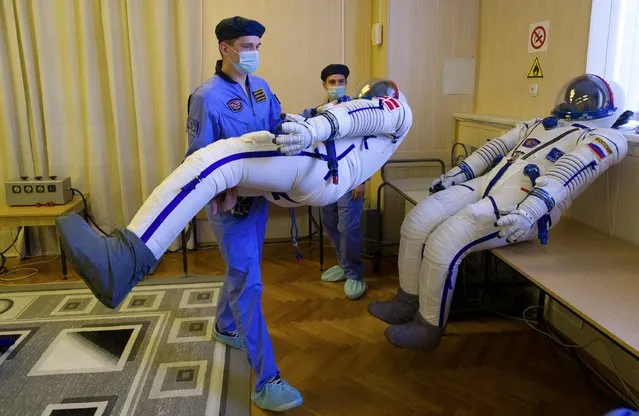
Employees prepare spacesuits at the Russian-leased Baikonur cosmodrome in Kazakhstan on August 19, 2015. Members of the main crew of the 45/46 expedition to the International Space Station ISS, Kazakhstan's cosmonaut Aydyn Aimbetov, Russian cosmonaut Sergei Volkov and Denmark's astronaut Andreas Mogensen from the European Space Agency, are scheduled to blast off to the International Space Station (ISS) on September 2, 2015. (Photo by AFP Photo)

Employees prepare spacesuits at the Russian-leased Baikonur cosmodrome in Kazakhstan on August 19, 2015. Members of the main crew of the 45/46 expedition to the International Space Station ISS, Kazakhstan's cosmonaut Aydyn Aimbetov, Russian cosmonaut Sergei Volkov and Denmark's astronaut Andreas Mogensen from the European Space Agency, are scheduled to blast off to the International Space Station (ISS) on September 2, 2015. (Photo by AFP Photo)
Details
20 Aug 2015 13:45:00
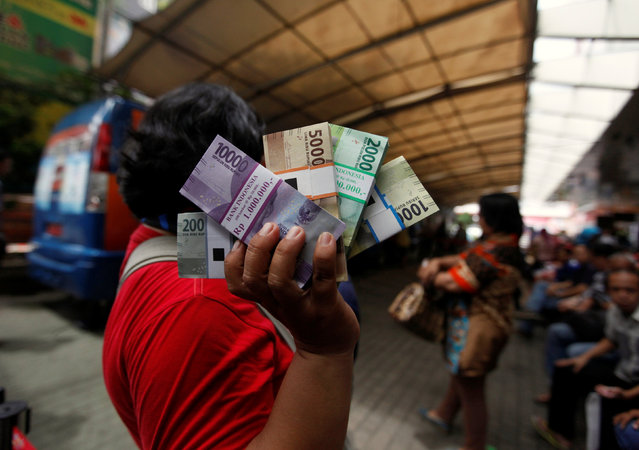
A woman holds newly designed Indonesia Rupiah banknotes after exchanging her old bills at a Bank Indonesia mobile bank in Jakarta, Indonesia December 19, 2016. (Photo by Fatima El-Kareem/Reuters)

A woman holds newly designed Indonesia Rupiah banknotes after exchanging her old bills at a Bank Indonesia mobile bank in Jakarta, Indonesia December 19, 2016. (Photo by Fatima El-Kareem/Reuters)
Details
14 Feb 2017 00:03:00
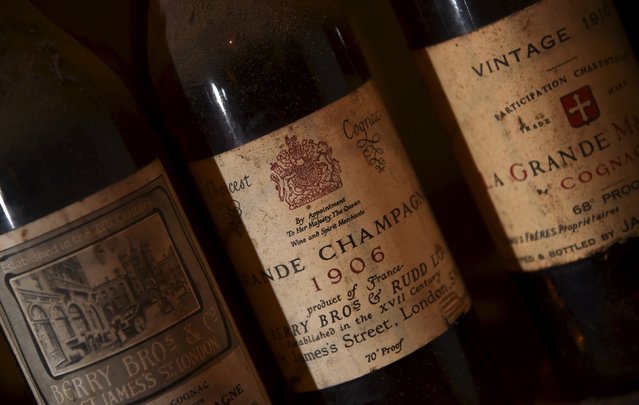
Bottles of vintage cognac, with a royal warrant stamp, are seen in storage inside Berry Bros and Rudd wine merchants in central London, Britain, August 21, 2015. Berry Bros. & Rudd, which started as grocers over 300 years ago in St. James's, central London, has two royal warrants. (Photo by Toby Melville/Reuters)

Bottles of vintage cognac, with a royal warrant stamp, are seen in storage inside Berry Bros and Rudd wine merchants in central London, Britain, August 21, 2015. Berry Bros. & Rudd, which started as grocers over 300 years ago in St. James's, central London, has two royal warrants. Every year Queen Elizabeth grants about 20 royal warrants, the gold emblem of the British monarchy, in a practice dating back to medieval times. The warrant holders can display the certificate and use the royal coat of arms in their marketing. The warrants lasting five years can help businesses break into new markets overseas, using their role as supplier to the royal family as a gauge of quality. On September 9, Queen Elizabeth will overtake Queen Victoria as Britain's longest-serving monarch. (Photo by Toby Melville/Reuters)
Details
03 Sep 2015 12:37:00