Loading...
Done
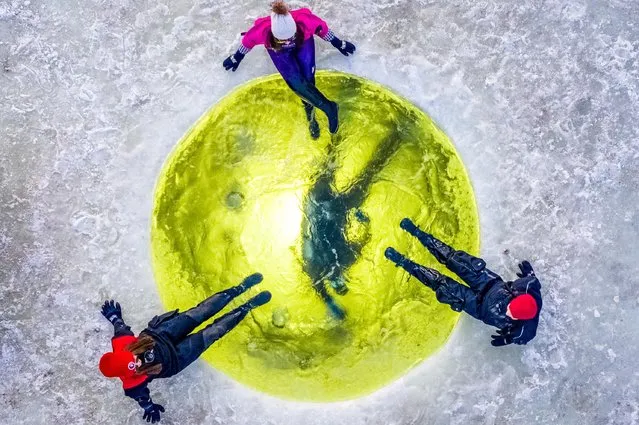
Scuba divers during an ice diving class at the Sea Frogs scuba diving center in the Russian Far Eastern city of Vladivostok on January 30, 2022. The air temperature is –11°C (12.2°F), the water temperature is –2°C (28.4°F). Scuba divers undergo theoretical and practical training in ice diving and perform dives in the open water during the day and the night time as part of the Ice Diver NDL special program. (Photo by Yuri Smityuk/TASS)

Scuba divers during an ice diving class at the Sea Frogs scuba diving center in the Russian Far Eastern city of Vladivostok on January 30, 2022. The air temperature is –11°C (12.2°F), the water temperature is –2°C (28.4°F). Scuba divers undergo theoretical and practical training in ice diving and perform dives in the open water during the day and the night time as part of the Ice Diver NDL special program. (Photo by Yuri Smityuk/TASS)
Details
03 Feb 2022 07:34:00
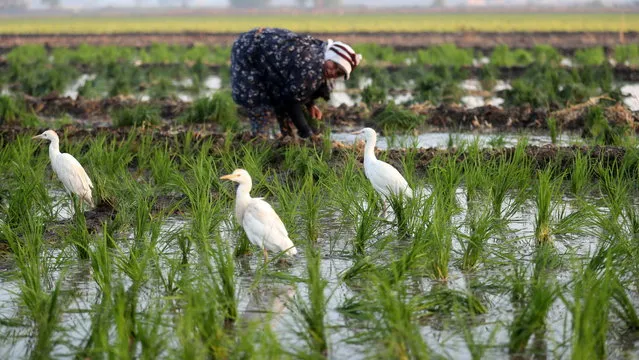
Egrets stand on a field as an Egyptian farmer plants rice seedling in Egypt's fertile Delta in Tanta, Algharbeya governorate, 100 km from Cairo, Egypt, 22 June 2022.  Egyptian Government reduced the planting of some crops that need a massive amount of irrigation water, while the government said it will reduce the rice agriculture area in Egypt, amid fear the Renaissance Dam project in Ethiopia could affect the amount of River Nile water reaching Egypt. (Photo by Khaled Elfiqi/EPA/EFE)

Egrets stand on a field as an Egyptian farmer plants rice seedling in Egypt's fertile Delta in Tanta, Algharbeya governorate, 100 km from Cairo, Egypt, 22 June 2022. Egyptian Government reduced the planting of some crops that need a massive amount of irrigation water, while the government said it will reduce the rice agriculture area in Egypt, amid fear the Renaissance Dam project in Ethiopia could affect the amount of River Nile water reaching Egypt. (Photo by Khaled Elfiqi/EPA/EFE)
Details
23 Jul 2022 04:52:00
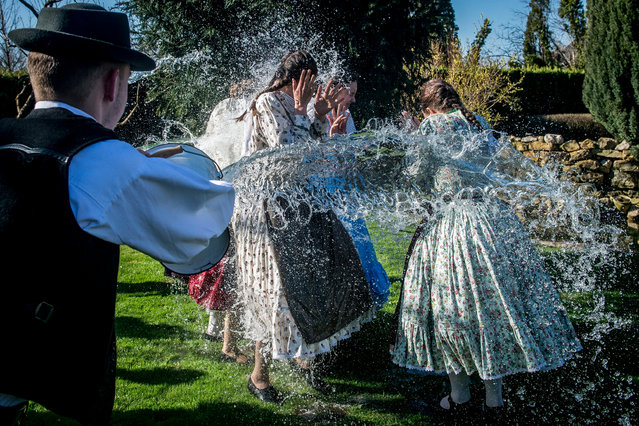
Members of the Mayossa Folk Dance Group pour water on young women in Kiskunmajsa, some 140 kms southeast of Budapest, Hungary, Monday, April 2, 2018. According to a several hundred years old tradition of Hungarian villages young men pour water on young women who in exchange present their sprinklers with beautifully colored eggs on Easter Monday. (Photo by Sandor Ujvari/MTI via AP Photo)

Members of the Mayossa Folk Dance Group pour water on young women in Kiskunmajsa, some 140 kms southeast of Budapest, Hungary, Monday, April 2, 2018. According to a several hundred years old tradition of Hungarian villages young men pour water on young women who in exchange present their sprinklers with beautifully colored eggs on Easter Monday. (Photo by Sandor Ujvari/MTI via AP Photo)
Details
03 Apr 2018 08:21:00
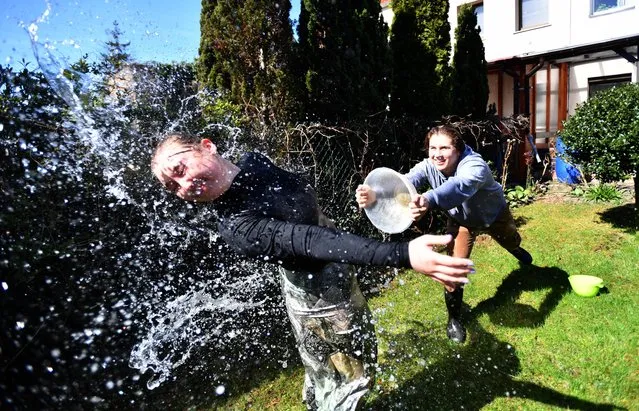
Polish boys and girls throw water over each other on “Smigus-dyngus” (or Wet Monday) during the Easter Monday in Szczecin, northwestern Poland, 18 April 2022. Smigus-dyngus is a Roman Catholic celebration held on Easter Monday in Poland. Traditionally, boys throw water over girls, this is accompanied by a number of other rituals, such as making verse declarations and holding door-to-door processions. (Photo by Marcin Bielecki/EPA/EFE)

Polish boys and girls throw water over each other on “Smigus-dyngus” (or Wet Monday) during the Easter Monday in Szczecin, northwestern Poland, 18 April 2022. Smigus-dyngus is a Roman Catholic celebration held on Easter Monday in Poland. Traditionally, boys throw water over girls, this is accompanied by a number of other rituals, such as making verse declarations and holding door-to-door processions. (Photo by Marcin Bielecki/EPA/EFE)
Details
15 Jul 2023 02:04:00
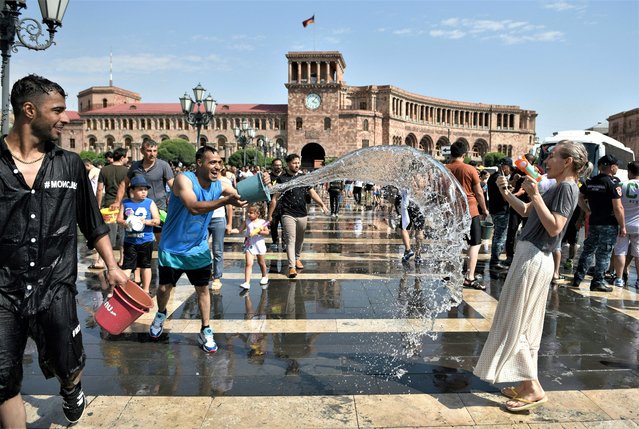
People splash each other in downtown Yerevan, Armenia during an annual Vardavar holiday on July 16, 2023. Vardavar is a traditional Armenian water festival, with people drenching each other, dating back to pagan times. The ancient festival is traditionally associated with the goddess Astghik, who was the goddess of water, beauty, love, and fertility. (Photo by Karen Minasyan/AFP Photo)

People splash each other in downtown Yerevan, Armenia during an annual Vardavar holiday on July 16, 2023. Vardavar is a traditional Armenian water festival, with people drenching each other, dating back to pagan times. The ancient festival is traditionally associated with the goddess Astghik, who was the goddess of water, beauty, love, and fertility. (Photo by Karen Minasyan/AFP Photo)
Details
18 Oct 2024 04:10:00
Male members of the Zeleziar folk dance group whip and water the local girls dressed in traditional clothing, during Easter in Bociar, Slovakia on April 1, 2024. Boys and younger men visit the houses of young girls, whip them with fresh-cut decorated wickers and sprinkle water on them. By tradition, the whipping should give the girls strength, health, and abundance throughout the whole year. (Photo by Robert Nemeti/Anadolu via Getty Images)

Male members of the Zeleziar folk dance group whip and water the local girls dressed in traditional clothing, during Easter in Bociar, Slovakia on April 1, 2024. Boys and younger men visit the houses of young girls, whip them with fresh-cut decorated wickers and sprinkle water on them. By tradition, the whipping should give the girls strength, health, and abundance throughout the whole year. (Photo by Robert Nemeti/Anadolu via Getty Images)
Details
18 Aug 2025 03:18:00
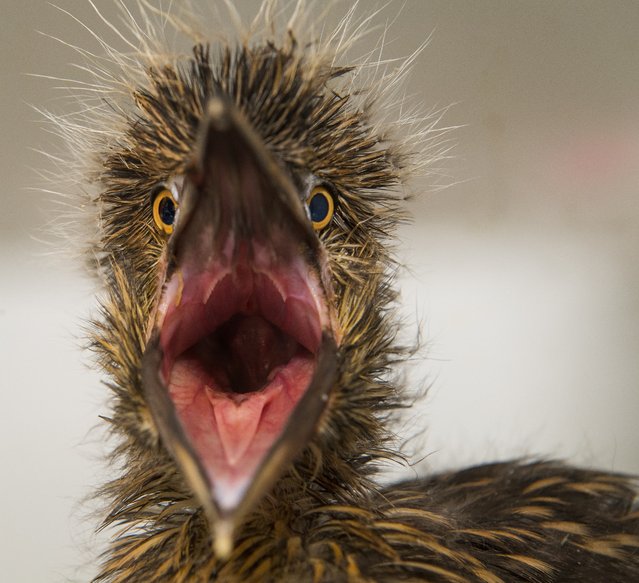
A baby Black-crowned Night Heron squawks in its incubator while being cared for at City Wildlife rescue and rehabilitation center in Washington, DC on May 31, 2017. The heron is one of several that have been brought to CW by the staff at The National Zoo over the past few years. The heron is a native bird and has made an established rookery inside the zoo grounds over a hundred years ago.  Every year at this time, some of the chicks get pushed or fall out of the nest and require human care.  Because the birds are native and not part of the Smithsonian collection, they partnered with CW to rehabilitate the herons for re-release back to the flock inside Zoo. They're reintroduced back to their flock so that they can migrate together in the Fall. The Black-crowned heron usually migrates from the DC area down to southeast North Carolina, some going as far as Jacksonville, FL in winter. The Black-crowned heron is the species of greatest conservation need in the District of Columbia because their numbers are in such rapid decline due to habitat loss. (Photo Linda Davidson/The Washington Post)

A baby Black-crowned Night Heron squawks in its incubator while being cared for at City Wildlife rescue and rehabilitation center in Washington, DC on May 31, 2017. The heron is one of several that have been brought to CW by the staff at The National Zoo over the past few years. (Photo Linda Davidson/The Washington Post)
Details
04 Jun 2017 08:04:00
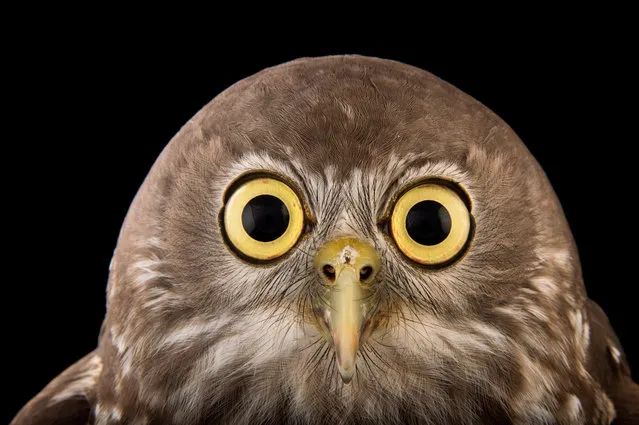
The National Geographic Photo Ark is a travelling exhibition of photographer Joel Sartore’s quest to create a photo archive of biodiversity around the world. So far, Sartore has captured studio portraits of more than 6,000 species – a number that he hopes to double. On 1 July, the ark will open at Melbourne zoo – the first time it has been exhibited in the southern hemisphere. More than 50 portraits will be on display, including many of Australian endangered animals being protected by programs at the zoo itself. These captions have been edited from text supplied by Melbourne zoo. Here: Barking owl. So-named because its call sounds like a barking dog, these birds are native to Australia, Indonesia and Papua New Guinea. In Victoria they are listed as an endangered species, and in 2003 there were estimated to be fewer than 50 breeding pairs. The main threat to the species in Victoria is loss of habitat, especially large trees with hollows in which they can nest and on which many of their prey depend. Apart from a bark, they may utter a chilling scream when they feel threatened. (Photo by Joel Sartore/National Geographic Photo Ark/The Guardian)

The National Geographic Photo Ark is a travelling exhibition of photographer Joel Sartore’s quest to create a photo archive of biodiversity around the world. So far, Sartore has captured studio portraits of more than 6,000 species – a number that he hopes to double. On 1 July, the ark will open at Melbourne zoo – the first time it has been exhibited in the southern hemisphere. More than 50 portraits will be on display, including many of Australian endangered animals being protected by programs at the zoo itself. These captions have been edited from text supplied by Melbourne zoo. Here: Barking owl. (Photo by Joel Sartore/National Geographic Photo Ark/The Guardian)
Details
01 Jul 2017 07:45:00