Loading...
Done
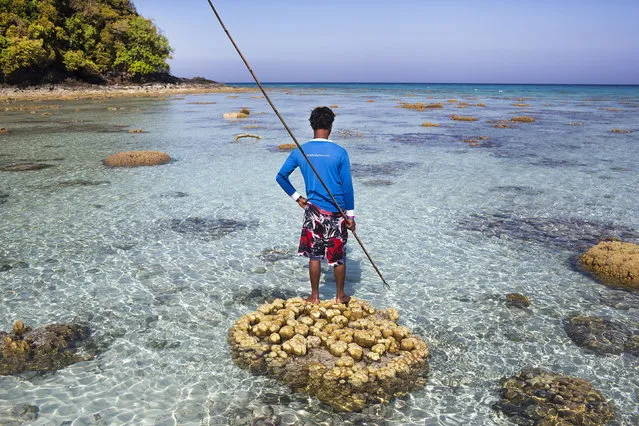
Hook, an indigenous Moken man, holds a three-pronged throwing spear and searches for fish in the waters of Ko Surin National Park. March 1, 2013 – Ko Surin, Thailand. (Photo by Taylor Weidman/zReportage via ZUMA Press)

“For centuries, the Moken sea nomads have traveled the islands between Thailand and Myanmar fishing and foraging for food on the sea floor. Throughout the Mergui Archipelago, Moken migrate in flotillas of Kabangs (traditional boat of the Moken people), stopping at different islands and beaches. Expert freedivers, the Moken have adapted physically to an aquatic life, developing unique characteristics that let them see better and hold their breath longer while underwater”. – Taylor Weidman. Photo: Hook, an indigenous Moken man, holds a three-pronged throwing spear and searches for fish in the waters of Ko Surin National Park. March 1, 2013 – Ko Surin, Thailand. (Photo by Taylor Weidman/zReportage via ZUMA Press)
Details
24 Mar 2014 06:45:00
This computer image provided Monday March 17, 2014 by the Press Office of socialist candidate to Paris Mayor Anne Hidalgo, shows a tunnel of abandoned railway from the 19th century, now ramshackle and overgrown, turned into a cinema. Hidalgo’s plan envisions not just a green space but in the tunnels, places for farming fish and mushrooms. (Photo by AP Photo/Anne Hidalgo's Press Office)

This computer image provided Monday March 17, 2014 by the Press Office of socialist candidate to Paris Mayor Anne Hidalgo, shows a tunnel of abandoned railway from the 19th century, now ramshackle and overgrown, turned into a cinema. Hidalgo’s plan envisions not just a green space but in the tunnels, places for farming fish and mushrooms. (Photo by AP Photo/Anne Hidalgo's Press Office)
Details
26 Mar 2014 08:43:00
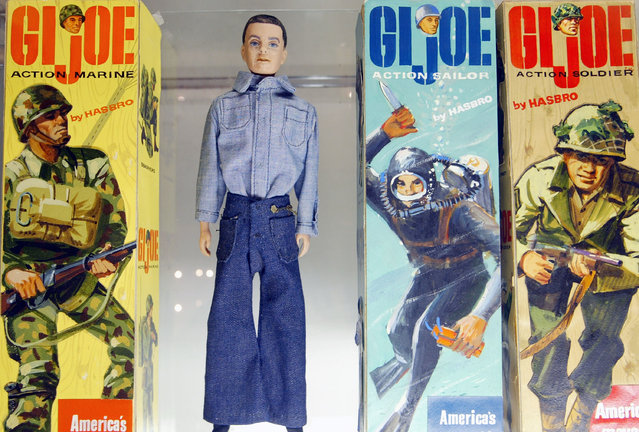
Vintage G.I. Joe figurers are on display at the 2003 Hasbro International G.I. Joe Collectors' Convention June 27, 2003 in Burlingame, California. Hundreds of G.I. Joe fans from around the country are attending the convention to buy, sell and trade G.I. Joe and military action figures. (Photo by Justin Sullivan/Getty Images)

“G.I. Joe is a line of action figures produced by the toy company Hasbro. The term G.I. stands, in popular usage, for Government Issued and after the First World War became a generic term for U.S. soldiers. The origin of the term dates to World War I, when much of the equipment issued to U.S. soldiers was stamped “G.I.”, meaning that it was made from galvanized iron. The development of G.I. Joe led to the coining of the term “action figure”. G.I. Joe's appeal to children has made it an American icon among toys”. – Wikipedia. Photo: Vintage G.I. Joe figurers are on display at the 2003 Hasbro International G.I. Joe Collectors' Convention June 27, 2003 in Burlingame, California. (Photo by Justin Sullivan/Getty Images)
Details
27 Mar 2014 07:46:00
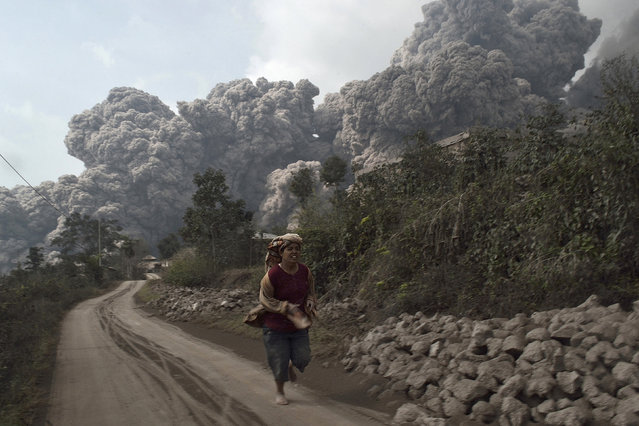
A villager run as Mount Sinabung erupt at Sigarang-Garang village in Karo district, Indonesia's North Sumatra province, February 1, 2014. Four people died and more than 28, 000 villagers have been evacuated since authorities raised the alert status for the volcano to the highest level in November 2013, local media reported on Saturday. (Photo by Reuters/Stringer)

A villager run as Mount Sinabung erupt at Sigarang-Garang village in Karo district, Indonesia's North Sumatra province, February 1, 2014. Four people died and more than 28, 000 villagers have been evacuated since authorities raised the alert status for the volcano to the highest level in November 2013, local media reported on Saturday. (Photo by Reuters/Stringer)
Details
02 Feb 2014 09:16:00
In this February 5, 2014 photo, Divaldo Aguiar, who plays the part of Pachencho, is carried in a mock coffin during the Burial of Pachencho celebration, through a cemetery in Santiago de Las Vegas, Cuba. Cuban villagers stage a mock funeral and burial of Pachencho, with a living man playing the part of Pachencho, in a boozy festival that has become an annual tradition in this small town near Havana, held each February 5 for the last 30 years. (Photo by Enric Marti/AP Photo)

In this February 5, 2014 photo, Divaldo Aguiar, who plays the part of Pachencho, is carried in a mock coffin during the Burial of Pachencho celebration, through a cemetery in Santiago de Las Vegas, Cuba. Cuban villagers stage a mock funeral and burial of Pachencho, with a living man playing the part of Pachencho, in a boozy festival that has become an annual tradition in this small town near Havana, held each February 5 for the last 30 years. (Photo by Enric Marti/AP Photo)
Details
10 Feb 2014 09:24:00
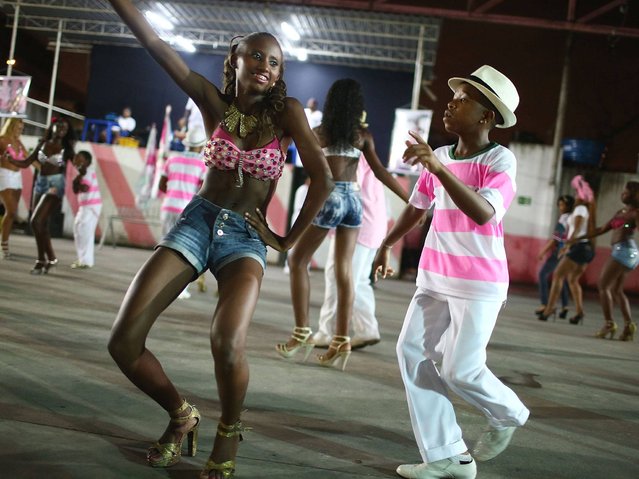
Revelers dance at a Jacarezinho samba school practice session ahead of Carnival celebrations on February 16, 2014 in Rio de Janeiro, Brazil. The Jacarezinho “favela” was previously controlled by drug traffickers and is now occupied by the city's Police Pacification Unit (UPP). Carnival officially begins February 28, but pre-Carnival celebrations are already underway. (Photo by Mario Tama/Getty Images)

Revelers dance at a Jacarezinho samba school practice session ahead of Carnival celebrations on February 16, 2014 in Rio de Janeiro, Brazil. The Jacarezinho “favela” was previously controlled by drug traffickers and is now occupied by the city's Police Pacification Unit (UPP). Carnival officially begins February 28, but pre-Carnival celebrations are already underway. (Photo by Mario Tama/Getty Images)
Details
19 Feb 2014 11:01:00
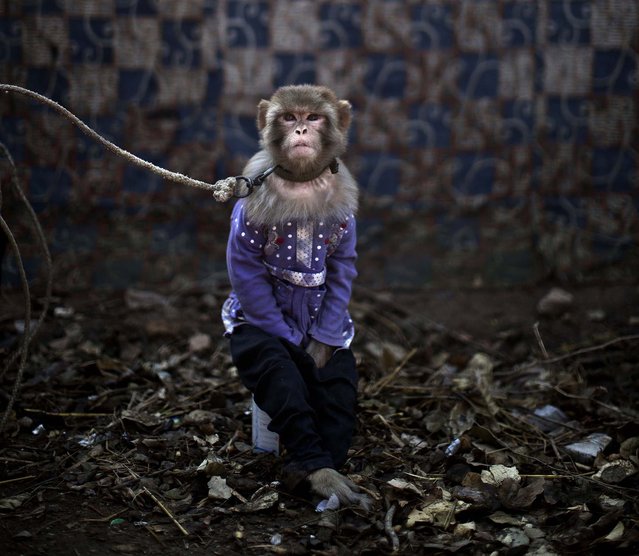
In this Tuesday, February 11, 2014, photo, a trained monkey, that makes a living for her Pakistani owner by performing to a crowd in public and private places, sits held by a leash, in Rawalpindi, Pakistan. For Pakistanis who raise and train the monkeys they are an important source of income in an impoverished country, and they form a strong bond with the animals. The monkeys are usually captured in the wild when they are babies and then trained. A trained monkey can fetch 20,000 to 30,000 rupees ($190 to $285). (Photo by Muhammed Muheisen/Associated Press)

In this Tuesday, February 11, 2014, photo, a trained monkey, that makes a living for her Pakistani owner by performing to a crowd in public and private places, sits held by a leash, in Rawalpindi, Pakistan. For Pakistanis who raise and train the monkeys they are an important source of income in an impoverished country, and they form a strong bond with the animals. The monkeys are usually captured in the wild when they are babies and then trained. A trained monkey can fetch 20,000 to 30,000 rupees ($190 to $285). (Photo by Muhammed Muheisen/Associated Press)
Details
23 Feb 2014 09:50:00
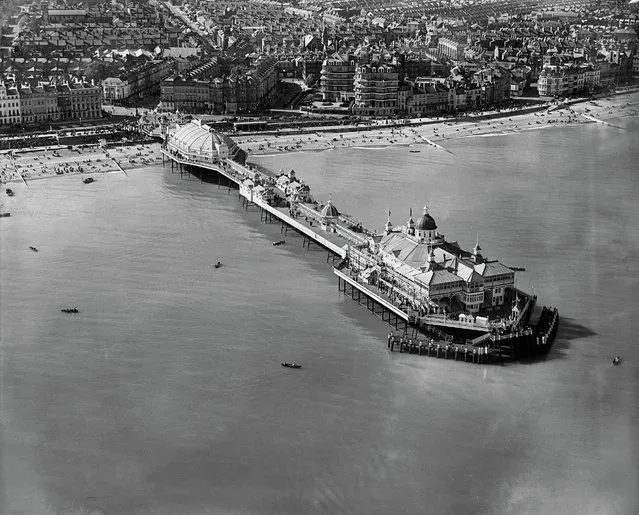
While the lido was described as bringing “modernism to the masses” on the British coast it was just the latest example of a trend that had been developing since Victorian times – transforming seaside towns into resorts for leisure and entertainment. In the latter half of the nineteenth century, the fashion was for local authorities to build great piers stretching from the promenade out into the sea

While the lido was described as bringing “modernism to the masses” on the British coast it was just the latest example of a trend that had been developing since Victorian times – transforming seaside towns into resorts for leisure and entertainment. In the latter half of the nineteenth century, the fashion was for local authorities to build great piers stretching from the promenade out into the sea. The Eastbourne Pier, pictured here in May 1931, was erected between 1866 and 1870 to an ingenious design by Eugenius Birch, which saw the structure sitting on special cups allowing the supporting struts to “move” in bad weather. Arranged on the pier's 1,000-foot length were kiosks, a theatre, a ballroom and a camera obscura. 1931. (Photo by Aerofilms Collection via “A History of Britain From Above”)
Details
25 Feb 2014 12:59:00