Loading...
Done
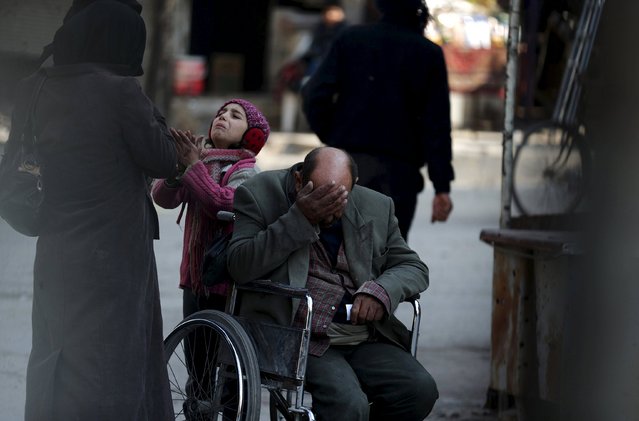
A girl asks a passerby for help to pay a medical bill as her father sits in his wheelchair in the Douma neighbourhood of Damascus Syria February 3, 2016. (Photo by Bassam Khabieh/Reuters)

Hadeel, 10, asks a passerby for help to pay a medical bill as her father Shahrour, 54, sits in his wheelchair in the Douma neighbourhood of Damascus Syria February 3, 2016. Shahrour said he developed diabetes at the beginning of the war in Syria. A lack of insulin led to his medical condition worsening and his right foot had to be amputated. Recently he also suffered a stroke that paralysed half his face. He and part of his extended family, a total of 18 people, live together and struggle to get by. (Photo by Bassam Khabieh/Reuters)
Details
12 Feb 2016 12:46:00
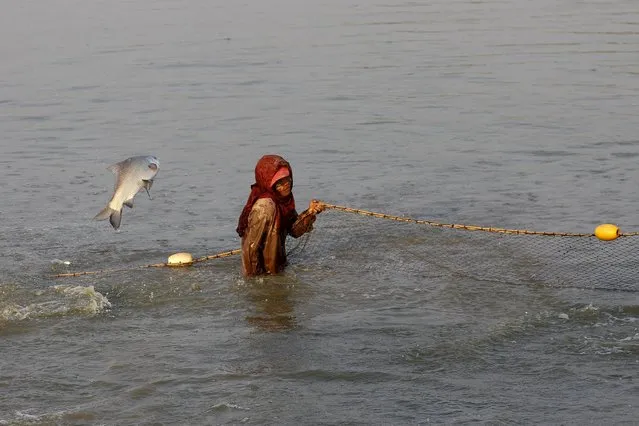
A fish jumps over a net as a boy works in a fish farm at Htantapin township, outside Yangon, Myanmar February 18, 2016. (Photo by Soe Zeya Tun/Reuters)

A fish jumps over a net as a boy works in a fish farm at Htantapin township, outside Yangon, Myanmar February 18, 2016. One in five children in Myanmar aged 10-17 go to work instead of school, according to figures from a census report on employment published last month, and the opening up of the economy since 2011 has triggered a spike in demand for labour. Many children work in fish farming and processing. At Yangon's San Pya fish market, the country's largest, girls and boys as young as nine clean and process fish and unload boats and trucks during 12-hour overnight shifts. (Photo by Soe Zeya Tun/Reuters)
Details
20 Apr 2016 12:18:00
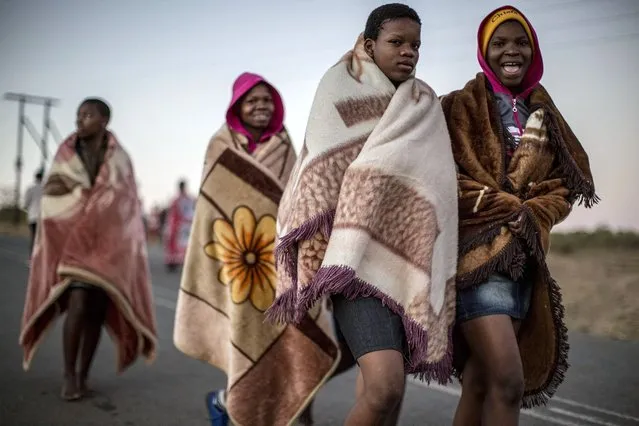
South African maidens wrap themselves in blankets as they head to a ritual bath in a local river on September 5, 2014 at the eNyokeni Royal Palace in Nongoma in the KwaZulu-Natal region ahead of the 13th anniversary of the Reed Dance (uMkhosi woMhlanga) celebrated by the Zulu King Goodwill Zwelithin. (Photo by Marco Longari/AFP Photo)

South African maidens wrap themselves in blankets as they head to a ritual bath in a local river on September 5, 2014 at the eNyokeni Royal Palace in Nongoma in the KwaZulu-Natal region ahead of the 13th anniversary of the Reed Dance (uMkhosi woMhlanga) celebrated by the Zulu King Goodwill Zwelithin. As part of the ceremony, the young women dance bare-breasted for the king, each carrying a long reed, deposited later as they approach the King and is a cultural celebration that promotes respect for young women, and preserves the custom of keeping girls as virgins until marriage. (Photo by Marco Longari/AFP Photo)
Details
07 Sep 2014 13:04:00
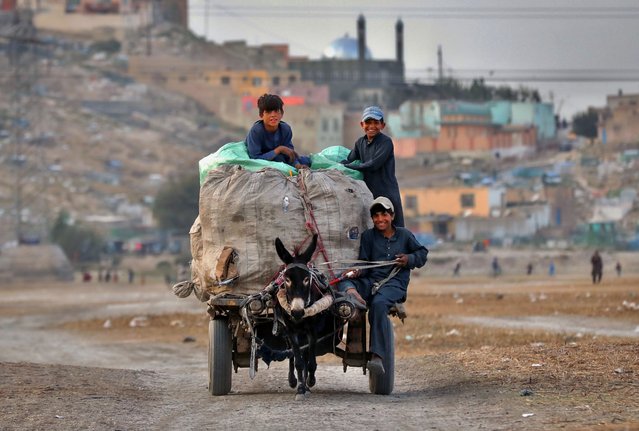
Afghan boys ride on donkey cart transporting plastic bottles for recycling, on the outskirts of Kabul, Afghanistan, on 16 September 2020. Nearly 19 years after the fall of the Taliban regime and the United States invasion, the Afghan government and insurgents on 12 September, began peace negotiations in Doha. Unlike the Taliban team, the 21-member negotiating group sent by Kabul includes four women, who – among other things – will look to safeguard the progress on women's rights since the fall of the Taliban regime that had prevented girls from going to schools and confined women to their homes. (Photo by Hedayatullah Amid/EPA/EFE)

Afghan boys ride on donkey cart transporting plastic bottles for recycling, on the outskirts of Kabul, Afghanistan, on 16 September 2020. Nearly 19 years after the fall of the Taliban regime and the United States invasion, the Afghan government and insurgents on 12 September, began peace negotiations in Doha. (Photo by Hedayatullah Amid/EPA/EFE)
Details
14 Oct 2020 00:01:00
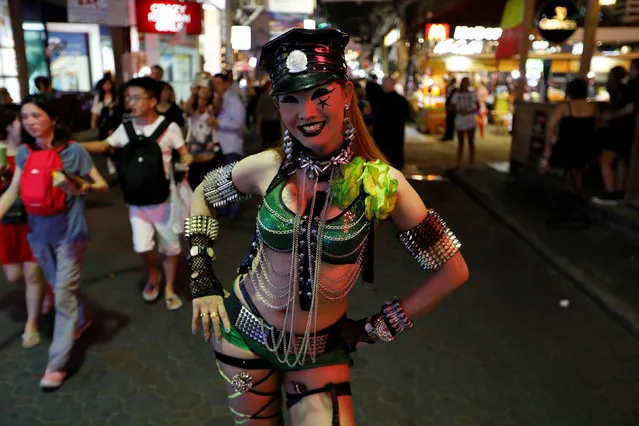
A woman promotes a go-go dance bar in Pattaya, Thailand March 25, 2017. With mascots dressed as smiling fish and a police rock band, Thai authorities launched a “Happy Zone” at the weekend to improve the image of a city notorious for sеx tourism. Stung by foreign headlines portraying the seaside resort of Pattaya as “Sin City” and “The World’s Sеx Capital”, Thailand’s junta has begun a new effort to re-brand it. Businesses in the Happy Zone are asked to make the area feel safer, there are increased security patrols, police launched a mobile phone app for visitors to summon them if an emergency occurs. (Photo by Jorge Silva/Reuters)

A woman promotes a go-go dance bar in Pattaya, Thailand March 25, 2017. With mascots dressed as smiling fish and a police rock band, Thai authorities launched a “Happy Zone” at the weekend to improve the image of a city notorious for sеx tourism. Stung by foreign headlines portraying the seaside resort of Pattaya as “Sin City” and “The World’s Sеx Capital”, Thailand’s junta has begun a new effort to re-brand it. Businesses in the Happy Zone are asked to make the area feel safer, there are increased security patrols, police launched a mobile phone app for visitors to summon them if an emergency occurs. (Photo by Jorge Silva/Reuters)
Details
28 Mar 2017 09:20:00
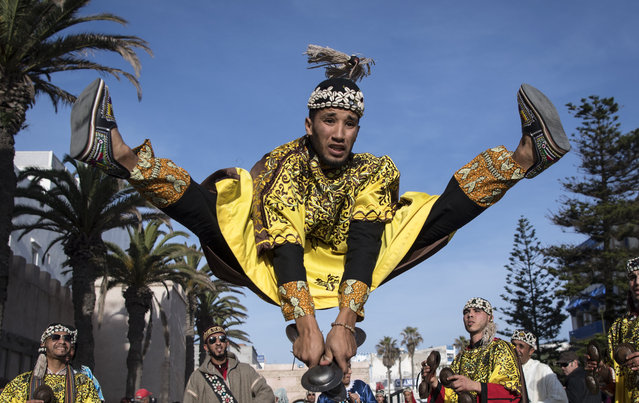
A Gnawa traditional group performs in the city of Essaouira on December 14, 2019, to celebrate the decision of adding the Gnawa culture to UNESCO's list of Intangible Cultural Heritage of Humanity. Gnawa culture, a centuries-old Moroccan practice rooted in music, African rituals and Sufi traditions, was added to UNESCO's list of Intangible Cultural Heritage of Humanity earlier in the week. Gnawa refers to a “set of musical productions, fraternal practices and therapeutic rituals where the secular mixes with the sacred”, according to the nomination submitted by Morocco. Often dressed in colourful outfits, Gnawa musicians play the guenbri, a type of lute with three strings, accompanied by steel castanets called krakebs. (Photo by Fadel Senna/AFP Photo)

A Gnawa traditional group performs in the city of Essaouira on December 14, 2019, to celebrate the decision of adding the Gnawa culture to UNESCO's list of Intangible Cultural Heritage of Humanity. Gnawa culture, a centuries-old Moroccan practice rooted in music, African rituals and Sufi traditions, was added to UNESCO's list of Intangible Cultural Heritage of Humanity earlier in the week. Gnawa refers to a “set of musical productions, fraternal practices and therapeutic rituals where the secular mixes with the sacred”, according to the nomination submitted by Morocco. Often dressed in colourful outfits, Gnawa musicians play the guenbri, a type of lute with three strings, accompanied by steel castanets called krakebs. (Photo by Fadel Senna/AFP Photo)
Details
18 Dec 2019 00:05:00
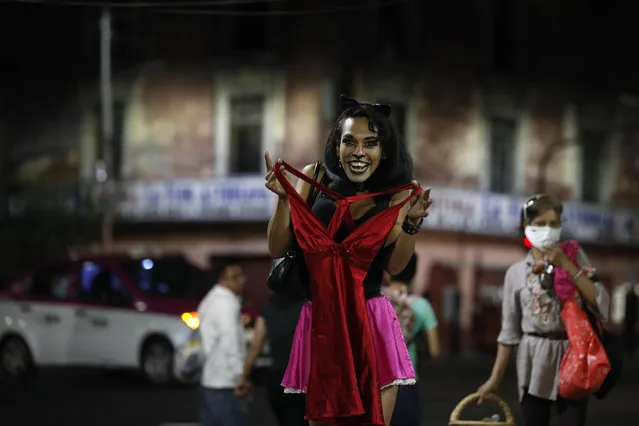
Sеx worker Geraldine, wearing cat make-up, excitedly holds up a dress she is thinking of buying from a street vendor, so that her partner, sitting nearby to keep her company, can see it, as she waits for clients outside the Revolution subway station, in Mexico City, Saturday, March 13, 2021. According to Geraldine, 30, the pandemic has cut clients and increased risks to the sеx workers but has also brought out more assistance for them too, both from dedicated organizations such as the activist group Brigada Callejera or “The Street Brigade” and from individuals who have donated food or clothing. (Photo by Rebecca Blackwell/AP Photo)

Sеx worker Geraldine, wearing cat make-up, excitedly holds up a dress she is thinking of buying from a street vendor, so that her partner, sitting nearby to keep her company, can see it, as she waits for clients outside the Revolution subway station, in Mexico City, Saturday, March 13, 2021. According to Geraldine, 30, the pandemic has cut clients and increased risks to the sеx workers but has also brought out more assistance for them too, both from dedicated organizations such as the activist group Brigada Callejera or “The Street Brigade” and from individuals who have donated food or clothing. (Photo by Rebecca Blackwell/AP Photo)
Details
25 Apr 2021 07:38:00
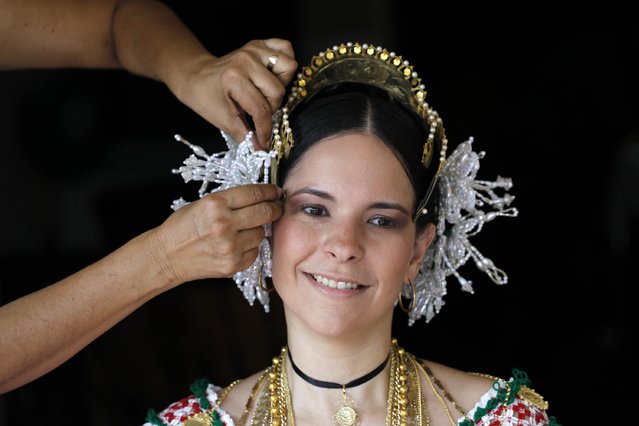
A woman is helped with adorning her hair with jewelry, part of the traditional clothing known as “Pollera”, before the annual Thousand Polleras parade in Las Tablas, in the province of Los Santos January 10, 2015. According to local residents, the Pollera dates back to the 18th century and was worn by the Spanish lower classes. (Photo by Carlos Jasso/Reuters)

A woman is helped with adorning her hair with jewelry, part of the traditional clothing known as “Pollera”, before the annual Thousand Polleras parade in Las Tablas, in the province of Los Santos January 10, 2015. According to local residents, the Pollera dates back to the 18th century and was worn by the Spanish lower classes. Today, it has become the Panamanian national costume. The dress is made entirely by hand and the jewellery worn is pure gold and worth thousands of dollars. (Photo by Carlos Jasso/Reuters)
Details
12 Jan 2015 15:46:00