Loading...
Done
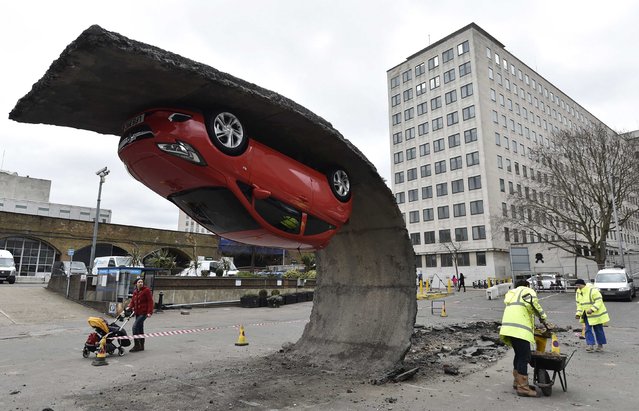
Pedestrians and workers pass an upside down car art installation in a car park on the South Bank in London, February 19, 2015. British artist Alex Chinneck's illusory piece, entitled “Pick yourself up and pull yourself together”, and on display in the working car park for a week, sees a Vauxhall car suspended upside down, appearing to be gripping onto a peeled back length of tarmac. (Photo by Toby Melville/Reuters)

Pedestrians and workers pass an upside down car art installation in a car park on the South Bank in London, February 19, 2015. British artist Alex Chinneck's illusory piece, entitled “Pick yourself up and pull yourself together”, and on display in the working car park for a week, sees a Vauxhall car suspended upside down, appearing to be gripping onto a peeled back length of tarmac. (Photo by Toby Melville/Reuters)
Details
20 Feb 2015 12:39:00
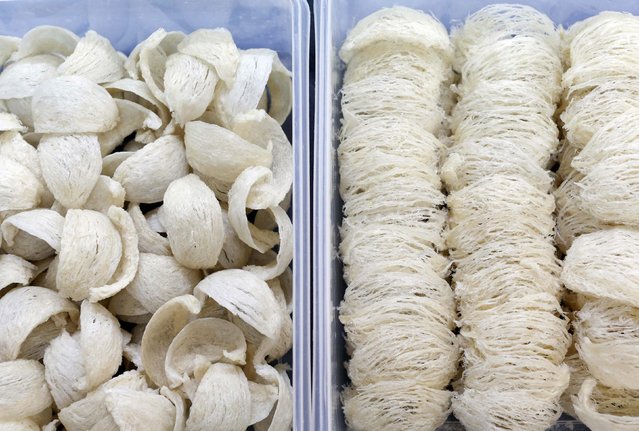
Two styles of cleaned bird's nest, Yan Zhan (L) and Su Zhan (R) await repacking at a processing plant in Kuala Lumpur, February 17, 2015. Prized in China for is alleged health benefits for hundreds of years, nests made from swiftlets' saliva are being mixed into coffee and cereal as the Southeast Asian producers of the delicacy seek to broaden its appeal, and their profit margins. (Photo by Olivia Harris/Reuters)

Two styles of cleaned bird's nest, Yan Zhan (L) and Su Zhan (R) await repacking at a processing plant in Kuala Lumpur, February 17, 2015. Prized in China for is alleged health benefits for hundreds of years, nests made from swiftlets' saliva are being mixed into coffee and cereal as the Southeast Asian producers of the delicacy seek to broaden its appeal, and their profit margins. The nests are among the world's most expensive foods, selling for up to $2,500 a kg and the swiftlets that weave them are indigenous to Indonesia, Malaysia, Thailand and Vietnam. (Photo by Olivia Harris/Reuters)
Details
24 Feb 2015 13:57:00
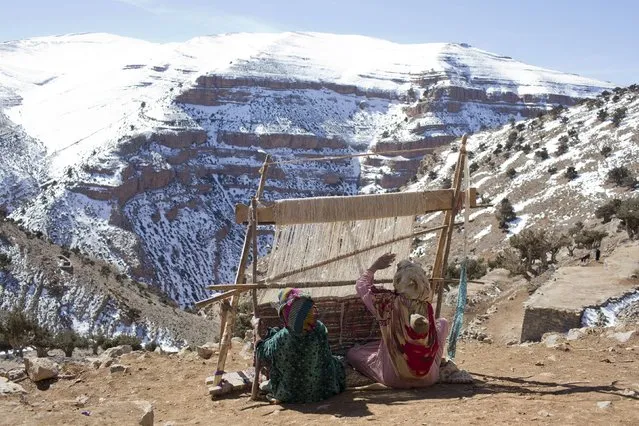
Berber women weave traditional carpets in the village of Ait Sghir in the High Atlas region of Morocco February 15, 2015. The snowy foothills of the High Atlas mountains in Morocco are home to several Berber villages where the inhabitants make their living by farming, baking bread in traditional ovens, herding cattle, and the making and selling of honey, olive oil and pottery. Extreme weather fluctuations and erosion that causes flooding and landslides have led to a drop in agricultural productivity, the United Nations said. (Photo by Youssef Boudlal/Reuters)

Berber women weave traditional carpets in the village of Ait Sghir in the High Atlas region of Morocco February 15, 2015. The snowy foothills of the High Atlas mountains in Morocco are home to several Berber villages where the inhabitants make their living by farming, baking bread in traditional ovens, herding cattle, and the making and selling of honey, olive oil and pottery. Extreme weather fluctuations and erosion that causes flooding and landslides have led to a drop in agricultural productivity, the United Nations said. (Photo by Youssef Boudlal/Reuters)
Details
26 Feb 2015 06:07:00
Chinese relative of a missing passenger on Malaysia Airlines flight MH370 reacts as she weeps outside the main gate of the Lama Temple on March 8, 2015 in Beijing, China. Foreign and local media were prevented by Chinese police from covering the relatives visit to the temple where they tried to pray .There were 239 people on board the flight when it disappeared March 8, 2014 en route from Kuala Lumpur to Beijing. After one year and an exhaustive search, investigators still have no clue as to the whereabouts of the missing airliner.  (Kevin Frayer/Getty Images)

Chinese relative of a missing passenger on Malaysia Airlines flight MH370 reacts as she weeps outside the main gate of the Lama Temple on March 8, 2015 in Beijing, China. Foreign and local media were prevented by Chinese police from covering the relatives visit to the temple where they tried to pray .There were 239 people on board the flight when it disappeared March 8, 2014 en route from Kuala Lumpur to Beijing. After one year and an exhaustive search, investigators still have no clue as to the whereabouts of the missing airliner. (Kevin Frayer/Getty Images)
Details
11 Mar 2015 19:24:00
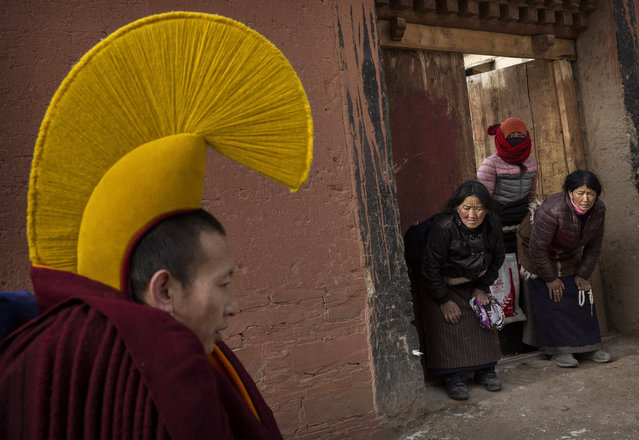
Devotees bow to a passingTibetan Buddhist monk on his way to take part in a special prayer during Monlam or the Great Prayer rituals on March 5, 2015 at the Labrang Monastery, Xiahe County, Amdo, Tibetan Autonomous Prefecture, Gansu Province, China. (Photo by Kevin Frayer/Getty Images)

Devotees bow to a passingTibetan Buddhist monk on his way to take part in a special prayer during Monlam or the Great Prayer rituals on March 5, 2015 at the Labrang Monastery, Xiahe County, Amdo, Tibetan Autonomous Prefecture, Gansu Province, China. Labrang Monastery is one of the six great monasteries of the Gelug school of Tibetan Buddhism and one of the largest outside of the Tibetan Autonomous Region. Monlam, the most important prayer event for many Tibetans was banned during the Cultural Revolution in China but once again in recent years it is celebrated in many areas. (Photo by Kevin Frayer/Getty Images)
Details
14 Mar 2015 14:37:00
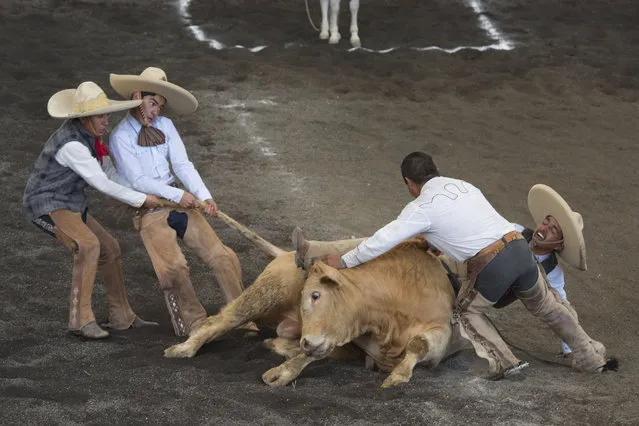
In this February 28, 2015 photo, teammates struggle to lift a bull off the trapped leg of a charro, during the bull riding event at a charreada in Mexico City. National Charros Association President Manuel Basurto Rojas said: “We in charreria are taking things into our own hands. We have codes, we have rules, for how to treat the animals. On the other hand, there is a lot of danger involved for the men doing these tricks”. (Photo by Rebecca Blackwell/AP Photo)

In this February 28, 2015 photo, teammates struggle to lift a bull off the trapped leg of a charro, during the bull riding event at a charreada in Mexico City. National Charros Association President Manuel Basurto Rojas said: “We in charreria are taking things into our own hands. We have codes, we have rules, for how to treat the animals. On the other hand, there is a lot of danger involved for the men doing these tricks”. (Photo by Rebecca Blackwell/AP Photo)
Details
15 Mar 2015 06:44:00
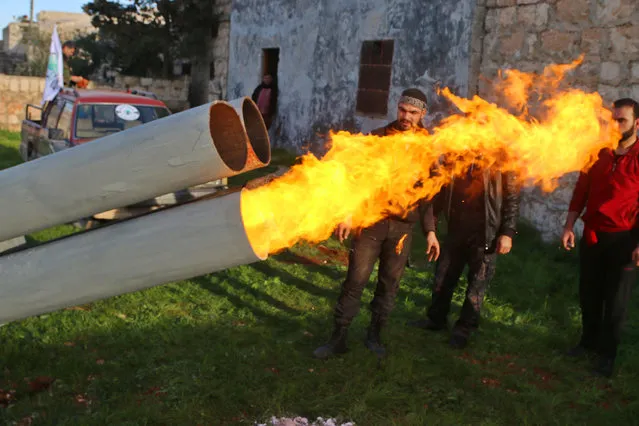
Al-Shamiyah Front fighters inspect a new locally-made cannon named “Borkan” (Volcano) as it was being launched towards forces loyal to Syria's president Bashar Al-Assad located in Aleppo artillery school, March 7, 2015. The “Borkan” is made out of four tubes attached to a loader, which can fire four shells at a time, and have a range of three kilometers (1.86 miles). (Photo by Abdalrhman Ismail/Reuters)

Al-Shamiyah Front fighters inspect a new locally-made cannon named “Borkan” (Volcano) as it was being launched towards forces loyal to Syria's president Bashar Al-Assad located in Aleppo artillery school, March 7, 2015. The “Borkan” is made out of four tubes attached to a loader, which can fire four shells at a time, and have a range of three kilometers (1.86 miles). (Photo by Abdalrhman Ismail/Reuters)
Details
24 Mar 2015 10:11:00
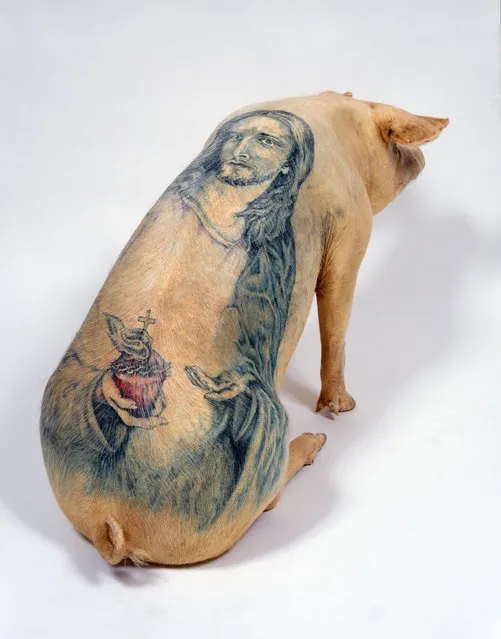
Tattooing Pigs By Wim Delvoye

Wim Delvoye is a notorious tattoo artist, who became famous when he started tattooing live pigs. He first began in 1997 and after animal rights activists found out about what he was doing, he had to move to China to continue his business. There is nothing special about the tattoos that Wim Delvoye creates, they look mediocre at best, and the only reason why he’s famous is his acts of animal cruelty. Nevertheless, Wim states that the pigs feel just fine and are well fed and taken care off. Full anesthesia is used to ensure that the pig doesn’t feel pain during the course of the whole procedure. During this time three tattoo artists work on the tattoo simultaneously to complete it as quickly as possible. Skins of those pigs are then sold for as much as £50k a piece.
Details
02 Apr 2015 09:06:00