Loading...
Done
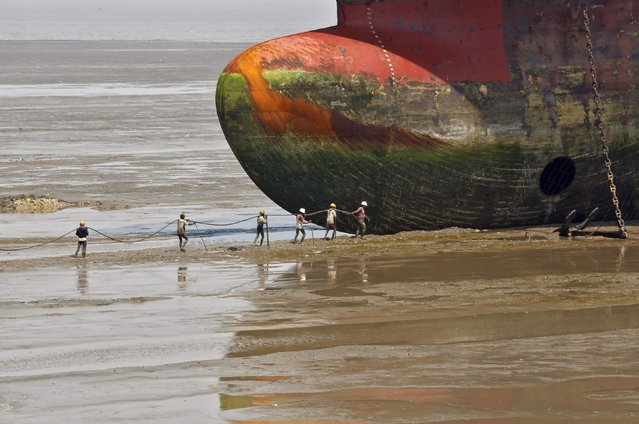
Workers carry a rope line to fasten a decommissioned ship at the Alang shipyard in the western Indian state of Gujarat, March 27, 2015. The European Union plans to impose strict new rules on how companies scrap old tankers and cruise liners, run aground and dismantled on beaches in South Asia. (Photo by Amit Dave/Reuters)

Workers carry a rope line to fasten a decommissioned ship at the Alang shipyard in the western Indian state of Gujarat, March 27, 2015. The European Union plans to impose strict new rules on how companies scrap old tankers and cruise liners, run aground and dismantled on beaches in South Asia. However the practice in India, Bangladesh and Pakistan, hazardous for humans and the environment, will still be hard to stop. European, Turkish and Chinese recyclers are set to benefit from the revamped standards. Depending on raw material prices, ship owners can make up to $500 per tonne of steel from an Indian yard, compared with $300 in China and just $150 in Europe. (Photo by Amit Dave/Reuters)
Details
01 Apr 2015 11:40:00
A picture made available on 13 May 2016 shows A Tiwa girl performing her traditional dance as they celebrated the Wanchuwa festival in Karbi Anglong District of Assam state, India, 11 May 2016. Wanchuwa is one of the most important festivals of the Tiwa tribal community living in the hills as it is related with agriculture which is the mainstay of their economy. Tiwas pray for a bountiful harvest during this festival and to protect their crops from pest and other natural calamities. (Photo by EPA/Stringer)

A picture made available on 13 May 2016 shows A Tiwa girl performing her traditional dance as they celebrated the Wanchuwa festival in Karbi Anglong District of Assam state, India, 11 May 2016. Wanchuwa is one of the most important festivals of the Tiwa tribal community living in the hills as it is related with agriculture which is the mainstay of their economy. Tiwas pray for a bountiful harvest during this festival and to protect their crops from pest and other natural calamities. Tiwa is a major tribe of Assam state who practice Jhum or shifting cultivation for their living in the hills. (Photo by EPA/Stringer)
Details
14 May 2016 11:45:00


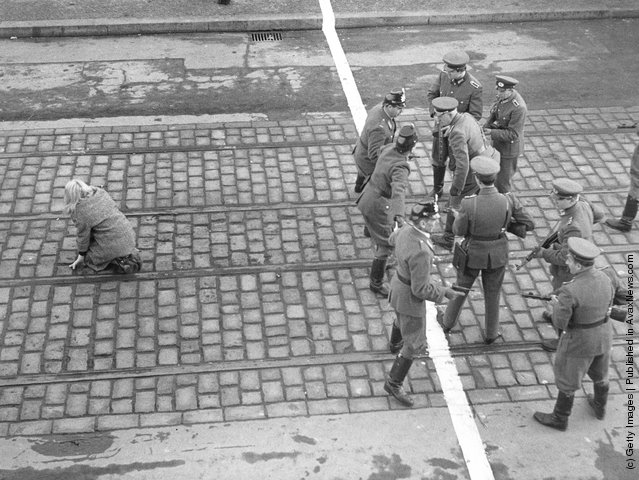
“The Berlin Wall (German: Berliner Mauer) was a barrier constructed by the German Democratic Republic (GDR, East Germany) starting on 13 August 1961, that completely cut off West Berlin from surrounding East Germany and from East Berlin. The barrier included guard towers placed along large concrete walls, which circumscribed a wide area (later known as the “death strip”) that contained anti-vehicle trenches, “fakir beds” and other defenses. The Soviet-dominated Eastern Bloc officially claimed that the wall was erected to protect its population from fascist elements conspiring to prevent the “will of the people” in building a socialist state in East Germany. However, in practice, the Wall served to prevent the massive emigration and defection that marked Germany and the communist Eastern Bloc during the post-World War II period”. – Wikipedia

Photo: West Berlin policemen and East German Volkspolizei face each other across the border in Berlin, circa 1955. (Photo by Three Lions/Hulton Archive/Getty Images)
Details
22 May 2011 10:49:00


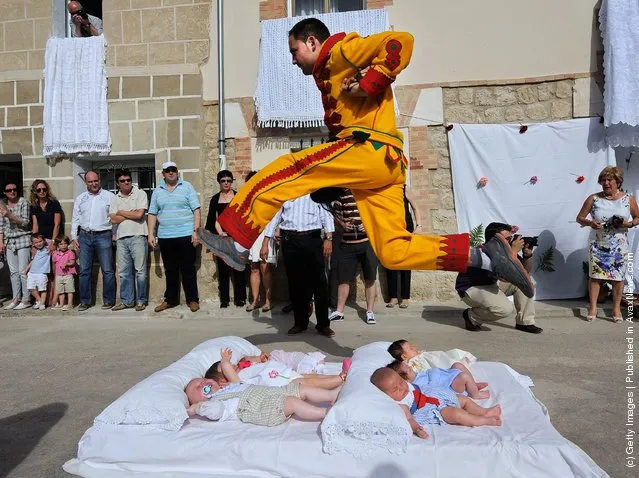
“Baby jumping (El Colacho) is a traditional Spanish practice dating back to 1620 that takes place annually to celebrate the Catholic feast of Corpus Christi in the village of Castrillo de Murcia near Burgos. During the act – known as El Salto del Colacho (the devil's jump) or simply El Colacho – men dressed as the Devil (known as the Colacho) jump over babies born during the previous twelve months of the year who lie on mattresses in the street. ... The festival has been rated as one of the most dangerous in the world”. – Wikipedia

Photo: A man representing the devil leaps over babies during the festival of El Colacho on June 26, 2011 in Castrillo de Murcia near Burgos, Spain. The festival, held on the first Sunday after Corpus Cristi, represents the devil taking away original sin from the newly born babies by leaping over them. (Photo by Denis Doyle/Getty Images)
Details
27 Jun 2011 09:20:00
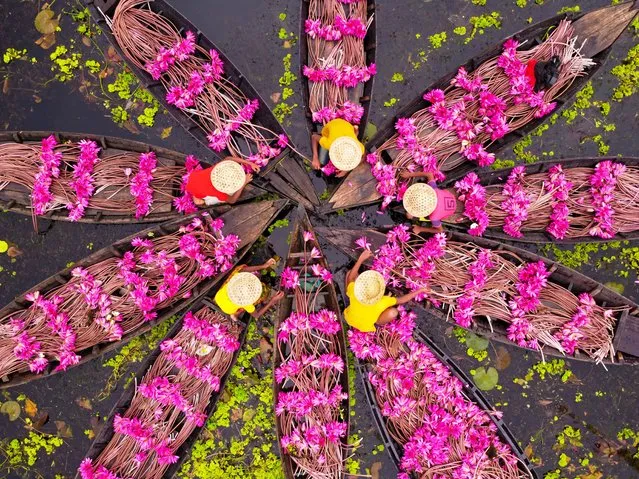
Farmers arrange bunches of water lilies after harvesting them from the wetlands in Barishal, Bangladesh on March 21, 2023. Floating through 10,000 acres of canal, farmers use their little boats to fetch the flowers. They break through the layer of water lilies on the surface of the water as they practice the traditional craft of picking water lilies by hand. Every flower is carefully hand-picked, collected inside the farmers' little wooden boat, tied in bundles, and sold to markets. After working for an entire day, a farmer can pick around 80 to 120 bundles of water lilies. Water lily harvesting is a major source of income for more than 250 families in the area. (Photo by Joy Saha/Cover Images)

Farmers arrange bunches of water lilies after harvesting them from the wetlands in Barishal, Bangladesh on March 21, 2023. Floating through 10,000 acres of canal, farmers use their little boats to fetch the flowers. (Photo by Joy Saha/Cover Images)
Details
01 May 2023 04:00:00
Sue Bunclark, 40, from Rotherham poses for a photograph besides her 1964 first generation or T1, split-screen Volkswagen Transporter Samba van in Newquay on August 6, 2014 in Cornwall, England. The van, which she and her family have owned for five years is nicknamed Sammy. (Photo by Matt Cardy/Getty Images)

Sue Bunclark, 40, from Rotherham poses for a photograph besides her 1964 first generation or T1, split-screen Volkswagen Transporter Samba van in Newquay on August 6, 2014 in Cornwall, England. The van, which she and her family have owned for five years is nicknamed Sammy. The Volkswagen Transporter was first produced in 1950 and has sold over ten million units worldwide evolving through five generations of functional and practical body styles, each representing the ultimate multi-purpose vehicle of its time. To commemorate the model's 60th anniversary in the UK Volkswagen has launched a special edition of the Transporter dubbed the Sportline 60. (Photo by Matt Cardy/Getty Images)
Details
15 Aug 2014 08:58:00
Pilot Felix Baumgartner of Austria is seen before his jump during the first manned test flight for Red Bull Stratos

“Felix Baumgartner (born 20 April 1969 in Salzburg, Austria) is a skydiver and a BASE jumper. He is renowned for the particularly dangerous nature of the stunts he has performed during his career. Baumgartner spent time in the Austrian military where he practiced parachute jumping, including training to land on small target zones”. – Wikipedia

Photo: Pilot Felix Baumgartner of Austria is seen before his jump during the first manned test flight for Red Bull Stratos on March 15, 2012 in Roswell, New Mexico. In this test he reach the altitude 21800 meters (71500 ft) and landed safely near Roswell. Red Bull Stratos is a mission to the edge of the earths atmosphere, where upon reaching altitude of 120,000 feet by helium baloon, pilot and basejumper Felix Baumgartner will then freefall to the ground in an attempt to break the speed of sound. (Photo by Jay Nemeth/Red Bull via Getty Images)
Details
17 Mar 2012 13:11:00
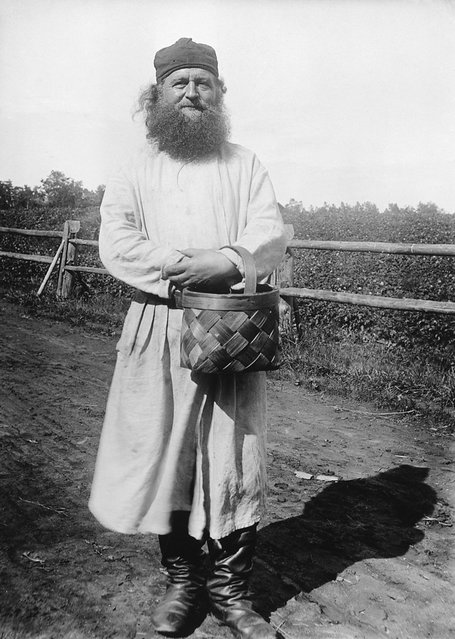
Priest, Valamo Monastery, Karelia, Russia (then Finland), 1930s. Father Venerius with a birchbark basket. (Photo by Einar Erici)

“Einar Erici (1885–1965) was a physician by profession, working at a tuberculosis hospital in Stockholm, even running a private medical practice. He was by then the most renowned Swedish expert of church organs and organ builders, and his archival collection is today held by the Swedish National Heritage Board. This archive includes mostly writings, such as letters and manuscripts for published articles and essays, but also more than 2 000 black and white photos – original prints, glass plates and film negatives”. – Swedish National Heritage Board

Photo: Priest, Valamo Monastery, Karelia, Russia (then Finland), 1930s. Father Venerius with a birchbark basket. (Photo by Einar Erici)
Details
09 Dec 2012 11:41:00