A king eider sea duck tackles a prickly dinner of sea urchin on a lake in Batsfjord, Norway in the last decade of August 2024. The drake’s breeding plumage consists of a distinctive powder-blue head and neck, orange frontal lobe and a red bill. (Photo by Mia Surakka/Solent News)
Freshmen in Zhengzhou Institute of Aeronautical Industry Management head bottles of mineral water for upright stand during military training on September 17, 2015 in Zhengzhou, Henan Province of China. More than 6,800 freshmen in the school are required to take part in the military training. (Photo by ChinaFotoPress/ChinaFotoPress via Getty Images)
Chinese aids activists hand out condoms in a subway train in Wuhan, central China's Hubei province on December 1, 2014. The World Health Organization issued a call to action to China on December 1, 2014 over HIV/AIDS as government figures said nearly half a million people are living with the disease or its precursor, with hundreds of thousands more thought to be undiagnosed. (Photo by AFP Photo)
Tajammu Al-Ezza brigade fighters react while firing a Grad shell towards forces of Syria's President Bashar Al-Assad stationed in Salhab village, Hama countryside, May 7, 2015. (Photo by Mohamad Bayoush/Reuters)
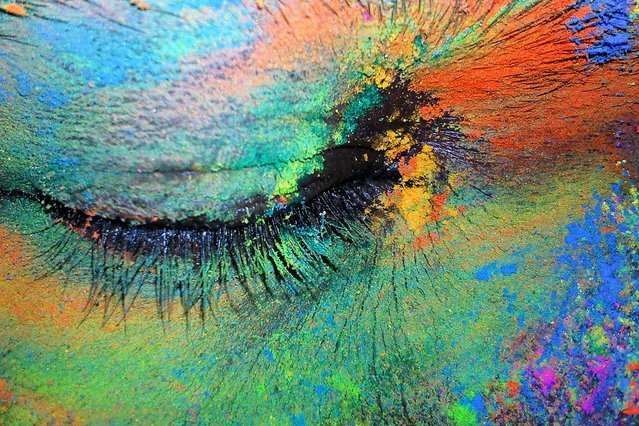
This close-up image – of a Holi Festival celebrant in Vrindivan, India, coated in neon-colored powder – was submitted to National Geographic’s Your Shot in the last week of March. On April 1 we published it on our Daily News site, along with seven other bright scenes captured during the Hindu spring Festival of Colors. (Photo by Tinto Alencherry/National Geographic)
Members of the Wasteland Warriors from the movie “MadMax” pose during the Wacken Open Air festival on August 4, 2016 in Wacken, Germany. Wacken is a village in northern Germany with a population of 1,800 that has hosted the annual festival, which attracts heavy metal fans from around the world, since 1990. (Photo by Alexander Koerner/Getty Images)
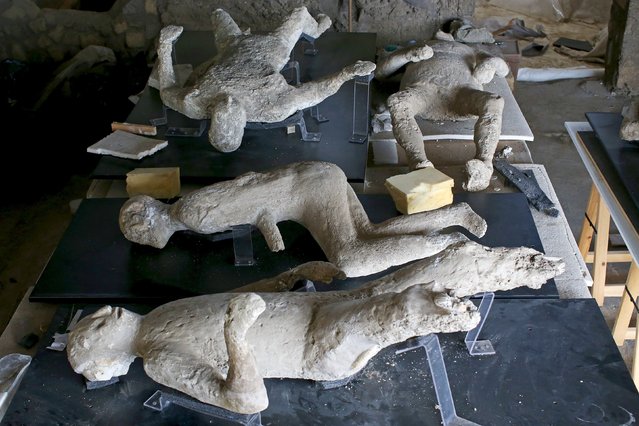
Plaster cast moulds of victims of the Mount Vesuvius eruption lie on a display table in a laboratory at Pompeii October 13, 2015. An expert team made up of archaeologists, radiologists, orthodontists and anthropologists began on September 2015 to use CAT scan technology (computerised axial tomography) to peer inside the plaster cast moulds of Pompeii's victims, in a study that has added more detail to previous findings. A 16-layer scan had to be used in order to penetrate the hardened plaster but the results showed up impressive skeletal remains and near perfect teeth. (Photo by Alessandro Bianchi/Reuters)