Loading...
Done
A Munduruku Indian child is pictured at the Planalto Palace, where a meeting with Minister of the General Secretariat of the Presidency of Brazil Gilberto Carvalho was being held with other Munduruku Indians, in Brasilia, June 4, 2013. (Photo by Ueslei Marcelino/Reuters)

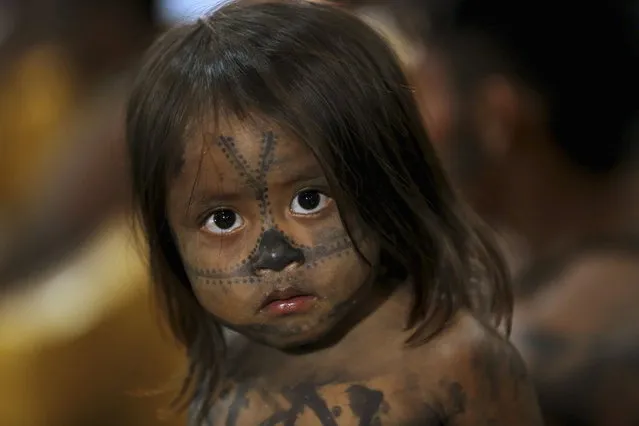
A Munduruku Indian child is pictured at the Planalto Palace, where a meeting with Minister of the General Secretariat of the Presidency of Brazil Gilberto Carvalho was being held with other Munduruku Indians, in Brasilia, June 4, 2013. President Dilma Rousseff's government sought on Tuesday to defuse mounting conflicts with indigenous groups over its decision to stop setting aside farm land for Indians and plans to build more hydroelectric dams in the Amazon. The government flew 144 Munduruku Indians to Brasilia for talks to end a week-long occupation of the controversial Belo Monte dam on the Xingu river, a huge project aimed at feeding Brazil's fast-growing demand for electricity. (Photo by Ueslei Marcelino/Reuters)
Details
06 Jun 2013 09:25:00
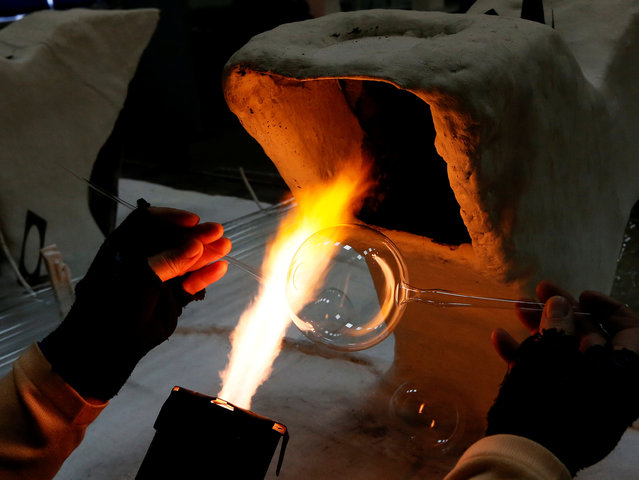
An employee works on a glass sphere for Christmas and New Year decoration at the “Biryusinka” toy factory, which has been producing decorations and toys for the festive season since 1942, in the Siberian city of Krasnoyarsk, Russia, November 16, 2016. (Photo by Ilya Naymushin/Reuters)

An employee works on a glass sphere for Christmas and New Year decoration at the “Biryusinka” toy factory, which has been producing decorations and toys for the festive season since 1942, in the Siberian city of Krasnoyarsk, Russia, November 16, 2016. (Photo by Ilya Naymushin/Reuters)
Details
17 Nov 2016 11:24:00
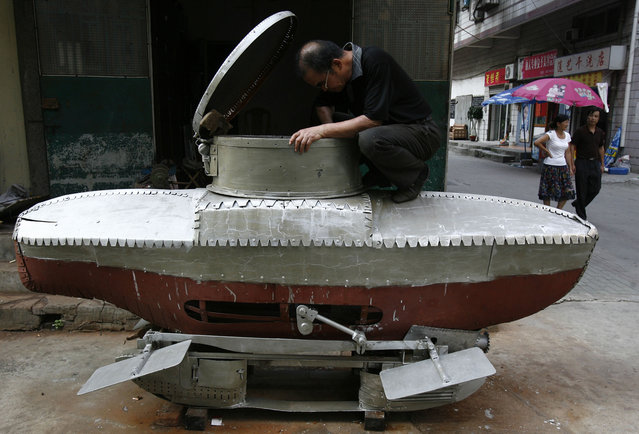
Li Yuming, a local farmer who is interested in scientific invention, works on his unfinished miniature submarine “Xiaguang V” on the outskirts of Wuhan, capital of central China's Hubei province August 24, 2007. “Xiaguang V”, which is 3-metre long, 1.2-metre in height, has a maximum diving depth of 20 metres, and can hold two adults and one child at the same time. The submarine will be used for tour after safety test, local media said. (Photo by Reuters/Stringer)

Li Yuming, a local farmer who is interested in scientific invention, works on his unfinished miniature submarine “Xiaguang V” on the outskirts of Wuhan, capital of central China's Hubei province August 24, 2007. “Xiaguang V”, which is 3-metre long, 1.2-metre in height, has a maximum diving depth of 20 metres, and can hold two adults and one child at the same time. The submarine will be used for tour after safety test, local media said. (Photo by Reuters/Stringer)
Details
09 Sep 2013 10:44:00
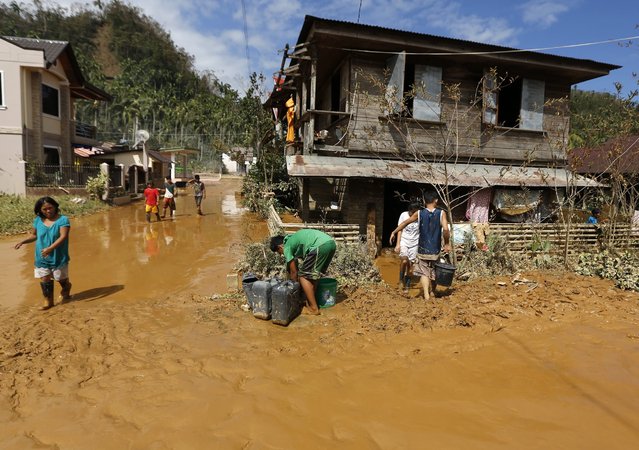
Filipino typhoon victims walk through heavy mud in the typhoon hit town of Taft, Samar island, Philippines, 08 December 2014. Typhoon Hagupit weakened into a tropical storm as it moved towards the Philippine capital after killing at least 27 people and displacing more than one million people in the eastern and central provinces. (Photo by Francis R. Malasig/EPA)

Filipino typhoon victims walk through heavy mud in the typhoon hit town of Taft, Samar island, Philippines, 08 December 2014. Typhoon Hagupit weakened into a tropical storm as it moved towards the Philippine capital after killing at least 27 people and displacing more than one million people in the eastern and central provinces. Hagupit slammed into the country's eastern coast on 06 December evening, bringing heavy rains and gale-force winds that flattened homes, ripped off roofs, and knocked out power and communications. (Photo by Francis R. Malasig/EPA)
Details
10 Dec 2014 11:37:00
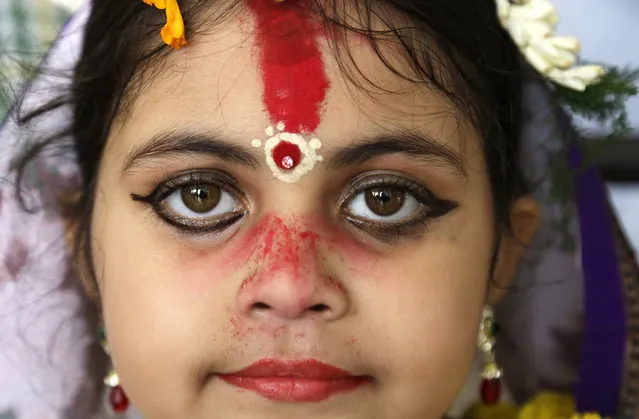
A young Hindu girl sits for a ceremony where she and other girls are worshipped as “Kumari”, or living goddess, during Ram Navami festival, at a temple in Kolkata, India, Saturday, March 28, 2015. (Photo by Bikas Das/AP Photo)

A young Hindu girl sits for a ceremony where she and other girls are worshipped as “Kumari”, or living goddess, during Ram Navami festival, at a temple in Kolkata, India, Saturday, March 28, 2015. Ram Navami marks the birth of Hindu God Rama. (Photo by Bikas Das/AP Photo)
Details
29 Mar 2015 12:23:00
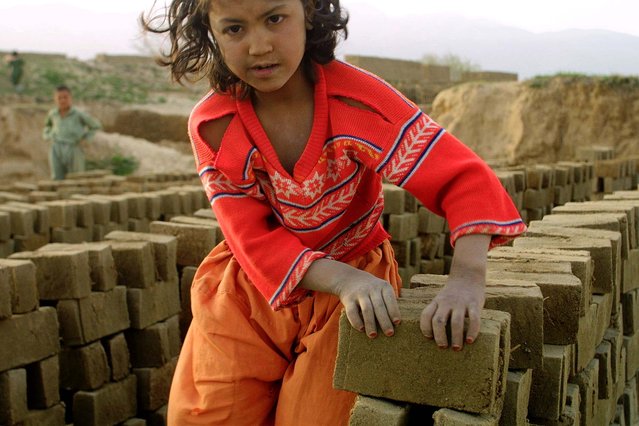
An Afghan girl makes a pile of unbaked bricks near the road passing through the Shamali Plains, about 10 kilometers (6 miles), west of Bagram, Afghanistan, Wednesay April 9, 2003. Children assist parents in their job to supplement family income. (Photo by Gurinder Osan/AP Photo)

An Afghan girl makes a pile of unbaked bricks near the road passing through the Shamali Plains, about 10 kilometers (6 miles), west of Bagram, Afghanistan, Wednesay April 9, 2003. Children assist parents in their job to supplement family income. (Photo by Gurinder Osan/AP Photo)
Details
10 Sep 2016 09:14:00
A Ruthenian woman circa 1906 from the region historically inhabiting the kingdom of the Rus, incorporating parts of modern-day Slavic speaking countries. Her outfit consists of a shirt and underskirt made from linen embroidered with traditional floral-based patterns. (Photo by Augustus Francis Sherman/New York Public Library/The Guardian)

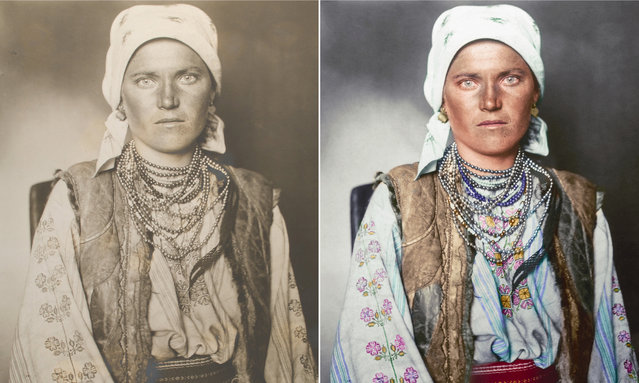
Many of the 12 million people who entered the US through New York’s Ellis Island wore traditional dress from their homelands. Here: A Ruthenian woman circa 1906 from the region historically inhabiting the kingdom of the Rus, incorporating parts of modern-day Slavic speaking countries. Her outfit consists of a shirt and underskirt made from linen embroidered with traditional floral-based patterns. (Photo by Augustus Francis Sherman/New York Public Library/The Guardian)
Details
03 Oct 2016 09:15:00
The unromantic gypsies. Children boxing in a gypsy camp in Kent, England on July 1, 1951. Like all boys these gypsy lads like to try their hand at boxing. Encouraged by their friends they fight it out on Corke's Meadow. Few Romanies now live a life of wandering romance. Most are like the three hundred squatters of Corke's Meadow, Kent, which is part of a “gypsy problem” that involves about 100,000 today. Of those about 25,000 can be rightly called gypsies, the rest are Mumpers and Posh-rats and Hobos. Corke's Meadow has both kinds. “Picture Post” cameraman Bert Hardy photographs the Corke's Meadow gypsies in their encampment. (Photo by Hulton-Deutsch Collection/Corbis via Getty Images)

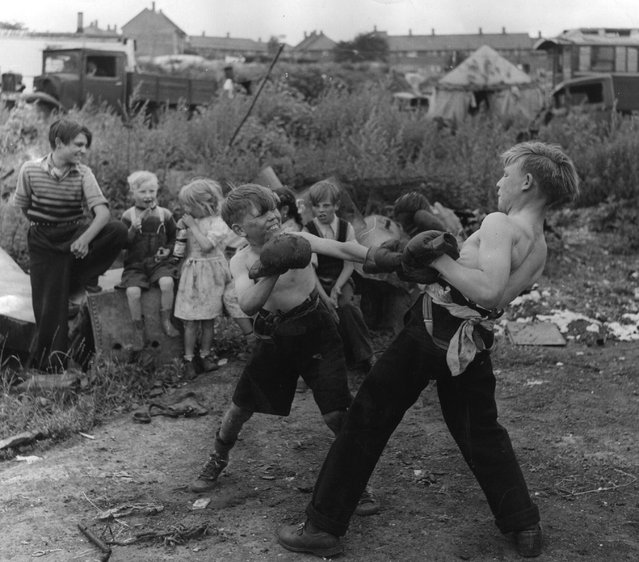
The unromantic gypsies. Children boxing in a gypsy camp in Kent, England on July 1, 1951. Like all boys these gypsy lads like to try their hand at boxing. Encouraged by their friends they fight it out on Corke's Meadow. Few Romanies now live a life of wandering romance. Most are like the three hundred squatters of Corke's Meadow, Kent, which is part of a “gypsy problem” that involves about 100,000 today. Of those about 25,000 can be rightly called gypsies, the rest are Mumpers and Posh-rats and Hobos. Corke's Meadow has both kinds. “Picture Post” cameraman Bert Hardy photographs the Corke's Meadow gypsies in their encampment. (Photo by Hulton-Deutsch Collection/Corbis via Getty Images)
Details
12 Mar 2017 00:01:00