Loading...
Done
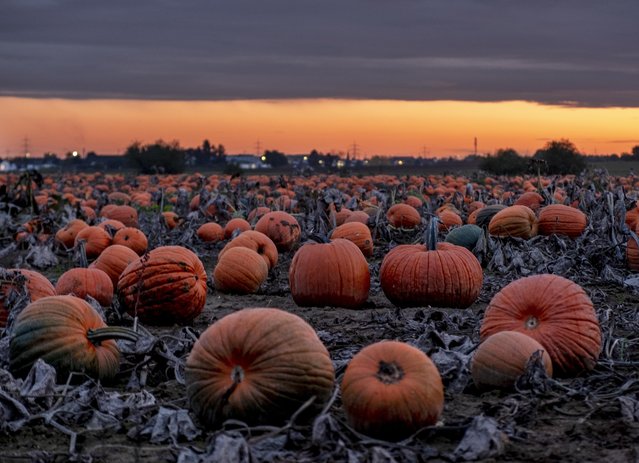
Hundreds of pumpkins lie on a field near Frankfurt, Germany, after sunset on Wednesday, October 16, 2019. The autumn vegetable heralds the approach of halloween. (Photo by Michael Probst/AP Photo)

Hundreds of pumpkins lie on a field near Frankfurt, Germany, after sunset on Wednesday, October 16, 2019. The autumn vegetable heralds the approach of halloween. (Photo by Michael Probst/AP Photo)
Details
19 Oct 2019 00:07:00
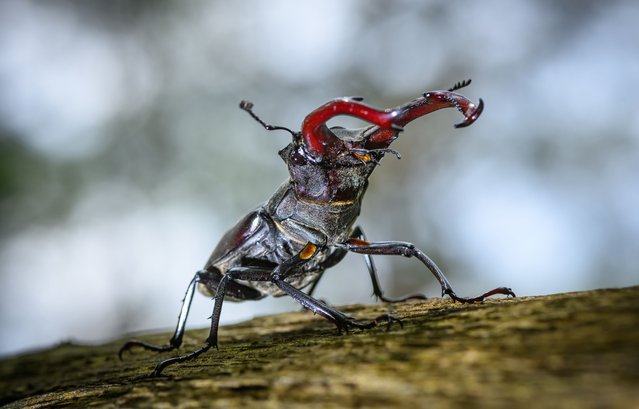
A male stag beetle walks on a branch in an oak forest near the Spree River in Kersdorf, Brandenburg, Germany, on June 8, 2025. (Photo by Patrick Pleul/picture alliance via Getty Images)

A male stag beetle walks on a branch in an oak forest near the Spree River in Kersdorf, Brandenburg, Germany, on June 8, 2025. (Photo by Patrick Pleul/picture alliance via Getty Images)
Details
29 Jun 2025 03:45:00
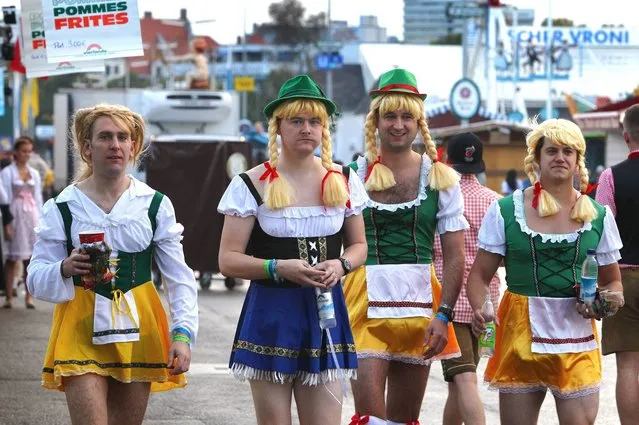
British visitors wearing Bavarian costumes walk ahead the opening of the traditional Bavarian Oktoberfest festival at the Theresienwiese in Munich, southern Germany, on September 20, 2014. (Photo by Karl-Josef Hildenbrand/AFP Photo/DPA)

British visitors wearing Bavarian costumes walk ahead the opening of the traditional Bavarian Oktoberfest festival at the Theresienwiese in Munich, southern Germany, on September 20, 2014. Germany's world-famous Oktoberfest kicks off with millions of revellers set to soak up the frothy atmosphere in a 16-day extravaganza of lederhosen, oompah music and, of course, beer. (Photo by Karl-Josef Hildenbrand/AFP Photo/DPA)
Details
22 Sep 2014 11:27:00


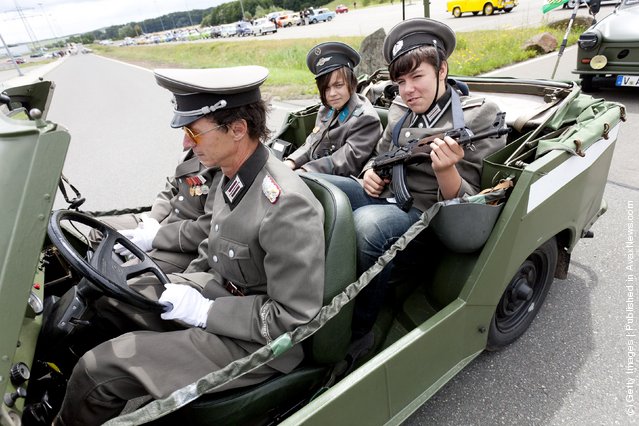
“The Trabant is a car that was produced by former East German auto maker VEB Sachsenring Automobilwerke Zwickau in Zwickau, Sachsen. It was the most common vehicle in East Germany, and was also exported to countries both inside and outside the communist bloc. The main selling points was that it had room for four adults and luggage in a compact, light and durable shell and that it was fast (when introduced) and durable. With its mediocre performance, smoky two-stroke engine, and production shortages, the Trabant is often cited as an example of the disadvantages of centralized planning; on the other hand, it is regarded with derisive affection as a symbol of the failed former East Germany and of the fall of communism (in former West Germany, as many East Germans streamed into West Berlin and West Germany in their Trabants after the opening of the Berlin Wall in 1989). It was in production without any significant changes for nearly 30 years with 3,096,099 Trabants produced in total”. – Wikipedia

Photo: Enthusiasts weared in uniforms of the former eastern german army trive in a military Trabant car as fans and owners of East German-era Trabant cars gather at the 2011 International Trabantfahrer Treffen (International Trabant Drivers Meeting) on June 26, 2011 in Zwickau, Germany. The Trabant, also known as the Trabi, was among the main cars produced in communist East Germany and built by VEB Sachsenring Automobilwerke in Zwickau for 30 years until 1989. Today the car has cult status for many followers and one company, IndiKar, is even seeking to revive the brand in a modern, electric version. (Photo by Carsten Koall/Getty Images)
Details
27 Jun 2011 12:21:00
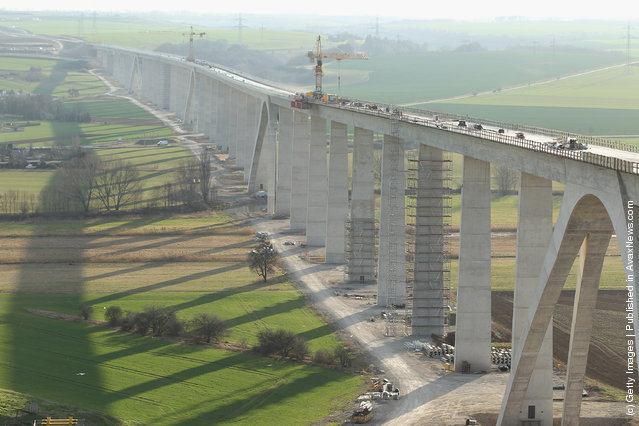
Unstrut Valley high-speed railway bridge near Karsdorf, Germany

Construction cranes stand on the Unstrut Valley high-speed railway bridge on March 19, 2012 near Karsdorf, Germany. The Unstrut bridge, which is 2,668m long (about 1.6 miles), is among 38 bridges and 26 tunnels German state rail carrier Deutsche Bahn is building along a new ICE high-speed railroad connection between Nuremberg, Erfurt, Halle, Leipzig and Berlin in a multi-billion Euro project across eastern Germany called the German Unity Transportation Project (Verkehrsprojekt der Deutschen Einheit). (Photo by Sean Gallup/Getty Images)
Details
22 Mar 2012 10:53:00


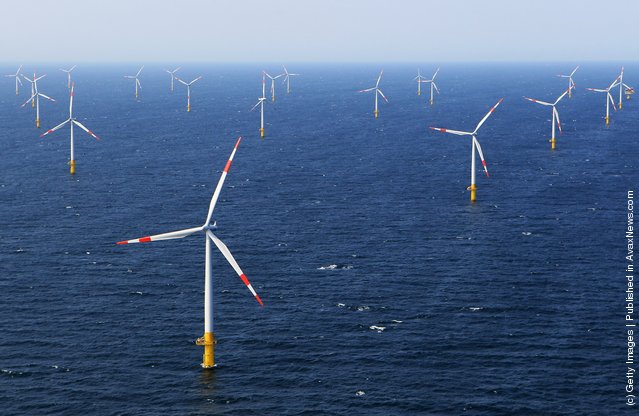
Wind turbines stand in the Baltic 1 offshore wind farm on April 29, 2011 in the Baltic Sea near Zingst, Germany. Baltic 1, a project of German energy utility EnBW that includes 21 turbines rated at 2.3 megawatts each, will be Germany's first commercial offshore wind farm once it officially begins operation on May 2. Germany has thus far lagged in offshore wind farm construction when compared to neighbors like Great Britain and Denmark, though German Chancellor Angela Merkel has vowed to invest heavily into offshore wind farms as part of an overall policy to encourage renewable energy production. (Photo by Joern Pollex/Getty Images)
Details
30 Apr 2011 12:54:00
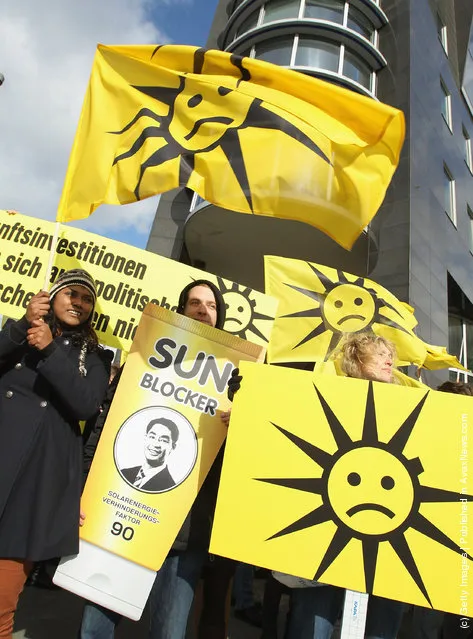
 Activists protesting cuts in subsidies to solar power in Germany protest outside the building where Vice Chancellor and Economy Minister Philipp Roesler and Environment Minister Norbert Roettgen were announcing the cuts

Activists protesting cuts in subsidies to solar power in Germany protest outside the building where Vice Chancellor and Economy Minister Philipp Roesler and Environment Minister Norbert Roettgen were announcing the cuts on February 23, 2012 in Berlin, Germany. (Photo by Sean Gallup/Getty Images)
Details
24 Feb 2012 11:29:00


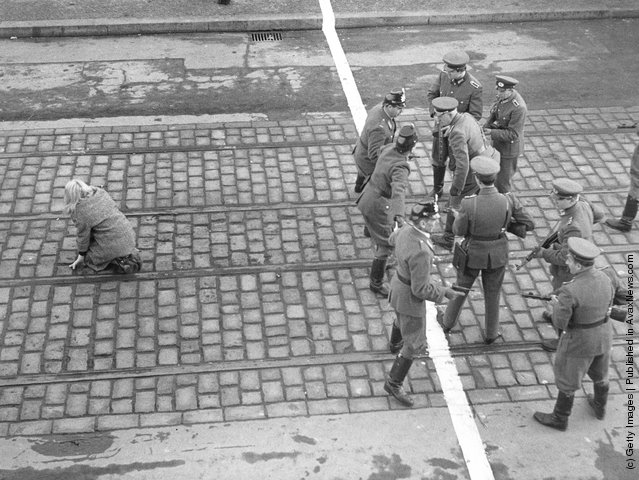
“The Berlin Wall (German: Berliner Mauer) was a barrier constructed by the German Democratic Republic (GDR, East Germany) starting on 13 August 1961, that completely cut off West Berlin from surrounding East Germany and from East Berlin. The barrier included guard towers placed along large concrete walls, which circumscribed a wide area (later known as the “death strip”) that contained anti-vehicle trenches, “fakir beds” and other defenses. The Soviet-dominated Eastern Bloc officially claimed that the wall was erected to protect its population from fascist elements conspiring to prevent the “will of the people” in building a socialist state in East Germany. However, in practice, the Wall served to prevent the massive emigration and defection that marked Germany and the communist Eastern Bloc during the post-World War II period”. – Wikipedia

Photo: West Berlin policemen and East German Volkspolizei face each other across the border in Berlin, circa 1955. (Photo by Three Lions/Hulton Archive/Getty Images)
Details
22 May 2011 10:49:00