Loading...
Done


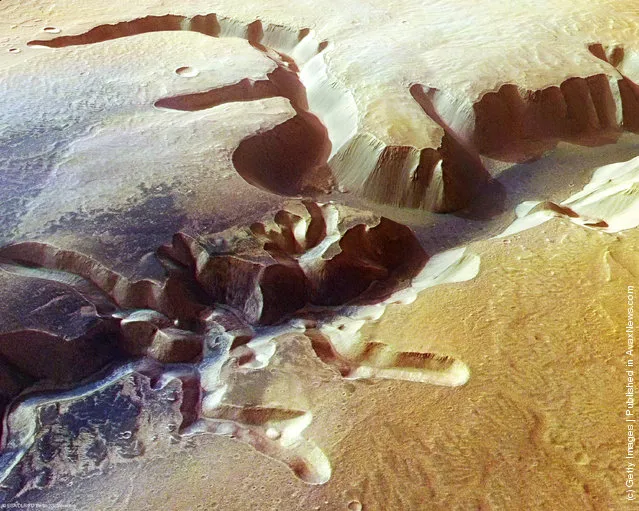
“Echus Chasma is a chasma in the Lunae Planum high plateau north of the Valles Marineris canyon system of Mars. Clay has been found in Echus Chasma that means that water once sat there for a time. Echus Chasma is approximately 100 km long and 10 km wide, with valleys ranging in depth from around 1 km to 4 km”. – Wikipedia

Photo: In this handout image supplied by the European Space Agency (ESA) on July 16, 2008, The Echus Chasma, one of the largest water source regions on Mars, is pictured from ESA's Mars Express. The data was acquired on September 25, 2005. The dark material shows a network of light-coloured, incised valleys that look similar to drainage networks known on Earth. It is still debated whether the valleys originate from precipitation, groundwater springs or liquid or magma flows on the surface. (Photo by ESA via Getty Images)
Details
18 Jul 2011 11:47:00
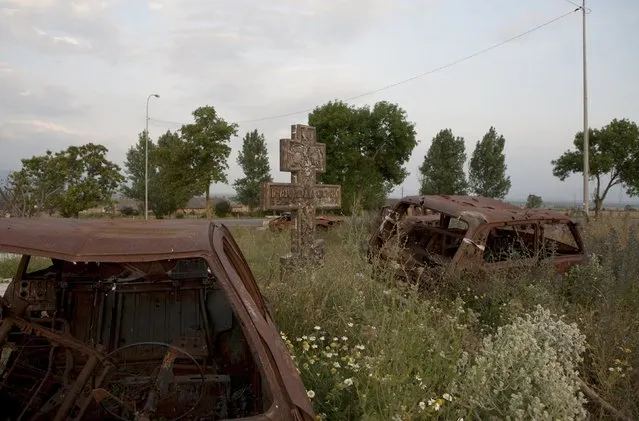
Abandoned cars are seen around a cross in the village of Tbeti near Tskhinvali, the capital of the breakaway region of South Ossetia, Georgia, July 4, 2015. President Vladimir Putin signed a treaty with Georgia's rebel South Ossetia region on March 18 that almost completely integrates it with Russia, alarming Georgia and the West a year after Moscow took over Crimea. (Photo by Kazbek Basaev/Reuters)

Abandoned cars are seen around a cross in the village of Tbeti near Tskhinvali, the capital of the breakaway region of South Ossetia, Georgia, July 4, 2015. President Vladimir Putin signed a treaty with Georgia's rebel South Ossetia region on March 18 that almost completely integrates it with Russia, alarming Georgia and the West a year after Moscow took over Crimea. Russia won a five-day war with Georgia in 2008 over the fate of South Ossetia and another rebel region, Abkhazia. It formally recognizes both regions as independent states and signed a similar treaty with Abkhazia last year. (Photo by Kazbek Basaev/Reuters)
Details
09 Jul 2015 11:43:00
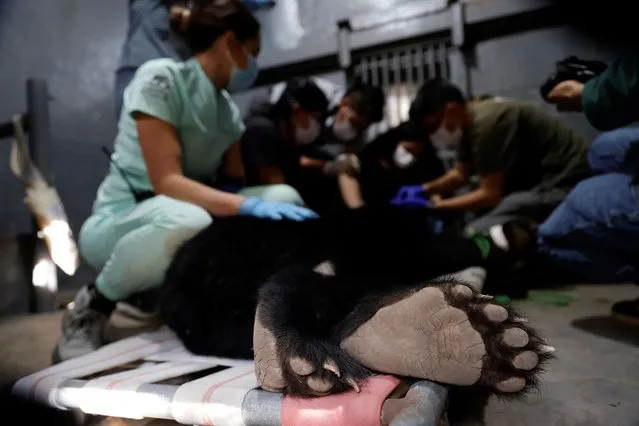
Veterinarians and biologists from the Quito Zoo and the Andean Condor Foundation fit a tracking collar that juvenile Andean bear Tupak will wear for the next four years, prior to his reintroduction into the wild, after the bear's life was deemed in danger due to proximity to humans, in Quito, Ecuador on March 31, 2024. (Photo by Karen Toro/Reuters)

Veterinarians and biologists from the Quito Zoo and the Andean Condor Foundation fit a tracking collar that juvenile Andean bear Tupak will wear for the next four years, prior to his reintroduction into the wild, after the bear's life was deemed in danger due to proximity to humans, in Quito, Ecuador on March 31, 2024. (Photo by Karen Toro/Reuters)
Details
07 Apr 2024 02:58:00
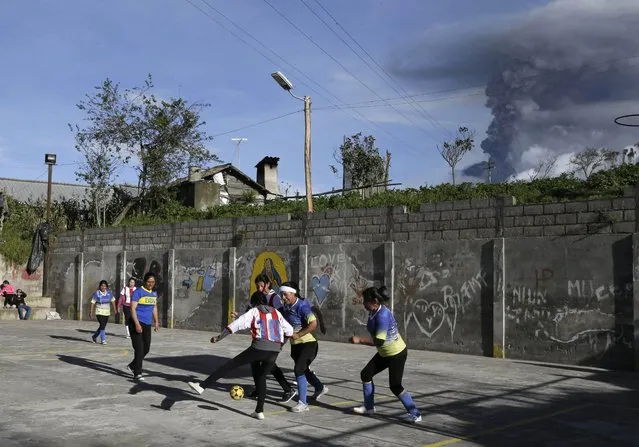
Women play soccer as  the Tungurahua volcano spews a column of ash during an eruption in Huambalo, Ecuador, Saturday, March 5, 2016. Tungurahua is 16,480 feet (5,023 meters) high and has been active since 1999. (Photo by Dolores Ochoa/AP Photo)

Women play soccer as the Tungurahua volcano spews a column of ash during an eruption in Huambalo, Ecuador, Saturday, March 5, 2016. Tungurahua is 16,480 feet (5,023 meters) high and has been active since 1999. (Photo by Dolores Ochoa/AP Photo)
Details
07 Mar 2016 11:28:00
A robot named Nia from Beijing Qingfei Technologies Co. Ltd greets visitors to the Zhongguancun Forum at the Zhongguancun International Innovation Center in Beijing, China, Friday, March 28, 2025. (Photo by Ng Han Guan/AP Photo)

A robot named Nia from Beijing Qingfei Technologies Co. Ltd greets visitors to the Zhongguancun Forum at the Zhongguancun International Innovation Center in Beijing, China, Friday, March 28, 2025. (Photo by Ng Han Guan/AP Photo)
Details
11 Apr 2025 02:50:00
A ring-tailed lemur sunbakes at Melbourne Zoo in Melbourne, Victoria, Australia on December 21 2016. (Photo by Julian Smith/EPA)

A ring-tailed lemur sunbakes at Melbourne Zoo in Melbourne, Victoria, Australia on December 21 2016. (Photo by Julian Smith/EPA)
Details
01 Jan 2017 09:12:00
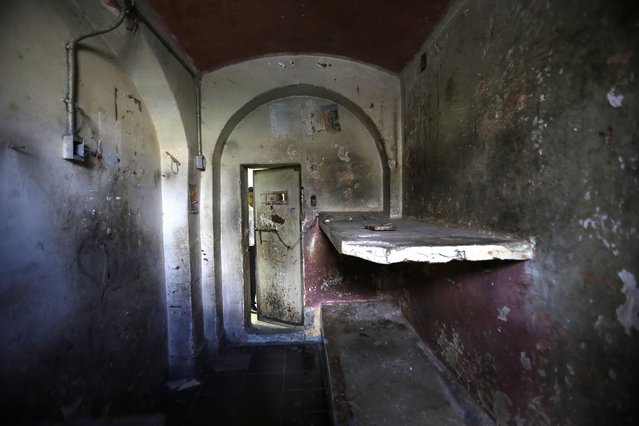
In this April 7, 2015 photo, a tourist peers through the door of a jail cell inside the now empty Garcia Moreno prison during a guided tour for the public in Quito, Ecuador. According to tour guides, this cell was nicknamed “Los Polillas”, or “The Moths”. Here, in a room designed to hold two prisoners, about 15 inmates with drug addictions were locked in overnight by the prison gangs that controlled daily life. The locked-in prisoners were also known to prostitute themselves to get access to drugs. (Photo by Dolores Ochoa/AP Photo)

In this April 7, 2015 photo, a tourist peers through the door of a jail cell inside the now empty Garcia Moreno prison during a guided tour for the public in Quito, Ecuador. According to tour guides, this cell was nicknamed “Los Polillas”, or “The Moths”. Here, in a room designed to hold two prisoners, about 15 inmates with drug addictions were locked in overnight by the prison gangs that controlled daily life. The locked-in prisoners were also known to prostitute themselves to get access to drugs. (Photo by Dolores Ochoa/AP Photo)
Details
03 May 2015 10:34:00
A military instructor helps a boy to shoot a rifle with blanks at a weapon exhibition during a military show in St.Petersburg, Russia, Sunday, January 17, 2016. (Photo by Dmitry Lovetsky/AP Photo)

A military instructor helps a boy to shoot a rifle with blanks at a weapon exhibition during a military show in St.Petersburg, Russia, Sunday, January 17, 2016. (Photo by Dmitry Lovetsky/AP Photo)
Details
18 Jan 2016 11:34:00