Loading...
Done
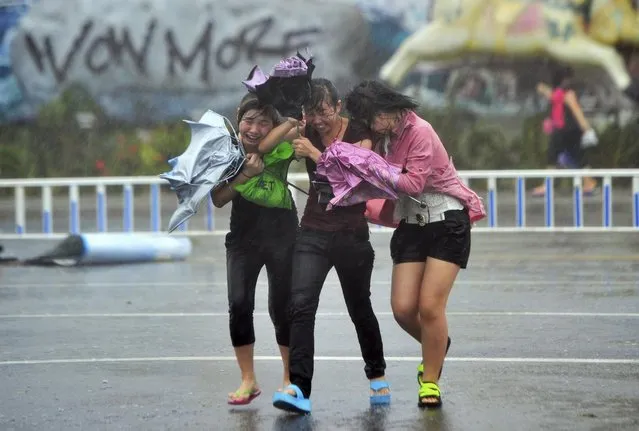
People cross a street against strong wind and heavy rainfall under the influence of Typhoon Haiyan, in Sanya, Hainan province November 10, 2013. One of the most powerful storms ever recorded killed at least 10,000 people in the central Philippines, a senior police official said on Sunday, with huge waves sweeping away entire coastal villages and devastating the region's main city. Despite weakening, the storm is likely to cause heavy rains, flooding, strong winds and mudslides as it makes its way north in the South China Sea. (Photo by Reuters/China Daily)

People cross a street against strong wind and heavy rainfall under the influence of Typhoon Haiyan, in Sanya, Hainan province November 10, 2013. One of the most powerful storms ever recorded killed at least 10,000 people in the central Philippines, a senior police official said on Sunday, with huge waves sweeping away entire coastal villages and devastating the region's main city. Despite weakening, the storm is likely to cause heavy rains, flooding, strong winds and mudslides as it makes its way north in the South China Sea. (Photo by Reuters/China Daily)
Details
16 Nov 2013 12:28:00
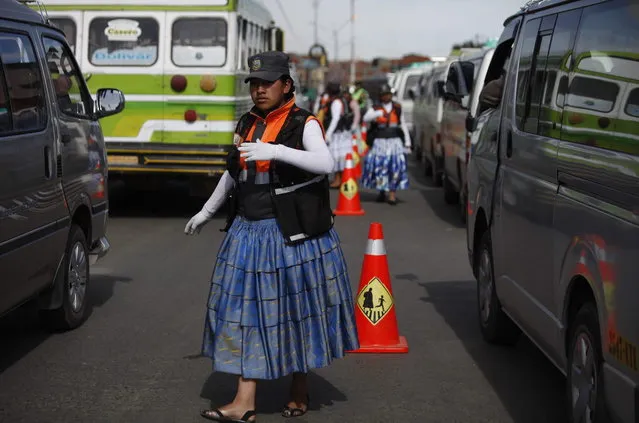
In this December 3, 2013 photo, an Aymara woman cops directs traffic on the streets of El Alto, Bolivia. The women wear the bright petticoats and shawls of indigenous women in the Andes, called cholitas in Bolivian slang, the main difference being that instead of bowler hats they wear khaki green police-style caps. Some don fluorescent traffic vests. (Photo by Juan Karita/AP Photo)

“This city in Bolivia's highlands has hired Aymara women dressed in traditional multilayered Andean skirts and brightly embroidered vests to work as traffic cops and bring order to its road chaos. About 20 of the “traffic cholitas” have been trained to direct cars and buses in El Alto, a teeming, impoverished sister city of La Paz in Bolivia's Andes mountains”. – El Alto via Associated Press. Photo: In this December 3, 2013 photo, an Aymara woman cops directs traffic on the streets of El Alto, Bolivia. The women wear the bright petticoats and shawls of indigenous women in the Andes, called cholitas in Bolivian slang, the main difference being that instead of bowler hats they wear khaki green police-style caps. Some don fluorescent traffic vests. (Photo by Juan Karita/AP Photo)
Details
25 Dec 2013 10:48:00
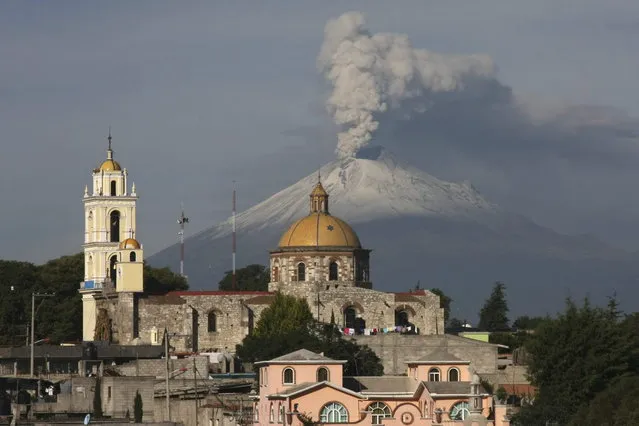
The main church in the town of San Damian Texoloc, Mexico stands in front of the Popocatepetl volcano as is spews ash and vapor early Tuesday, July 9, 2013. Last Saturday, Mexico's National Center for Disaster Prevention raised the volcano alert from Stage 2 Yellow to Stage 3 Yellow, the final step before a Red alert, when possible evacuations could be ordered after the Popocatepetl volcano spit out a cloud of ash and vapor 2 miles (3 kilometers) high over several days of eruptions. (Photo by J. Guadalupe Perez/AP Photo)

The main church in the town of San Damian Texoloc, Mexico stands in front of the Popocatepetl volcano as is spews ash and vapor early Tuesday, July 9, 2013. Last Saturday, Mexico's National Center for Disaster Prevention raised the volcano alert from Stage 2 Yellow to Stage 3 Yellow, the final step before a Red alert, when possible evacuations could be ordered after the Popocatepetl volcano spit out a cloud of ash and vapor 2 miles (3 kilometers) high over several days of eruptions. (Photo by J. Guadalupe Perez/AP Photo)
Details
10 Jul 2013 08:45:00
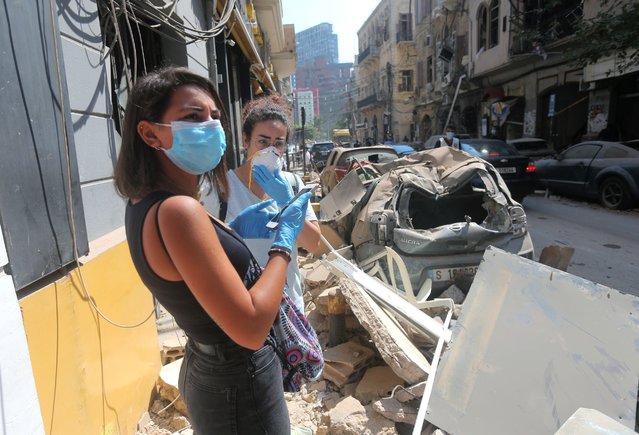
Young Lebanese women wearing protective masks and gloves against the coronavirus pandemic, stand on August 5, 2020 amid the rubble in Beirut's Gimmayzeh commercial district which was heavily damaged by the previous day's powerful explosion that tore through Lebanon's capital, resulting from the ignition of a huge depot of ammonium nitrate at the city's main port. Rescuers searched for survivors in Beirut after a cataclysmic explosion at the port sowed devastation across entire neighbourhoods, killing more than 100 people, wounding thousands and plunging Lebanon deeper into crisis. The blast, which appeared to have been caused by a fire igniting 2,750 tonnes of ammonium nitrate left unsecured in a warehouse, was felt as far away as Cyprus, some 150 miles (240 kilometres) to the northwest. (Photo by AFP Photo/Stringer)

Young Lebanese women wearing protective masks and gloves against the coronavirus pandemic, stand on August 5, 2020 amid the rubble in Beirut's Gimmayzeh commercial district which was heavily damaged by the previous day's powerful explosion that tore through Lebanon's capital, resulting from the ignition of a huge depot of ammonium nitrate at the city's main port. Rescuers searched for survivors in Beirut after a cataclysmic explosion at the port sowed devastation across entire neighbourhoods, killing more than 100 people, wounding thousands and plunging Lebanon deeper into crisis. The blast, which appeared to have been caused by a fire igniting 2,750 tonnes of ammonium nitrate left unsecured in a warehouse, was felt as far away as Cyprus, some 150 miles (240 kilometres) to the northwest. (Photo by AFP Photo/Stringer)
Details
10 Aug 2020 00:05:00


Princess Charlene of Monaco and Prince Albert II of Monaco kiss on the balcony after the civil ceremony of the Royal Wedding of Prince Albert II of Monaco to Charlene Wittstock at the Prince's Palace on July 1, 2011 in Monaco. The ceremony took place in the Throne Room of the Prince's Palace of Monaco, followed by a religious ceremony to be conducted in the main courtyard of the Palace on July 2. With her marriage to the head of state of Principality of Monaco, Charlene Wittstock has/will become Princess consort of Monaco and gain the title, Princess Charlene of Monaco. Celebrations including concerts and firework displays are being held across several days, attended by a guest list of global celebrities and heads of state. (Photo by Pascal Le Segretain/Getty Images)
Details
02 Jul 2011 13:41:00
In this photo taken on Saturday, May 16, 2015, Snoek fish with salt on them after they were cleaned  in Lambert's Bay, South Africa. (Photo by Schalk van Zuydam/AP Photo)

In this photo taken on Saturday, May 16, 2015, Snoek fish with salt on them after they were cleaned in Lambert's Bay, South Africa. The boats line up along the jetty, bobbing in the cold south Atlantic waters, bringing in the day's catch in the early afternoon. The long silver snoek fish is one of South Africa's traditional foods, and a main source of income for the town of Lambert's Bay. (Photo by Schalk van Zuydam/AP Photo)
Details
25 May 2015 09:28:00
Hawa Mahal India

Hawa Mahal, which translates as the Palace of Winds, was built in 1799 by Maharaja Sawai Pratap Singh. The design of the palace was created by Shreyansh Jain to resemble the crown of Krishna. The design of this unique five-story building is akin to a honeycomb. The main purpose of this building was to allow royal ladies to watch the street below while remaining unseen, since during those times they had a strict code of dressing, which meant covering their faces. The palace was designed to produce the Venturi effect, which created natural air conditioning and kept the interior relatively cool during hot summers.
Details
22 Nov 2014 13:22:00
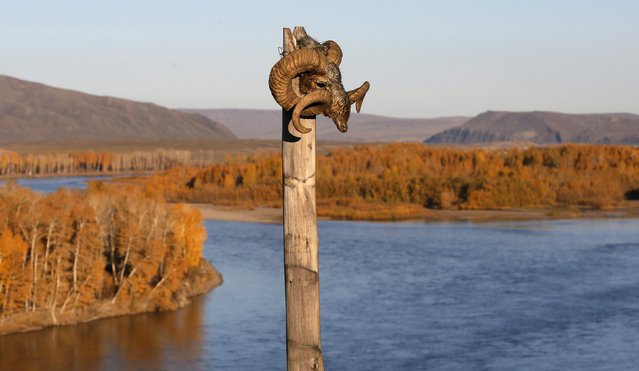
The head of a mountain ram is attached to a wooden column at the site used for shamans' rituals in the Aldyn Bulak area on the bank of the Yenisei River during sunset outside the village of Elegest, Tuva region, Southern Siberia, Russia, October 7, 2015. (Photo by Ilya Naymushin/Reuters)

The head of a mountain ram is attached to a wooden column at the site used for shamans' rituals in the Aldyn Bulak area on the bank of the Yenisei River during sunset outside the village of Elegest, Tuva region, Southern Siberia, Russia, October 7, 2015. The region is inhabited by Tuvans, historically cattle-herding nomads, who nowadays practise two main confessions – Buddhism and Shamanism. (Photo by Ilya Naymushin/Reuters)
Details
19 Oct 2015 08:05:00