Loading...
Done
Bathers brave the cold waters of the North Sea as they take part in the annual Boxing Day dip at Redcar Beach on December 26, 2023 in Redcar, England. The event attracts hundreds of people each year, with many wearing fancy dress, who take to the water to help raise money for a number of charities. (Photo by Ian Forsyth/Getty Images)

Bathers brave the cold waters of the North Sea as they take part in the annual Boxing Day dip at Redcar Beach on December 26, 2023 in Redcar, England. The event attracts hundreds of people each year, with many wearing fancy dress, who take to the water to help raise money for a number of charities. (Photo by Ian Forsyth/Getty Images)
Details
08 Feb 2025 04:37:00
Kaori Sakamoto, from Japan, on April 17, 2025 at the ISU World Team Trophy in Figure Skating 2025, held in Tokyo. Teams from all over the world compete in a number of events with two men, two women, one pair and one ice dance entry. (Photo by Yohei Osada/AFLO SPORT via Alamy Live News)

Kaori Sakamoto, from Japan, on April 17, 2025 at the ISU World Team Trophy in Figure Skating 2025, held in Tokyo. Teams from all over the world compete in a number of events with two men, two women, one pair and one ice dance entry. (Photo by Yohei Osada/AFLO SPORT via Alamy Live News)
Details
25 Apr 2025 02:56:00
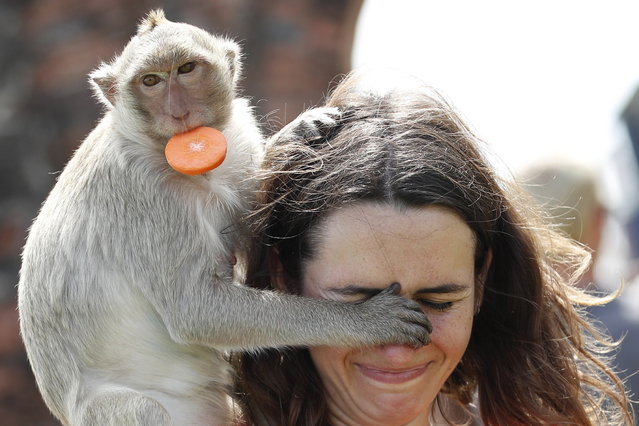
A monkey is being fed by a foreign tourist during the annual Monkey Banquet at Phra Prang Sam Yod ancient temple in Lopburi, some 180km from Bangkok, central Thailand, 24 November 2024. The annual gala has been organized since 1989 by Lopburi's entrepreneur Yongyuth Kitwatananusont, offering all-you-can-eat fruits, vegetables, and desserts for monkeys to honor the long-tailed macaques to attract tourists to visit the town to promote tourism. According to the Wildlife Department, more than 2,000 urban monkeys were captured in 2024 by authorities to control the monkey population after the growing complaints of residents that the macaques maraud food, frequently confront residents, causing accidents as well as their properties, assets, and the ancient city to be overrun and damaged by the monkeys. (Photo by Rungroj Yongrit/EPA)

A monkey is being fed by a foreign tourist during the annual Monkey Banquet at Phra Prang Sam Yod ancient temple in Lopburi, some 180km from Bangkok, central Thailand, 24 November 2024. The annual gala has been organized since 1989 by Lopburi's entrepreneur Yongyuth Kitwatananusont, offering all-you-can-eat fruits, vegetables, and desserts for monkeys to honor the long-tailed macaques to attract tourists to visit the town to promote tourism. (Photo by Rungroj Yongrit/EPA)
Details
08 Dec 2024 04:22:00
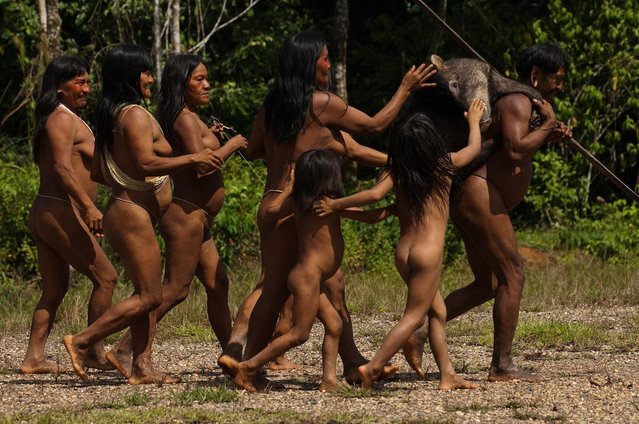
Spectacular images offering insight into the lives of the Huaorani people in the Ecuadorian Amazon have been revealed showing how they use traditional methods to hunt monkeys for food. The stunning pictures were taken by conservation photographer Pete Oxford from Torquay, Devon in the Ecuadorian Amazon. “The Huaorani Indians are a forest people highly in tune with their environment. Many are now totally acculturated since the 1950s by missionaries”, said Pete. “Today they face radical change to their culture to the proximity of oil exploration within their territory and the Yasuni National Park and Biosphere Reserve, they are vastly changed. Some still live very traditionally and for this shoot, through my Huaorani friend, a direct relative of those photographed he wanted to depict them as close to their original culture as possible. They still largely hunt with blow pipes and spears eating a lot of monkeys and peccaries”. The Huaorani are also known as the Waorani, Waodani or the Waos and are native Amerindians. Their lands are located between the Curaray and Napo rivers and speak the Huaorani language. Pete says that during his visit he was welcomed into the group and hopes that ancient cultures can be saved. Here: The tribe were seen celebrating after a hunter returned to camp with a wild pig. (Photo by Pete Oxford/Mediadrumworld.com)

Spectacular images offering insight into the lives of the Huaorani people in the Ecuadorian Amazon have been revealed showing how they use traditional methods to hunt monkeys for food. The stunning pictures were taken by conservation photographer Pete Oxford from Torquay, Devon in the Ecuadorian Amazon. Here: The tribe were seen celebrating after a hunter returned to camp with a wild pig. (Photo by Pete Oxford/Mediadrumworld.com)
Details
20 Jan 2017 07:58:00
Billboard acts as a mood-meter by analyzing Twitter and guaging the number of happy and sad emoticons used at any given moment, causing the billboard's face to change between a smile and a frown

A billboard for JELL-O stands at the corner of Grand Street and West Broadway on August 2, 2011 in New York City. The billboard acts as a mood-meter by analyzing Twitter and guaging the number of happy and sad emoticons used at any given moment, causing the billboard's face to change between a smile and a frown. (Photo by Andrew Burton/Getty Images)
Details
03 Aug 2011 11:46:00
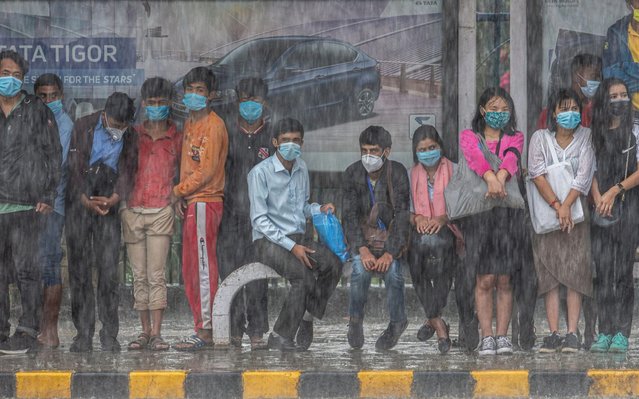
People wait at a bus stop during heavy rain in Kathmandu, Nepal on September 21, 2020. The government eased the coronavirus lockdown for economic activities despite the number of COVID-19 cases is on the rise in Nepal. (Photo by Narendra Shrestha/EPA/EFE/Rex Features/Shutterstock)

People wait at a bus stop during heavy rain in Kathmandu, Nepal on September 21, 2020. The government eased the coronavirus lockdown for economic activities despite the number of COVID-19 cases is on the rise in Nepal. (Photo by Narendra Shrestha/EPA/EFE/Rex Features/Shutterstock)
Details
09 Oct 2020 00:01:00
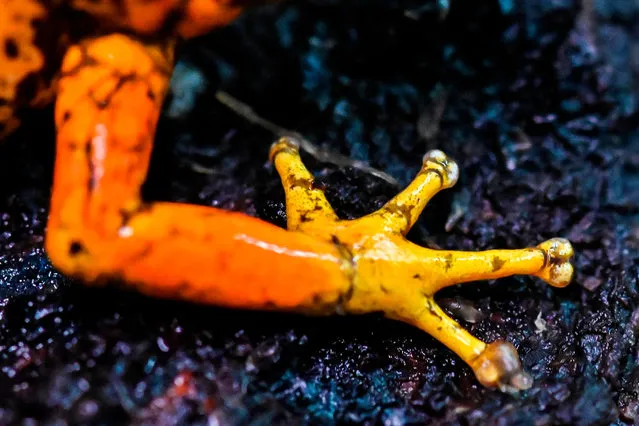
A leg of a “diablito” frog (Oophaga sylvatica) is photographed in a laboratory at a laboratory in the zoo of Cali, Colombia, on July 19, 2019. Colombia is the second country with the largest number of amphibians in the world after Brazil. More than 40% of amphibian species worldwide are in danger of extinction. (Photo by Luis Robayo/AFP Photo)

A leg of a “diablito” frog (Oophaga sylvatica) is photographed in a laboratory at a laboratory in the zoo of Cali, Colombia, on July 19, 2019. Colombia is the second country with the largest number of amphibians in the world after Brazil. More than 40% of amphibian species worldwide are in danger of extinction. (Photo by Luis Robayo/AFP Photo)
Details
28 Nov 2020 00:03:00
Relatives of inmates of the «Santiago 1» jail react outside the prison after a large number of prisoners attempted to escape amid panic over the spread of the COVID-19 coronavirus in Santiago, Chile, on March 19, 2020. (Photo by Javier Torres/AFP Photo)

Relatives of inmates of the «Santiago 1» jail react outside the prison after a large number of prisoners attempted to escape amid panic over the spread of the COVID-19 coronavirus in Santiago, Chile, on March 19, 2020. (Photo by Javier Torres/AFP Photo)
Details
05 Jan 2021 00:03:00