Loading...
Done
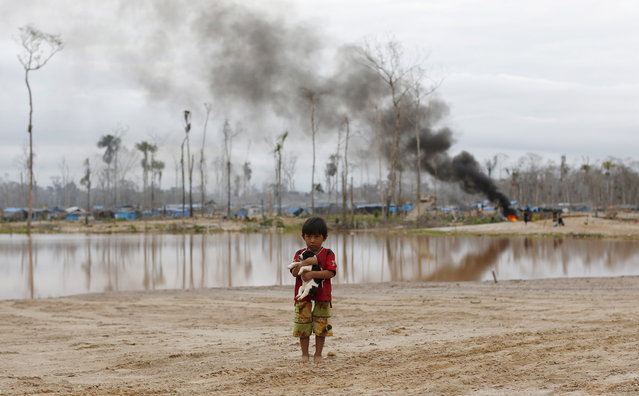
A boy carries a dog as he stands after a Peruvian police operation to destroy illegal gold mining camps in a zone known as Mega 14, in the southern Amazon region of Madre de Dios July 14, 2015. Peruvian police razed dozens of illegal gold mining camps at the edge of an Amazonian nature reserve this week, part of a renewed bid to halt the spread of wildcatting in a remote rainforest region. (Photo by Janine Costa/Reuters)

A boy carries a dog as he stands after a Peruvian police operation to destroy illegal gold mining camps in a zone known as Mega 14, in the southern Amazon region of Madre de Dios July 14, 2015. Peruvian police razed dozens of illegal gold mining camps at the edge of an Amazonian nature reserve this week, part of a renewed bid to halt the spread of wildcatting in a remote rainforest region. (Photo by Janine Costa/Reuters)
Details
18 Jul 2015 12:29:00
A homeless man sleeps against a wall adorned with a mural featuring a Shipibo Indigenous girl and Amazon rainforest animals, in Pucallpa, in Peru's Ucayali region, Wednesday, September 2, 2020. Peru is home to one of Latin America's largest Indigenous populations, whose ancestors lived in the Andean country before the arrival of Spanish colonists. (Photo by Rodrigo Abd/AP Photo)

A homeless man sleeps against a wall adorned with a mural featuring a Shipibo Indigenous girl and Amazon rainforest animals, in Pucallpa, in Peru's Ucayali region, Wednesday, September 2, 2020. Peru is home to one of Latin America's largest Indigenous populations, whose ancestors lived in the Andean country before the arrival of Spanish colonists. (Photo by Rodrigo Abd/AP Photo)
Details
23 Oct 2020 00:03:00
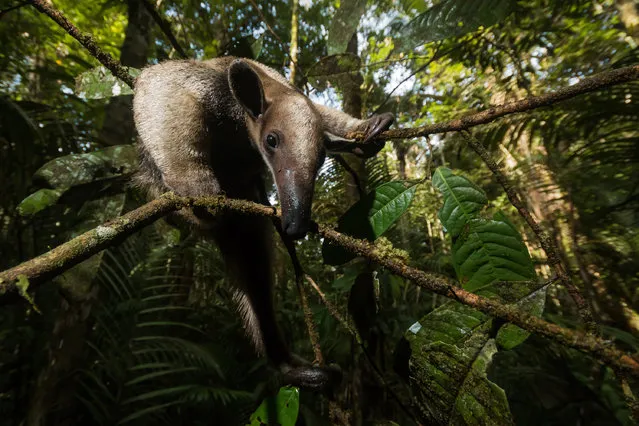
Individuals and populations student winner. Limbing in the Tropics, photographed in Manaus, Brazil. While walking in the Amazon rainforest looking for bat roosts to set up mist nets to capture bats for scientific research, a faint and almost imperceptible noise suddenly caught this photographer’s attention. An anteater was climbing with exceptional ability in a tangled mess of branches and lianas. With an unbelievable calmness, the animal watched the photographer at work and seemed to enjoy being the subject of an impromptu photography session in the most biodiverse ecosystem on Earth. (Photo by Adrià López Baucells/University of Lisbon/British Ecological Society)

Individuals and populations student winner. Limbing in the Tropics, photographed in Manaus, Brazil. While walking in the Amazon rainforest looking for bat roosts to set up mist nets to capture bats for scientific research, a faint and almost imperceptible noise suddenly caught this photographer’s attention. An anteater was climbing with exceptional ability in a tangled mess of branches and lianas. (Photo by Adrià López Baucells/University of Lisbon/British Ecological Society)
Details
05 Dec 2018 00:03:00
Gunung Leuser National Parkr"

Gunung Leuser National Park is a national park covering 7,927 km² in northern Sumatra, Indonesia, straddling the border of North Sumatra and Aceh provinces. The national park, named after Mount Leuser (3,381 m), protects a wide range of ecosystems. An orangutan sanctuary of Bukit Lawang is located inside the park. Together with Bukit Barisan Selatan and Kerinci Seblat national parks it forms a World Heritage Site, Tropical Rainforest Heritage of Sumatra.
Details
14 Jul 2013 10:28:00
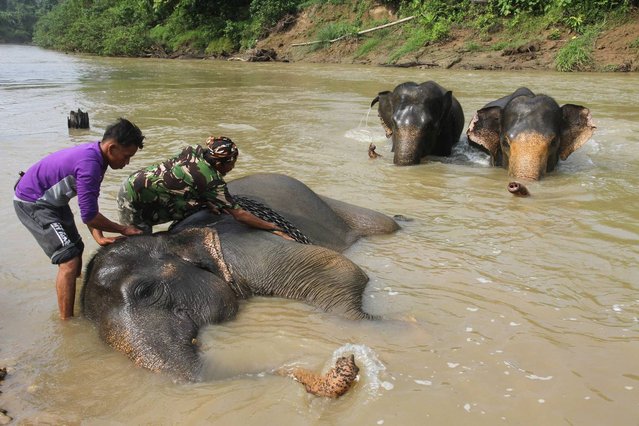
Indonesian mahouts (elephant masters) bathe elephants prior to a daily patrol at a Conservation Respons Unite (CRU) to control elephant-human conflicts in Serbajadi, East Aceh on April 7, 2016. Elephants have joined the front line in the fight against poaching and illegal logging in the dense jungles of Sumatra. Guided by their Indonesian mahouts, they trek alongside rivers, over rough terrain and deep into the rainforest in an area that is home to numerous endangered species, from orangutans to tigers, but which has suffered devastating deforestation in recent years. (Photo by AFP Photo/Januar)

Indonesian mahouts (elephant masters) bathe elephants prior to a daily patrol at a Conservation Respons Unite (CRU) to control elephant-human conflicts in Serbajadi, East Aceh on April 7, 2016. Elephants have joined the front line in the fight against poaching and illegal logging in the dense jungles of Sumatra. Guided by their Indonesian mahouts, they trek alongside rivers, over rough terrain and deep into the rainforest in an area that is home to numerous endangered species, from orangutans to tigers, but which has suffered devastating deforestation in recent years. (Photo by AFP Photo/Januar)
Details
11 Apr 2016 10:24:00
A member of the Boi Bumba Garantido association performs during the Boi Bumba folklore festival at the Bumbodromo in Parintins, Amazonas State, Brazil, on June 28, 2024. Parintins is well-known internationally for its Boi Bumba folklore festival, which lasts for three days in late June and whose themes, costumes, and songs are based on indigenous cultures of the Amazon rainforest. (Photo by Michael Dantas/AFP Photo)

A member of the Boi Bumba Garantido association performs during the Boi Bumba folklore festival at the Bumbodromo in Parintins, Amazonas State, Brazil, on June 28, 2024. Parintins is well-known internationally for its Boi Bumba folklore festival, which lasts for three days in late June and whose themes, costumes, and songs are based on indigenous cultures of the Amazon rainforest. (Photo by Michael Dantas/AFP Photo)
Details
23 Oct 2025 04:17:00
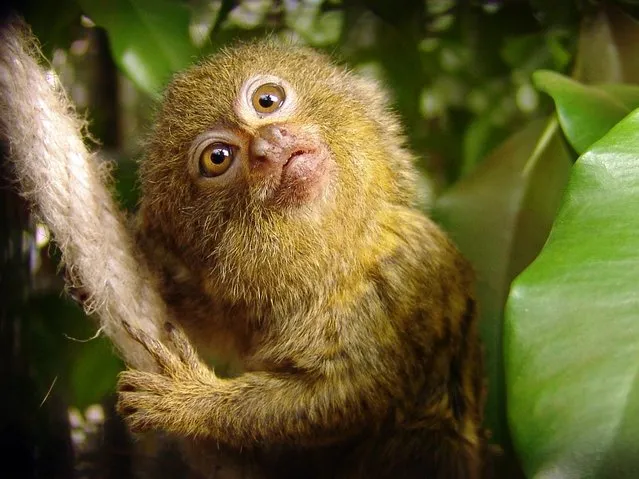
Pygmy Marmoset - The Smallest Monkey

The pygmy marmoset (Cebuella pygmaea) is a small New World monkey native to rainforests of the western Amazon Basin in South America. It is notable for being the smallest monkey in the world at just over 100 grams (3.5 oz). It is generally found in evergreen and river edge forests and is a gum-feeding specialist
Details
29 Jan 2014 12:59:00
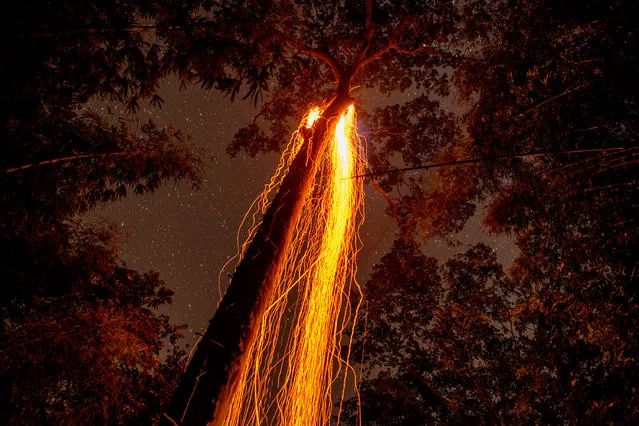
Bees are sensitive to light, which makes them follow the glowing embers down to the ground. (Photo by Hasnoor Hussain/The Guardian)

During the spring harvest season, a group of traditional Malaysian honey hunters travel to the rainforest near the Thai border to collect honeycombs from giant bees – and risk their lives climbing 200ft trees. Here: Bees are sensitive to light, which makes them follow the glowing embers down to the ground. (Photo by Hasnoor Hussain/The Guardian)
Details
22 Oct 2016 10:26:00