Loading...
Done
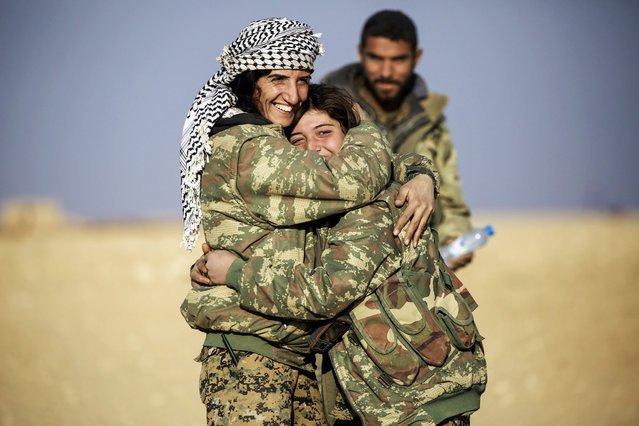
Rougine, a 19-year-old female Arab fighter among the Syrian Democratic Forces, made up of US-backed Kurdish and Arab fighters, stands in fatigues embracing another colleague near the village of al-Torshan, 20 km on the outskirts of Raqa on February 6, 2017. Unlike Syria's Kurds, who have emphasised gender equality in both their militias and nascent autonomous governing institutions in north and northeast Syria, the Arab tribes in the same region are among the more conservative segments of the country's population, and most Arab families find the concept of female fighters “hard to accept”. (Photo by Delil Souleiman/AFP Photo)

Rougine, a 19-year-old female Arab fighter among the Syrian Democratic Forces, made up of US-backed Kurdish and Arab fighters, stands in fatigues embracing another colleague near the village of al-Torshan, 20 km on the outskirts of Raqa on February 6, 2017. (Photo by Delil Souleiman/AFP Photo)
Details
13 Feb 2017 00:05:00
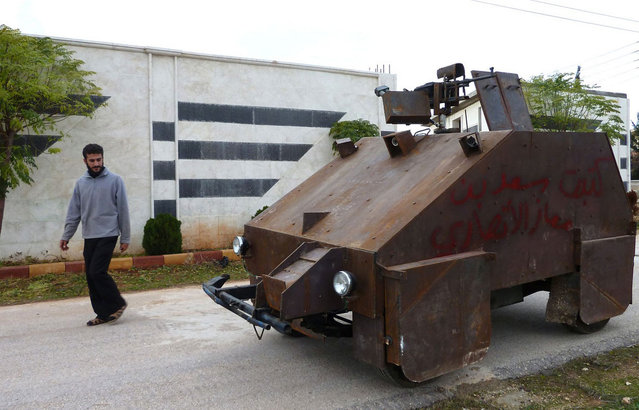
A Syrian rebel walks past Sham 2, a homemade armored vehicle, in Bishqatin, Syria, on December 8, 2012. From a distance it looks rather like a big rusty metal box but closer inspection reveals a homemade armored vehicle waiting to be deployed. Sham II, named after ancient Syria, is built from the chassis of a car and touted by rebels as “100 percent made in Syria”. (Photo by Herve Bar/AFP Photo)

A Syrian rebel walks past Sham 2, a homemade armored vehicle, in Bishqatin, Syria, on December 8, 2012. From a distance it looks rather like a big rusty metal box but closer inspection reveals a homemade armored vehicle waiting to be deployed. Sham II, named after ancient Syria, is built from the chassis of a car and touted by rebels as “100 percent made in Syria”. (Photo by Herve Bar/AFP Photo)
Details
03 Sep 2013 09:30:00
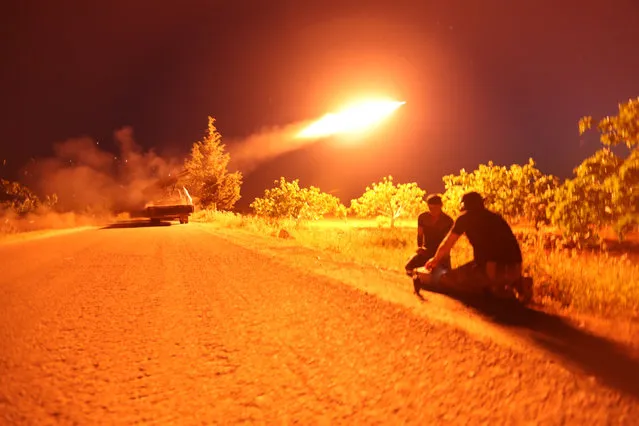
Syrian fighters from the Turkish-backed National Liberation Front (NLF) fire a missile against regime positions on May 13, 2019 in the rebel-held northern part of Syria's Hama province. Clashes on the edge of a jihadist bastion in northwestern Syria have killed at least 42 fighters in 24 hours, a monitor said today, after regime bombardment on the region devastated health services. (Photo by Omar Haj Kadour/AFP Photo)

Syrian fighters from the Turkish-backed National Liberation Front (NLF) fire a missile against regime positions on May 13, 2019 in the rebel-held northern part of Syria's Hama province. Clashes on the edge of a jihadist bastion in northwestern Syria have killed at least 42 fighters in 24 hours, a monitor said today, after regime bombardment on the region devastated health services. (Photo by Omar Haj Kadour/AFP Photo)
Details
15 May 2019 00:07:00
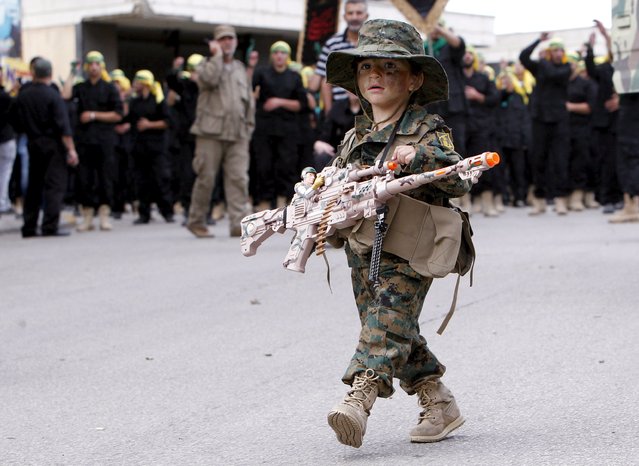
A boy wearing a Lebanon's Hezbollah military outfit and carrying a toy gun walks during the funeral of three Hezbollah fighters who were killed while fighting alongside Syrian army forces in Syria in Nabatieh town, southern Lebanon, October 27, 2015. (Photo by Ali Hashisho/Reuters)

A boy wearing a Lebanon's Hezbollah military outfit and carrying a toy gun walks during the funeral of three Hezbollah fighters who were killed while fighting alongside Syrian army forces in Syria in Nabatieh town, southern Lebanon, October 27, 2015. The fighters names are Hussein Hassan Shreifie, Ali al-Akbar Mohamad Khashfeh and Mohamad Saeed Fawaz. (Photo by Ali Hashisho/Reuters)
Details
30 Oct 2015 08:02:00
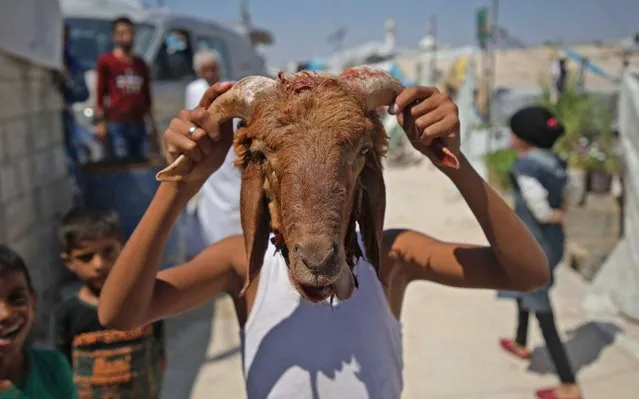
A Syrian boy plays with the head of a sacrificed sheep at a DIP camp for Interally Displaced Persons near the town of Aqrabat in Syria's northern Idlib province on August 12, 2019. Known as the “big” festival, Eid Al-Adha is celebrated each year by Muslims sacrificing various animals according to religious traditions, including cows, camels, goats and sheep. The festival marks the end of the Hajj pilgrimage to Mecca and commemorates Prophet Abraham's readiness to sacrifice his son to show obedience to God. (Photo by Aaref Watad/AFP Photo)

A Syrian boy plays with the head of a sacrificed sheep at a DIP camp for Interally Displaced Persons near the town of Aqrabat in Syria's northern Idlib province on August 12, 2019. Known as the “big” festival, Eid Al-Adha is celebrated each year by Muslims sacrificing various animals according to religious traditions, including cows, camels, goats and sheep. The festival marks the end of the Hajj pilgrimage to Mecca and commemorates Prophet Abraham's readiness to sacrifice his son to show obedience to God. (Photo by Aaref Watad/AFP Photo)
Details
15 Aug 2019 00:05:00
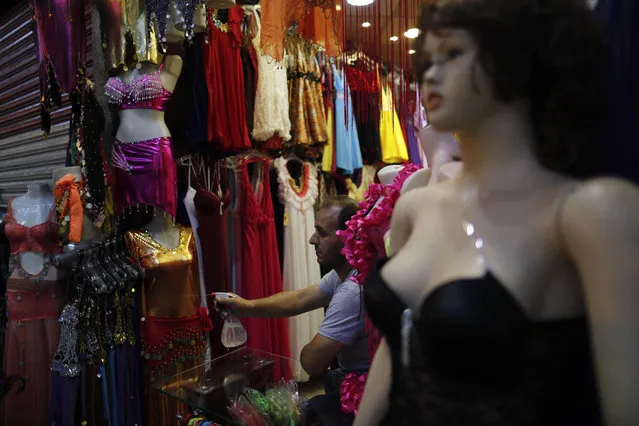
In this Thursday, July 19, 2018, photo, a Syrian shopkeeper spraying water as waits for customers at the Hamadiyah market, named after the 34th Sultan of the Ottoman Empire Abdul Hamid II, in the Old City of Damascus, Syria. The celebratory mood in government-controlled areas stems from successive military advances in the past year and an impression that President Bashar Assad, with massive support by unwavering allies Russia and Iran, has won the war or at least militarily defeated the opposition trying to topple him. (Photo by Hassan Ammar/AP Photo)

In this Thursday, July 19, 2018, photo, a Syrian shopkeeper spraying water as waits for customers at the Hamadiyah market, named after the 34th Sultan of the Ottoman Empire Abdul Hamid II, in the Old City of Damascus, Syria. The celebratory mood in government-controlled areas stems from successive military advances in the past year and an impression that President Bashar Assad, with massive support by unwavering allies Russia and Iran, has won the war or at least militarily defeated the opposition trying to topple him. (Photo by Hassan Ammar/AP Photo)
Details
13 Aug 2018 00:01:00
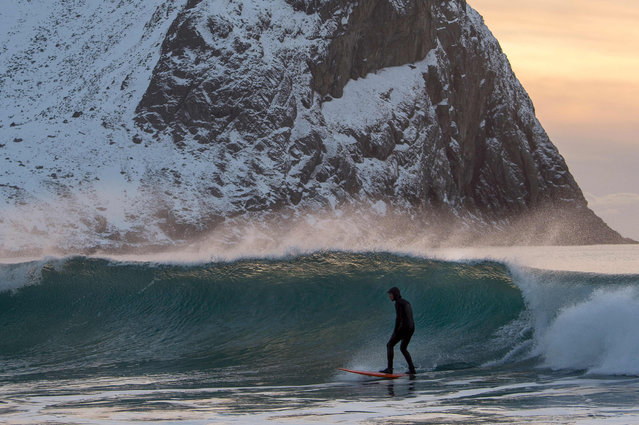
A surfer rides a wave at the snowy beach of Unstad, in Lofoten Island, Arctic Circle, on March 9, 2016. (Photo by Olivier Morin/AFP Photo)

A surfer rides a wave at the snowy beach of Unstad, in Lofoten Island, Arctic Circle, on March 9, 2016. Surfers from all over the world comes to Lofoten island to surf in extrem conditions. Ocean temperature is 6-7 °C, air temperature around 0°C in spite of a weather very unstable. (Photo by Olivier Morin/AFP Photo)
Details
15 Mar 2016 13:54:00
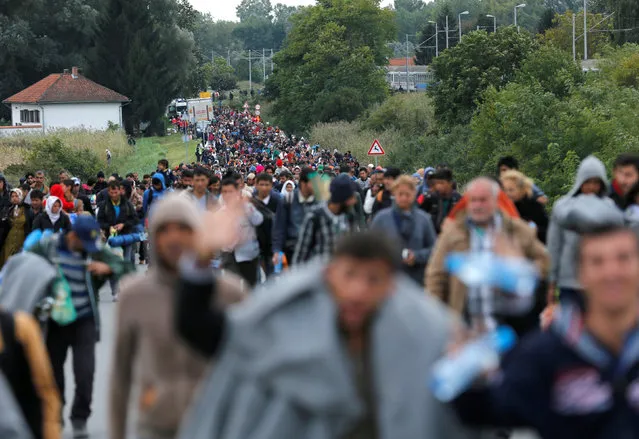
A year after hundreds of thousands of migrants and refugees snaked their way across southeastern Europe and onto television screens worldwide, the roads through the Balkans are now clear, depriving an arguably worsening tragedy of its poignant visibility. Europe's migrant crisis is at the very least numerically worse than it was last year. More people are arriving and more are dying. (Photo by Antonio Bronic/Reuters)

A year after hundreds of thousands of migrants and refugees snaked their way across southeastern Europe and onto television screens worldwide, the roads through the Balkans are now clear, depriving an arguably worsening tragedy of its poignant visibility. Reuters photographer, Antonio Bronic revisiting the people-packed locations where he and his colleagues captured last year's diaspora, found empty roads, unencumbered railway tracks and bucolic countryside. (Photo by Antonio Bronic/Reuters)


Details
12 Aug 2016 12:10:00