Loading...
Done
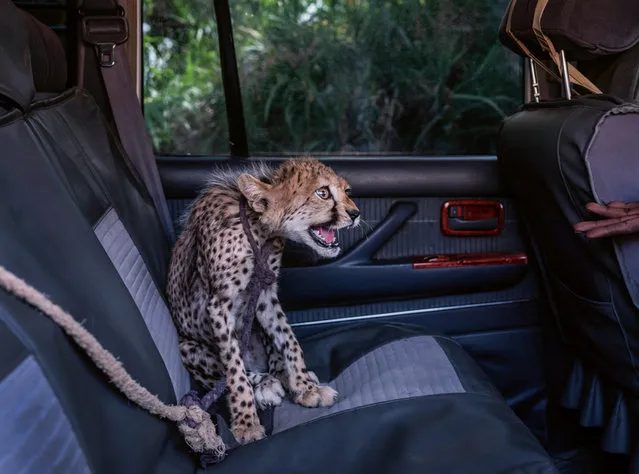
A five-month-old cheetah seated in the back of a Land Cruiser growls at an outstretched hand after being taken from traffickers in Ethiopia and driven to Harirad, Somaliland, in 2020. This photo is part of the work of more than 100 artists in Why We Photograph Animals, a new collection of wildlife photography that aims to help understand why people have photographed animals at different points in history and what it means in the present. (Photo by Nichole Sobecki/Thames & Hudson)

A five-month-old cheetah seated in the back of a Land Cruiser growls at an outstretched hand after being taken from traffickers in Ethiopia and driven to Harirad, Somaliland, in 2020. This photo is part of the work of more than 100 artists in Why We Photograph Animals, a new collection of wildlife photography that aims to help understand why people have photographed animals at different points in history and what it means in the present. (Photo by Nichole Sobecki/Thames & Hudson)
Details
28 Apr 2024 03:15:00
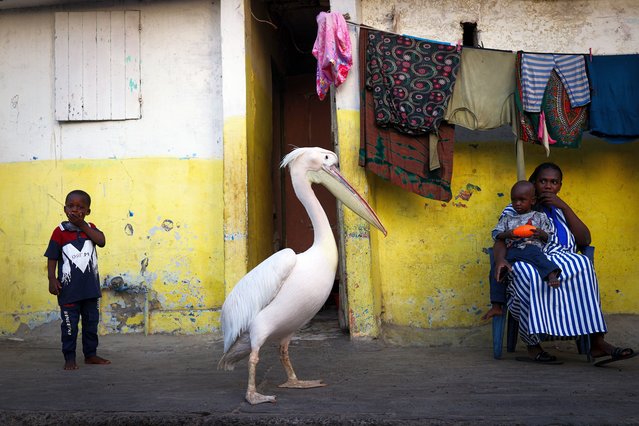
The pelican, named “Ndagabar”, which means pelican in the local Wolof language, begins visiting the neighborhood in the early hours of the day in Saint-Louis, Senegal on November 02, 2024. The pelican, which 62-year-old retired fisherman Madiop Gueye, has been keeping in front of his house for five years, has become the center of both the neighborhood and the region, attracting the attention of both local and foreign tourists. (Photo by Cem Ozdel/Anadolu via Getty Images)

The pelican, named “Ndagabar”, which means pelican in the local Wolof language, begins visiting the neighborhood in the early hours of the day in Saint-Louis, Senegal on November 02, 2024. The pelican, which 62-year-old retired fisherman Madiop Gueye, has been keeping in front of his house for five years, has become the center of both the neighborhood and the region, attracting the attention of both local and foreign tourists. (Photo by Cem Ozdel/Anadolu via Getty Images)
Details
10 Nov 2024 03:59:00
Luling, Louisiana US. New evidence contradicts previous claims of the relative safety of glyphosate, the world’s most widely used herbicide, which is manufactured here. It is often used in conjunction with seeds that have been genetically modified to tolerate its application, meaning that anyone consuming these crops is eating a genetically modified plant, and whatever residue of the pesticide that remains. (Photo by J. Henry Fair/Industrial Scars/Papadakis Publisher)

Luling, Louisiana, US. New evidence contradicts previous claims of the relative safety of glyphosate, the world’s most widely used herbicide, which is manufactured here. It is often used in conjunction with seeds that have been genetically modified to tolerate its application, meaning that anyone consuming these crops is eating a genetically modified plant, and whatever residue of the pesticide that remains. (Photo by J. Henry Fair/Industrial Scars/Papadakis Publisher)
Details
25 Oct 2016 10:40:00
Iraqi Kurds carry fire torches as they celebrate Nowruz Day, a festival marking the first day of spring, Kurdish and Persian New Year in Akre, Iraq on March 20, 2024. Newroz or Nowruz means “new day” in Persian, and is celebrated to mark the arrival of spring and the first day of the Iranian calendar. It is widely celebrated in Persian and neighboring regions and is recognized on UNESCO's Intangible Cultural Heritage of Human List. (Photo by Ismael Adnan/SOPA Images/Rex Features/Shutterstock)

Iraqi Kurds carry fire torches as they celebrate Nowruz Day, a festival marking the first day of spring, Kurdish and Persian New Year in Akre, Iraq on March 20, 2024. Newroz or Nowruz means “new day” in Persian, and is celebrated to mark the arrival of spring and the first day of the Iranian calendar. It is widely celebrated in Persian and neighboring regions and is recognized on UNESCO's Intangible Cultural Heritage of Human List. (Photo by Ismael Adnan/SOPA Images/Rex Features/Shutterstock)
Details
29 Mar 2024 05:30:00
A baby turtle's perilous first moments are captured as it takes to the sea for the first time on Heron Island in Queensland, Australia in July 2022. Predators such as sharks, birds, and pollution mean that approximately only one out of every 1000 turtles that hatch make it to adulthood, with some not even reaching open ocean. Amateur photographer (Photo by Hannah Mitchell/Solent News & Photo Agency)

A baby turtle's perilous first moments are captured as it takes to the sea for the first time on Heron Island in Queensland, Australia in July 2022. Predators such as sharks, birds, and pollution mean that approximately only one out of every 1000 turtles that hatch make it to adulthood, with some not even reaching open ocean. Amateur photographer (Photo by Hannah Mitchell/Solent News & Photo Agency)
Details
06 Oct 2023 04:29:00
A devotee gestures after being flogged by a reveler dressed as a devil during a mass celebration of the “Talciguines” of Texistepeque, El Salvador on Easter Monday, April 3, 2023. In the Nahuatl, Talciguin means “deviled men”, a traditional procession performed during Easter monday to represent the fight against the devil of the Christian prophet Jesus Christ. (Photo by Camilo Freedman/SOPA Images/Rex Features/Shutterstock)

A devotee gestures after being flogged by a reveler dressed as a devil during a mass celebration of the “Talciguines” of Texistepeque, El Salvador on Easter Monday, April 3, 2023. In the Nahuatl, Talciguin means “deviled men”, a traditional procession performed during Easter monday to represent the fight against the devil of the Christian prophet Jesus Christ. (Photo by Camilo Freedman/SOPA Images/Rex Features/Shutterstock)
Details
06 Apr 2023 03:48:00
Coloured X-ray of a barn owl. A physicist has used X-ray to create an extraordinary collection of artwork. Arie van't Riets pictures reveal birds, fish, monkeys and flowers in an incredible new light. The 66-year-old, from Bathmen in the Netherlands, began X-raying flowers as a means to teach radiographers and physicians how the machine worked. But after adding a bit of colour to the pictures, the retired medical physicist realised the potential for an exciting new collection of art. (Photo by Arie van't Riet/Barcroft Media)

Coloured X-ray of a barn owl. A physicist has used X-ray to create an extraordinary collection of artwork. Arie van't Riets pictures reveal birds, fish, monkeys and flowers in an incredible new light. The 66-year-old, from Bathmen in the Netherlands, began X-raying flowers as a means to teach radiographers and physicians how the machine worked. But after adding a bit of colour to the pictures, the retired medical physicist realised the potential for an exciting new collection of art. (Photo by Arie van't Riet/Barcroft Media)
Details
08 Jul 2014 13:25:00
The rotating updraft base of a supercell thunderstorm, and a rear flank downdraft containing rain and hail, backlit by the setting sun, on May 10, 2014, in Climax, Kansas, United States. To most of us, dark clouds on the horizon usually means rain – but here in Kansas, they can also signal the start of a supercell. The huge formations, also known as rotating thunderstorms, are among the most powerful weather phenomenon found over land. (Photo by Stephen Locke/Barcroft Media)

The rotating updraft base of a supercell thunderstorm, and a rear flank downdraft containing rain and hail, backlit by the setting sun, on May 10, 2014, in Climax, Kansas, United States. To most of us, dark clouds on the horizon usually means rain – but here in Kansas, they can also signal the start of a supercell. The huge formations, also known as rotating thunderstorms, are among the most powerful weather phenomenon found over land. They can occur anywhere where the conditions are right, but are normally found in more arid climates. These awe-inspiring supercells were captured south of Climax city by storm chaser Stephen Locke. (Photo by Stephen Locke/Barcroft Media)
Details
18 Jul 2014 12:01:00