Loading...
Done
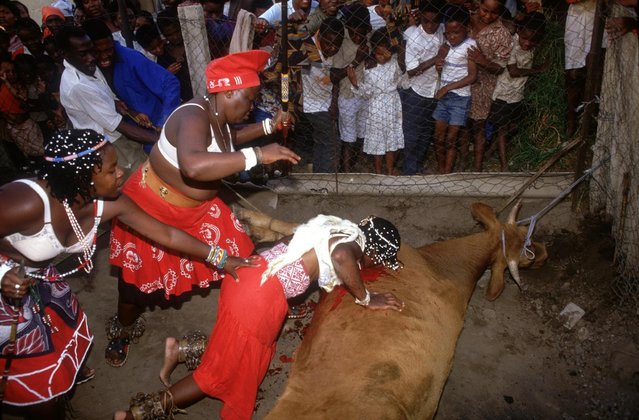
South African Sangomas are wizards and witches who are supposedly chosen by their ancestors to follow a traditional training and go through a rite of passage after which they become Sangomas and can cure and help people. They are so respected and trusted that western medical authorities have actually advised the government of South Africa to develop its cooperation with Sangomas in order to improve hygiene and health among the population. Today is graduation day for Trissa, 25, a Sangoma student in Tembisa, near Pretoria. Thanks to the help of the spirits of her ancestors, she has found a cow that had been hidden. The cow has then been killed by Sangoma Thelma and Trissa is now drinking its blood, thus becoming a Sangoma and changing her name to Nomadlozi. Location: Tembisa, near Pretoria, South Africa. (Photo by Patrick Durand/Sygma via Getty Images)

South African Sangomas are wizards and witches who are supposedly chosen by their ancestors to follow a traditional training and go through a rite of passage after which they become Sangomas and can cure and help people. They are so respected and trusted that western medical authorities have actually advised the government of South Africa to develop its cooperation with Sangomas in order to improve hygiene and health among the population. (Photo by Patrick Durand/Sygma via Getty Images)
Details
24 Feb 2017 00:05:00
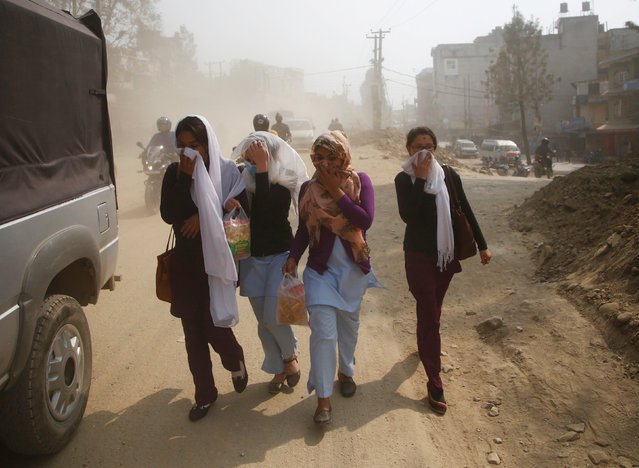
Pedestrians cover their face as they walk along the dusty road in Kathmandu, Nepal February 27, 2017. Nepal has forced 2,500 old vehicles off roads in its capital city of Kathmandu, part of a fight against alarming air pollution levels that have hit nine times World Health Organisation (WHO) limits. Air pollution has been a chronic problem in rapidly growing Kathmandu, which sits in a Himalayan valley and is home to more than 3mn people. Rising public anger with the smog is turning into a headache for a beleaguered government headed by former Maoist rebels. Dust from road works, exhaust from old, poorly maintained vehicles and smoke from coal-burning brick kilns blend in a murky haze that hangs over the ancient city, raising the risk of cancer, stroke, asthma and high blood pressure, experts say. Officials hope the ban on vehicles more than 20 years old will be a step towards a cleaner future. (Photo by Navesh Chitrakar/Reuters)

Pedestrians cover their face as they walk along the dusty road in Kathmandu, Nepal February 27, 2017. Nepal has forced 2,500 old vehicles off roads in its capital city of Kathmandu, part of a fight against alarming air pollution levels that have hit nine times World Health Organisation (WHO) limits. Air pollution has been a chronic problem in rapidly growing Kathmandu, which sits in a Himalayan valley and is home to more than 3mn people. (Photo by Navesh Chitrakar/Reuters)
Details
04 Mar 2017 00:04:00
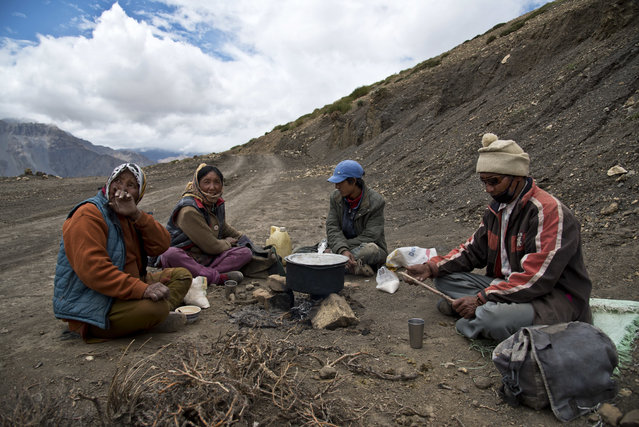
In this August 17, 2016, photo, from left to right, Chhering Chodom, 60, Tashi Yangzom, 50, Lobsang Chhering, 27, and Dorje Tandup, 58, drink milk tea on the side of the road. For centuries, the sleepy valley nestled in the Indian Himalayas remained a hidden Buddhist enclave forbidden to outsiders. Enduring the harsh year-round conditions of the high mountain desert, the people of Spiti Valley lived by a simple communal code – share the Earth's bounty, be hospitable to neighbors, and eschew greed and temptation at all turns. That's all starting to change, for better or worse. Since India began allowing its own citizens as well as outsiders to visit the valley in the early 1990s, tourism and trade have boomed. And the marks of modernization, such as solar panels, asphalt roads and concrete buildings, have begun to appear around some of the villages that dot the remote landscape at altitudes above 4,000 meters (13,000 feet). (Photo by Thomas Cytrynowicz/AP Photo)

In this August 17, 2016, photo, from left to right, Chhering Chodom, 60, Tashi Yangzom, 50, Lobsang Chhering, 27, and Dorje Tandup, 58, drink milk tea on the side of the road. For centuries, the sleepy valley nestled in the Indian Himalayas remained a hidden Buddhist enclave forbidden to outsiders. Enduring the harsh year-round conditions of the high mountain desert, the people of Spiti Valley lived by a simple communal code – share the Earth's bounty, be hospitable to neighbors, and eschew greed and temptation at all turns. That's all starting to change, for better or worse. (Photo by Thomas Cytrynowicz/AP Photo)
Details
15 Sep 2016 09:22:00
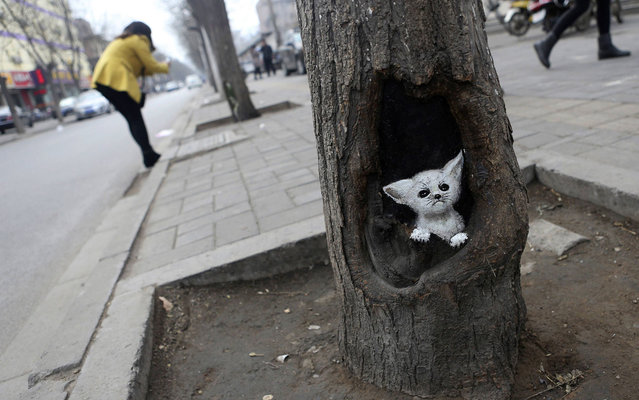
An image of a Fennec fox painted on a tree hole by Wang Yue is seen in Shijiazhuang, on March 13, 2013. Wang Yue, a senior at Dalian Industry University, uses her paintbrush to turn ugly tree holes into lovely views in Shijiazhuang, capital city of Hebei Province, China. Wang and her companions call the tree-hole paintings “meitu”, which means “beautiful journey”. The paintings on the trees have brightened the city during the dull, grey winter. (Photo by Pillar Lee/Reuters)

An image of a Fennec fox painted on a tree hole by Wang Yue is seen in Shijiazhuang, on March 13, 2013. Wang Yue, a senior at Dalian Industry University, uses her paintbrush to turn ugly tree holes into lovely views in Shijiazhuang, capital city of Hebei Province, China. Wang and her companions call the tree-hole paintings “meitu”, which means “beautiful journey”. The paintings on the trees have brightened the city during the dull, grey winter. (Photo by Pillar Lee/Reuters)

P.S. All pictures are presented in high resolution. To see Hi-Res images – just TWICE click on any picture. In other words, click small picture – opens the BIG picture. Click BIG picture – opens VERY BIG picture (if available; this principle works anywhere on the site AvaxNews).
Details
16 Mar 2013 11:27:00
“A snapshot from mountaineer's life”. Have you ever wondered how does a mountaineer's day start? (Photo and caption by Kamil Tamiola/National Geographic Traveler Photo Contest)

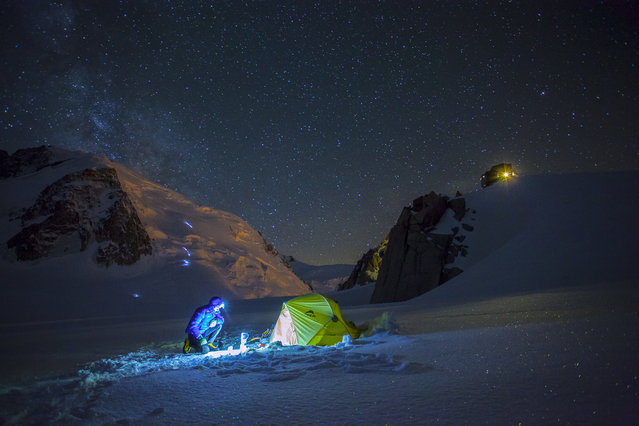
“A snapshot from mountaineer's life”. Have you ever wondered how does a mountaineer's day start? I will give you a hint: you wake up at 3 am, set the stove, wake up your partner, pretend it is warm, quickly consume a high-calorie breakfast, watch your friends slowly ascending the icy slopes of your dream summit with their tiny head torches glimmering against perfectly blue ice, and hope for the good weather. One would ask: why all this trouble? The answer is easy: for the love of the adventure and the unknown. Location: Chamonix, Haute Savoye, France. (Photo and caption by Kamil Tamiola/National Geographic Traveler Photo Contest)

ATTENTION! All pictures are presented in high resolution. To see Hi-Res images – just TWICE click on any picture. In other words, click small picture – opens the BIG picture. Click BIG picture – opens VERY BIG picture.
Details
27 Jun 2013 12:47:00
A woman holds Kalashnikov assault rifle during a training session with members of the Georgian Legion, a paramilitary unit formed mainly by ethnic Georgian volunteers to fight against Russian forces in Ukraine in 2014, in Kyiv, Ukraine, Saturday, February 19, 2022. Separatist leaders in eastern Ukraine have ordered a full military mobilization amid growing fears in the West that Russia is planning to invade the neighboring country. The announcement on Saturday came amid a spike in violence along the line of contact between Ukrainian forces and the pro-Russia rebels in recent days. (Photo by Efrem Lukatsky/AP Photo)

A woman holds Kalashnikov assault rifle during a training session with members of the Georgian Legion, a paramilitary unit formed mainly by ethnic Georgian volunteers to fight against Russian forces in Ukraine in 2014, in Kyiv, Ukraine, Saturday, February 19, 2022. Separatist leaders in eastern Ukraine have ordered a full military mobilization amid growing fears in the West that Russia is planning to invade the neighboring country. The announcement on Saturday came amid a spike in violence along the line of contact between Ukrainian forces and the pro-Russia rebels in recent days. (Photo by Efrem Lukatsky/AP Photo)
Details
24 Feb 2022 06:34:00
A Palestinian father evacuates his wounded daughter from the rubble of a destroyed house after an Israeli air strike in Gaza City, 16 May 2021. A total of 174 people have been killed in Israeli raids on Gaza, including 47 children and 29 women, the Palestinian Ministry of Health said on Sunday. In response violent confrontations between Israeli security forces and Palestinians in Jerusalem, various Palestinian militant factions in Gaza launched rocket attacks on Israel since 10 May, resulting in retaliatory strikes by Israel on Gaza. (Photo by Haitham Imad/EPA/EFE)

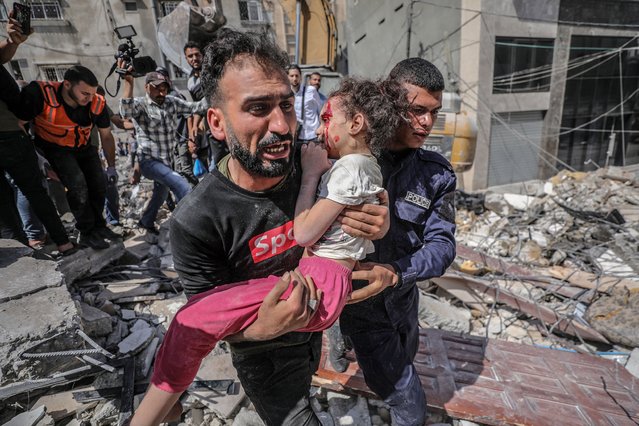
A Palestinian father evacuates his wounded daughter from the rubble of a destroyed house after an Israeli air strike in Gaza City, 16 May 2021. A total of 174 people have been killed in Israeli raids on Gaza, including 47 children and 29 women, the Palestinian Ministry of Health said on Sunday. In response violent confrontations between Israeli security forces and Palestinians in Jerusalem, various Palestinian militant factions in Gaza launched rocket attacks on Israel since 10 May, resulting in retaliatory strikes by Israel on Gaza. (Photo by Haitham Imad/EPA/EFE)
Details
17 May 2021 07:52:00
Police memebers stand guard as a group of women protest in front of the police headquarters after knowing that the body of María Belen Bernal was found murdered in a police officers' school and which main suspect – Bernal's husband police lieutenant German Caceres – is at large, in northern Quito, on October 1st, 2022. According to the prosecutor's office, at least 573 femicides have been registered in Ecuador's population of 17.7 million since 2014. In the first months of 2022 there had been 206 murders of women, according to Geraldine Guerra from the Aldea NGO that tracks femicides in the country. (Photo by Rodrigo Buendia/AFP Photo)

Police memebers stand guard as a group of women protest in front of the police headquarters after knowing that the body of María Belen Bernal was found murdered in a police officers' school and which main suspect – Bernal's husband police lieutenant German Caceres – is at large, in northern Quito, on October 1st, 2022. According to the prosecutor's office, at least 573 femicides have been registered in Ecuador's population of 17.7 million since 2014. In the first months of 2022 there had been 206 murders of women, according to Geraldine Guerra from the Aldea NGO that tracks femicides in the country. (Photo by Rodrigo Buendia/AFP Photo)
Details
24 Dec 2023 00:22:00