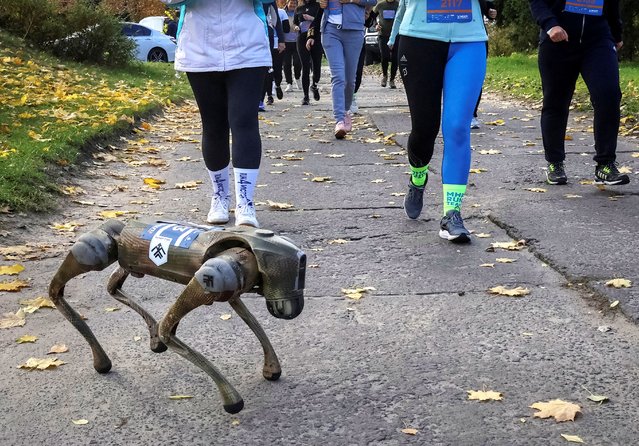
A robotic dog of the National Guard of Ukraine takes part in the Run4Victory charity marathon, amid Russia's attack on Ukraine, in Kyiv, Ukraine on October 27, 2024. (Photo by Oleksandr Klymenko/Reuters)
Newcastle United's Swiss defender #05 Fabian Schar heads the ball during the English League Cup semi-final second leg football match between Newcastle United and Arsenal at St James' Park, in Newcastle-upon-Tyne, north east England, on February 5, 2025. (Photo by Paul Ellis/AFP Photo)
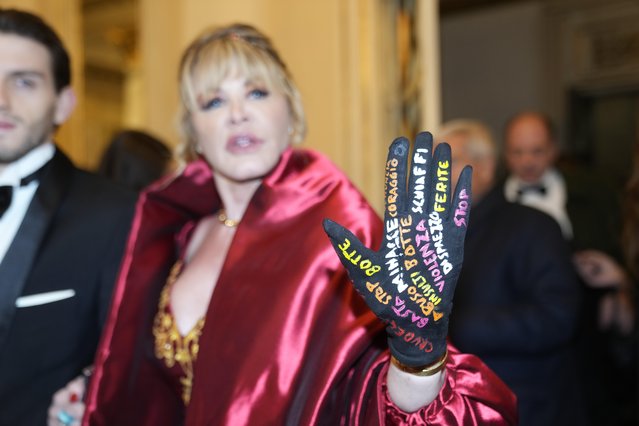
Doctor Dvora Ancona wears a glove bearing writings against violence on women as she arrives to attend La Scala opera house's gala season opener, Giuseppe Verdi's opera “Don Carlo” at the Milan La Scala theater, Italy, Thursday December 7, 2023. The season-opener Thursday, held each year on the Milan feast day St. Ambrose, is considered one of the highlights of the European cultural calendar. (Photo by Luca Bruno/AP Photo)
Carol Sofia Sanchez strikes a pose in her Shakira-inspired costume as she waits in line for the doors to open at Metropolitano Stadium, where pop star Shakira will perform in her hometown of Barranquilla in Colombia, Thursday, February 20, 2025. (Photo by Fernando Vergara/AP Photo)
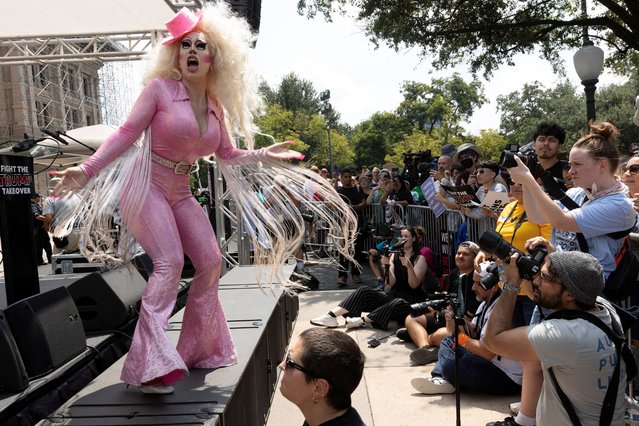
Drag queen Brigitte Bandit performs during the Fight the Trump Takeover, one of several held across the nation against Texas Republicans’ efforts to redraw the state's 38 congressional districts, at the State Capitol in Austin, Texas on August 16, 2025. (Photo by Nuri Vallbona/Reuters)
A festival-goer sings at Rock in Rio music festival while Brazilian rappers Veigh and Kayblack perform in Rio de Janeiro, Friday, September 13, 2024. (Photo by Hannah-Kathryn Valles/AP Photo)
On August 31, 2012, a long filament of solar material that had been hovering in the sun's atmosphere, the corona, erupted out into space at 4:36 p.m. EDT. The coronal mass ejection, or CME, traveled at over 900 miles per second. The CME did not travel directly toward Earth, but did connect with Earth's magnetic environment, or magnetosphere, causing aurora to appear on the night of Monday, September 3. (Photo by NASA/GSFC/SDO via The Atlantic)
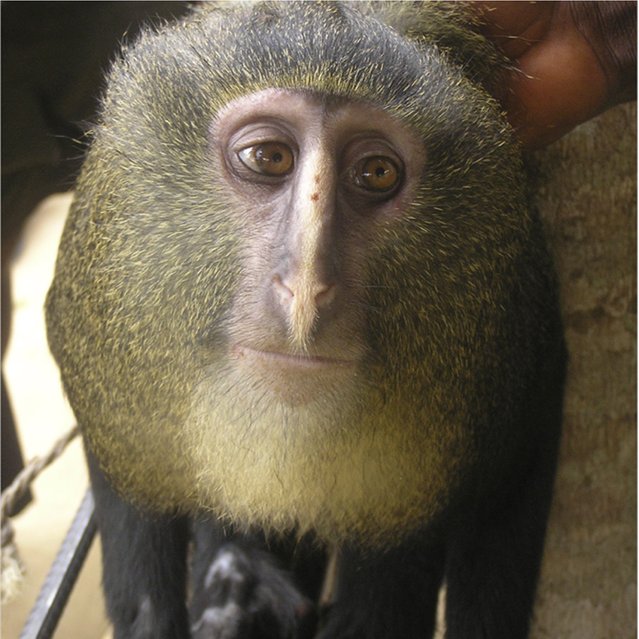
A new species of monkey found in the Democratic Republic of the Congo and identified as Lesula (Cercopithecus lomamiensis) is seen in this undated photograph from an article published September 12, 2012 in the science journal PLOS One. The monkey was first seen in 2007 by researchers John and Terese Hart of the Peabody Museum of Natural History at Yale Research Project. The finding of C. lomamiensis represents only the second new species of African monkey to be discovered in the past 28 years, according to the research article. (Photo by Hart J. A., Detwiler K. M., Gilbert C. C./Reuters)