Loading...
Done
Dancers prepare before a performance in the backstage area of the Buick exhibition during the “Auto China 2014” Beijing International Automotive Exhibition in Beijing on April 21, 2014. Leading automakers have gathered in Beijing for the kickoff of China's biggest car show, but lackluster growth and environmental restrictions in the world's largest car market have thrown uncertainty into the mix. (Photo by AFP Photo)

Dancers prepare before a performance in the backstage area of the Buick exhibition during the “Auto China 2014” Beijing International Automotive Exhibition in Beijing on April 21, 2014. Leading automakers have gathered in Beijing for the kickoff of China's biggest car show, but lackluster growth and environmental restrictions in the world's largest car market have thrown uncertainty into the mix. (Photo by AFP Photo)
Details
26 Apr 2014 12:10:00
A woman carries a stone cross in a cemetery in the village of Copaciu, southern Romania, on May 2, 2013.  As part of a Holy Week tradition, Romanians visit, on Maundy Thursday, the graves of their loved ones, light fires and share food with community members in memory of the departed. Orthodox worshipers celebrate Easter on May 5. (Photo by Andreea Alexandru/ Mediafax)

A woman carries a stone cross in a cemetery in the village of Copaciu, southern Romania, on May 2, 2013. As part of a Holy Week tradition, Romanians visit, on Maundy Thursday, the graves of their loved ones, light fires and share food with community members in memory of the departed. Orthodox worshipers celebrate Easter on May 5. (Photo by Andreea Alexandru/ Mediafax)
Details
06 May 2013 12:12:00
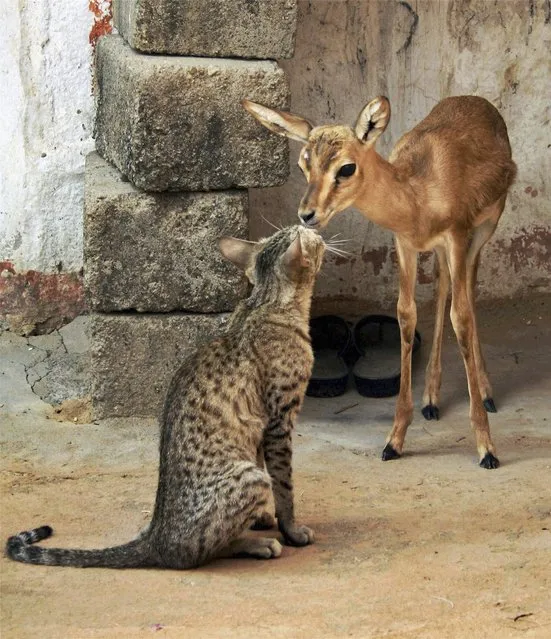
In this Wednesday, May 23, 2012 photograph, a young deer and a cat share a moment in Feench village near Jodhpur, Rajasthan state, India

In this Wednesday, May 23, 2012 photograph, a young deer and a cat share a moment in Feench village near Jodhpur, Rajasthan state, India. (Photo by AP Photo)
Details
16 Jun 2012 11:07:00
A miner with a donkey makes his way through the low and narrow tunnel leading out of a coal mine in Choa Saidan Shah in Punjab province, April 29, 2014. Workers at this mine in Choa Saidan Shah dig coal with pick axes, break it up and load it onto donkeys to be transported to the surface. (Photo by Sara Farid/Reuters)

A miner with a donkey makes his way through the low and narrow tunnel leading out of a coal mine in Choa Saidan Shah in Punjab province, April 29, 2014. Workers at this mine in Choa Saidan Shah dig coal with pick axes, break it up and load it onto donkeys to be transported to the surface. Employed by private contractors, a team of four workers can dig about a ton of coal a day, for which they earn around $10 to be split between them. The coalmine is in the heart of Punjab, Pakistan's most populous and richest province, but the labourers mostly come from the poorer neighbouring region of Khyber Pakhtunkhwa. (Photo by Sara Farid/Reuters)
Details
03 Aug 2014 07:35:00
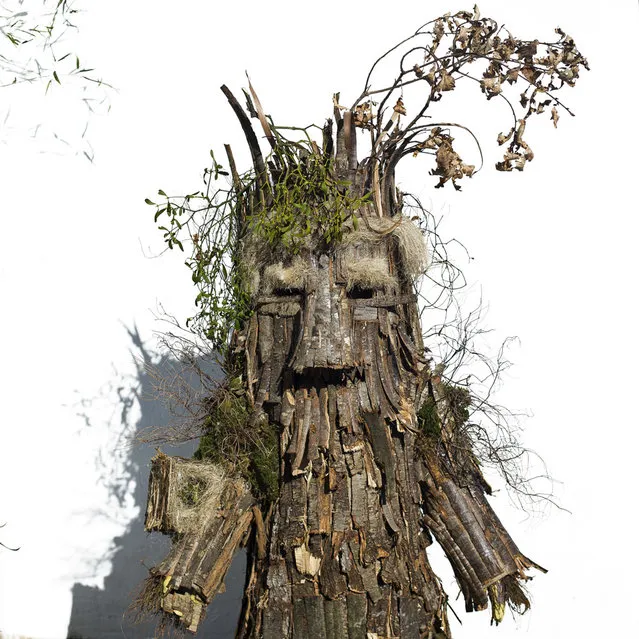
A man dressed as a  “Trapajon”, representing entities of nature, poses for a picture after taking part in the Vijanera Festival in Silio, northern Spain, Sunday, Jan. 6, 2013. The Vijanera masquerade, of pre-Roman origin, is the first carnival of the year in Europe symbolizing the triumph of good over evil and involving the participation of crowds of residents wearing different masks, animal skins and brightly colored clothing with its own complex function and symbolism and becoming the living example of the survival of archaic cults to nature. (Photo by Daniel Ochoa de Olza/AP Photo)

A man dressed as a “Trapajon”, representing entities of nature, poses for a picture after taking part in the Vijanera Festival in Silio, northern Spain, Sunday, Jan. 6, 2013. The Vijanera masquerade, of pre-Roman origin, is the first carnival of the year in Europe symbolizing the triumph of good over evil and involving the participation of crowds of residents wearing different masks, animal skins and brightly colored clothing with its own complex function and symbolism and becoming the living example of the survival of archaic cults to nature. (Photo by Daniel Ochoa de Olza/AP Photo)
Details
19 Jan 2013 13:01:00
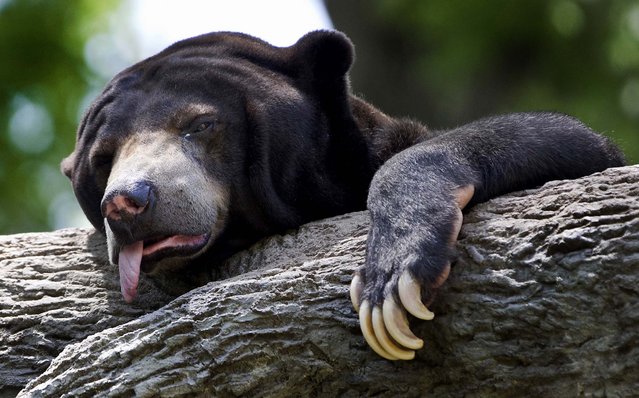
A sun bear reacts to triple-digit temperatures at the Henry Doorly Zoo in Omaha, Nebraska, where the temperature reached 103 degrees Fahrenheit

A sun bear reacts to triple-digit temperatures at the Henry Doorly Zoo in Omaha, Nebraska, where the temperature reached 103 degrees Fahrenheit on July 6, 2012. (Photo by Nati Harnik/Associated Press)
Details
15 Jul 2012 07:15:00
A handout image released by the Taronga Zoo shows Veiled Chameleon hatchlings at Taronga Zoo in Sydney, Australia, 11 March 2015. Taronga has welcomed more than 20 baby chameleons, with the last of three clutches of eggs hatching this week. Veiled Chameleons, or Chamaeleo calyptratus, are native to Saudi Arabia and Yemen and can live up to five years. (Photo by EPA/Taronga Zoo)

A handout image released by the Taronga Zoo shows Veiled Chameleon hatchlings at Taronga Zoo in Sydney, Australia, 11 March 2015. Taronga has welcomed more than 20 baby chameleons, with the last of three clutches of eggs hatching this week. Veiled Chameleons, or Chamaeleo calyptratus, are native to Saudi Arabia and Yemen and can live up to five years. (Photo by EPA/Taronga Zoo)
Details
21 Mar 2015 13:13:00
Members of the Gafatar sect walk in the rain as they evacuate their compound, which was later burned down by local villagers, in Antibar village, Mempawah Regency, Indonesia West Kalimantan Province, January 19, 2016 in this photo taken by Antara Foto. Local authorities and police moved the sect members to an army barracks located some 70 km (43 miles) away from Antibar for their safety following recent disputes between the sect and the villagers, Antara said on Tuesday. (Photo by Jessica Helena Wuysang/Reuters/Antara Foto)

Members of the Gafatar sect walk in the rain as they evacuate their compound, which was later burned down by local villagers, in Antibar village, Mempawah Regency, Indonesia West Kalimantan Province, January 19, 2016 in this photo taken by Antara Foto. Local authorities and police moved the sect members to an army barracks located some 70 km (43 miles) away from Antibar for their safety following recent disputes between the sect and the villagers, Antara said on Tuesday. (Photo by Jessica Helena Wuysang/Reuters/Antara Foto)
Details
20 Jan 2016 13:24:00