Loading...
Done
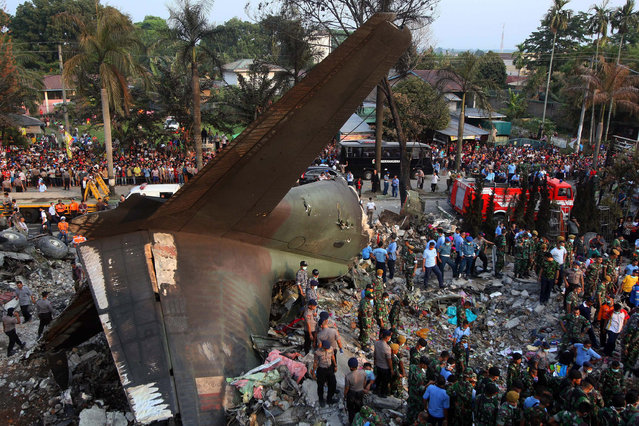
Indonesian rescuers search for victims of the crashed military airplane in Medan, North Sumatra, Indonesia, 30 June 2015. At least people 49 people were killed after an Indonesian military plane crashed in North Sumatra and burst into flames, officials said. Air Force chief Air Marshal Agus Supriatna said there were no survivors after the plane ploughed into houses and commercial buildings in Medan, the country's third largest city. (Photo by Dedi Sahputra/EPA)

Indonesian rescuers search for victims of the crashed military airplane in Medan, North Sumatra, Indonesia, 30 June 2015. At least people 49 people were killed after an Indonesian military plane crashed in North Sumatra and burst into flames, officials said. Air Force chief Air Marshal Agus Supriatna said there were no survivors after the plane ploughed into houses and commercial buildings in Medan, the country's third largest city. The plane left Jakarta with 113 people aboard, including military personnel and their relatives, but it was not clear how many continued the journey to Medan after stopovers in Pekanbaru and Dumai, Agus said. (Photo by Dedi Sahputra/EPA)
Details
01 Jul 2015 13:30:00
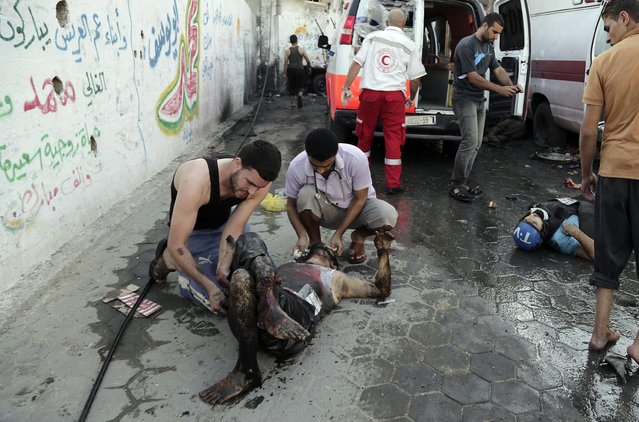
In this July 30, 2014 photo, neighbors help gravely injured Mohammed al-Selek, 39, wounded by an Israeli mortar strike as he lays next to the body of Palestinian journalist Rami Reyan who was killed, in the Shijaiyah neighborhood of the northern Gaza Strip. Al-Selek's life changed forever last July 30, when the shells slammed into his home killing all his three children, his father and six other relatives. (Photo by Adel Hana/AP Photo)

In this July 30, 2014 photo, neighbors help gravely injured Mohammed al-Selek, 39, wounded by an Israeli mortar strike as he lays next to the body of Palestinian journalist Rami Reyan who was killed, in the Shijaiyah neighborhood of the northern Gaza Strip. Al-Selek's life changed forever last July 30, when the shells slammed into his home killing all his three children, his father and six other relatives. A year later, al-Selek, who lost his leg during the airstrike, still struggles to recover and come to terms with his family's loss in the 50-day Israel-Hamas war. (Photo by Adel Hana/AP Photo)
Details
07 Jul 2015 11:28:00
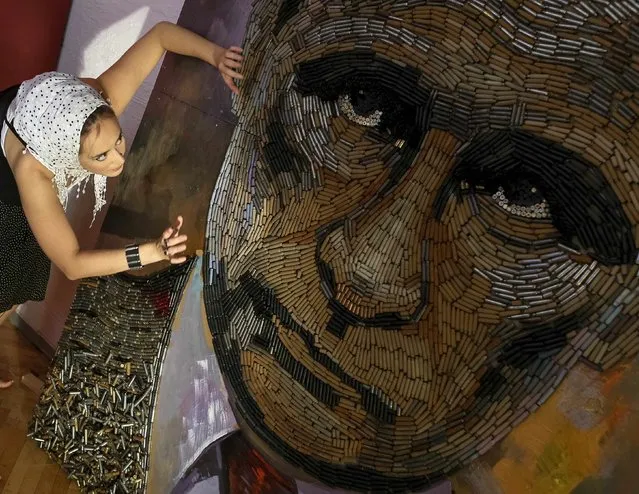
Ukrainian artist Dariya Marchenko works on a portrait of Russian President Vladimir Putin named “The Face of War” which is made out of 5,000 cartridges brought from the frontline in eastern Ukraine, in Kiev, July 23, 2015. The portrait will be presented along with a novel which will tell personal stories of six people involved in this project including Daria's own story and stories of people who helped her to collect shells from the frontline. (Photo by Gleb Garanich/Reuters)

Ukrainian artist Dariya Marchenko works on a portrait of Russian President Vladimir Putin named “The Face of War” which is made out of 5,000 cartridges brought from the frontline in eastern Ukraine, in Kiev, July 23, 2015. The portrait will be presented along with a novel which will tell personal stories of six people involved in this project including Daria's own story and stories of people who helped her to collect shells from the frontline. Daria Marchenko calls her art approach philosophic symbolism where every element has its hidden meaning. In her works cartridges mean human's life that was brutally ended. (Photo by Gleb Garanich/Reuters)
Details
28 Jul 2015 12:44:00
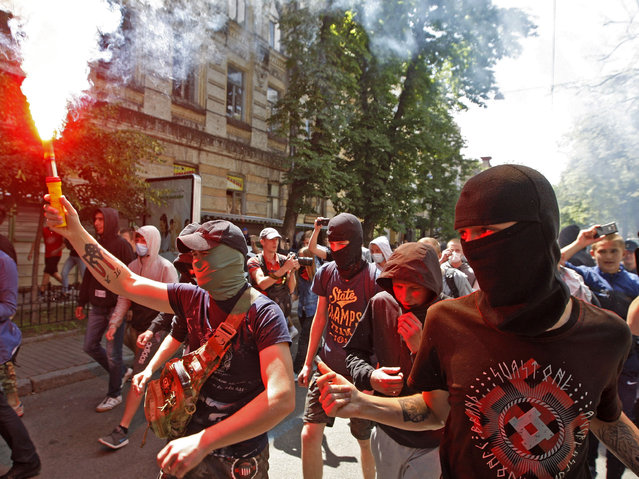
A man carries a smoke flare as far-right activists march during the Gay Pride parade on June 12, 2016 in Kiev. More than 700 gay rights activists marched through central Kiev on June 12 amid a massive police presence for the third such gay pride event in the ex-Soviet country where homophobia remains widespread. The June 12 march was the first ever gay pride rally to be held in central Kiev, prompting an unprecedented security operation with several thousand police and National Guard officers lining the route during the event, which lasted around 20 minutes. (Photo by Yuriy Kirnichny/AFP Photo)

A man carries a smoke flare as far-right activists march during the Gay Pride parade on June 12, 2016 in Kiev. More than 700 gay rights activists marched through central Kiev on June 12 amid a massive police presence for the third such gay pride event in the ex-Soviet country where homophobia remains widespread. The June 12 march was the first ever gay pride rally to be held in central Kiev, prompting an unprecedented security operation with several thousand police and National Guard officers lining the route during the event, which lasted around 20 minutes. (Photo by Yuriy Kirnichny/AFP Photo)
Details
13 Jun 2016 11:08:00
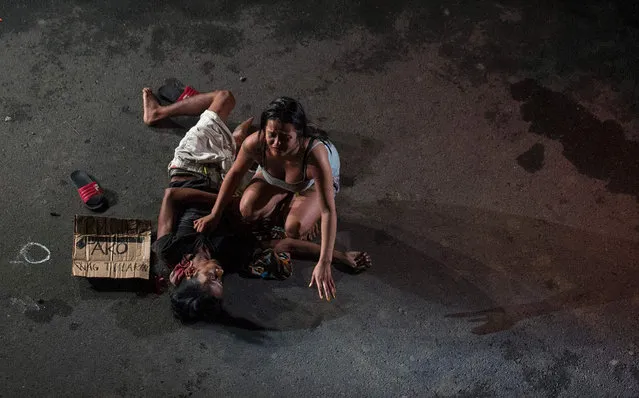
A woman mourns the loss of her husband, next to a placard which reads “I'm a pusher”, who was shot dead by an unidentified gunman in Manila on July 23, 2016. Philippine President Rodrigo Duterte swept to power in May on a promise to clampdown on drugs, and police have since confirmed killing nearly 200 people in a two-month crime blitz. There has also been a surge in killings by anti-drug vigilantes who leave victims' corpses on city streets wrapped in packaging tape with signs accusing them of being drug dealers. (Photo by Noel Celis/AFP Photo)

A woman mourns the loss of her husband, next to a placard which reads “I'm a pusher”, who was shot dead by an unidentified gunman in Manila on July 23, 2016. Philippine President Rodrigo Duterte swept to power in May on a promise to clampdown on drugs, and police have since confirmed killing nearly 200 people in a two-month crime blitz. There has also been a surge in killings by anti-drug vigilantes who leave victims' corpses on city streets wrapped in packaging tape with signs accusing them of being drug dealers. (Photo by Noel Celis/AFP Photo)
Details
24 Jul 2016 11:12:00
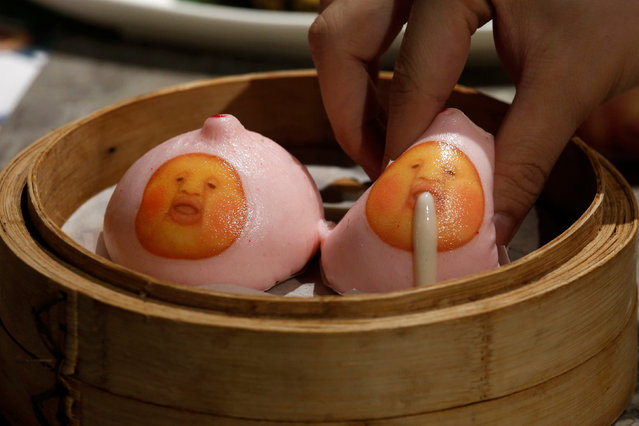
A milk custard bun made to resemble one of the popular Japanese “Kobitos” characters is squeezed during a display for the photographer at Dim Sum Icon restaurant in Hong Kong, China July 25, 2016. A dim sum restaurant in Hong Kong encourages diners to play with their food, and the result will either disgust or delight you. At Dim Sum Icon customers can squeeze a strange creature to poo or vomit on their plate before eating it. Hungry punters poke a hole into the mouth – or the rear – of the dim sum with a chopstick, squeeze it and watch the brown or white cream ooze out. (Photo by Bobby Yip/Reuters)

A milk custard bun made to resemble one of the popular Japanese “Kobitos” characters is squeezed during a display for the photographer at Dim Sum Icon restaurant in Hong Kong, China July 25, 2016. A dim sum restaurant in Hong Kong encourages diners to play with their food, and the result will either disgust or delight you. At Dim Sum Icon customers can squeeze a strange creature to poo or vomit on their plate before eating it. Hungry punters poke a hole into the mouth – or the rear – of the dim sum with a chopstick, squeeze it and watch the brown or white cream ooze out. The unique dim sums are made with a face to resemble Japanese Kobitos characters. (Photo by Bobby Yip/Reuters)
Details
31 Jul 2016 11:25:00
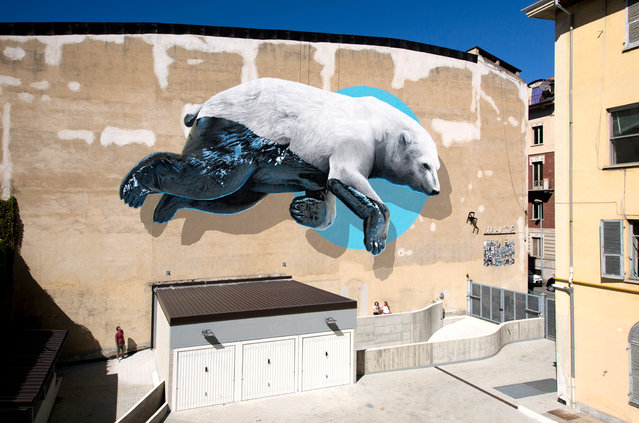
A polar bear whose bottom half is caked in oily black gunk. A whale wrapped in striped fabric: a pseudo straightjacket. These are the messes climate change leaves behind, the things we know are happening but often don’t have the opportunity to see with our own eyes. Swiss street art duo Christian Rebecchi and Pablo Togni, otherwise known as NeverCrew, met in art school when they were 15 and started making work together soon after. As a team, the artists adorn the world with eye-popping and gut-wrenching images depicting the consequences of humanity’s actions on earth. Here: “Black machine” mural painting and installation on the Colosseo theater in Turin, Italy, in September 2015. (Photo by NeverCrew/The Huffington Post)

A polar bear whose bottom half is caked in oily black gunk. A whale wrapped in striped fabric: a pseudo straightjacket. These are the messes climate change leaves behind, the things we know are happening but often don’t have the opportunity to see with our own eyes. Swiss street art duo Christian Rebecchi and Pablo Togni, otherwise known as NeverCrew, met in art school when they were 15 and started making work together soon after. As a team, the artists adorn the world with eye-popping and gut-wrenching images depicting the consequences of humanity’s actions on earth. (Photo by NeverCrew/The Huffington Post)
Details
13 Aug 2016 11:09:00
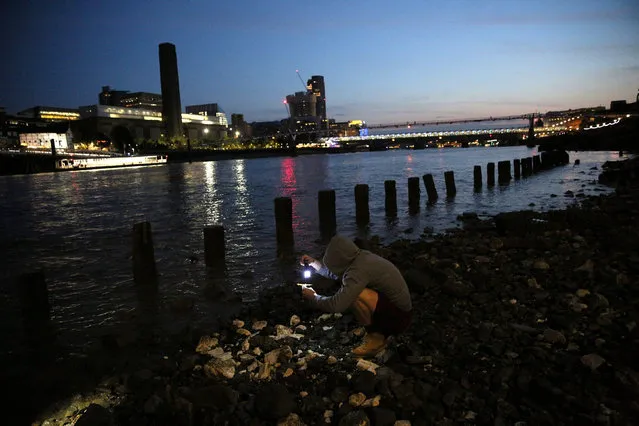
A mudlark uses a torch to look for items on the bank of the River Thames in London, Britain June 06, 2016. Mudlarking is believed to trace its origins to the 18th and 19th century, when scavengers searched the Thames' shores for items to sell. These days, history and archaeology fans are the ones hoping to find old relics such as coins, ceramics, artifacts or everyday items from across centuries. They wait for the low tide and then scour specific areas of exposed shores. "If you're in a field you could be out all day long, with the river you're restricted to about two or three hours," mudlark Nick Stevens said. While many just use the naked eye for their searches, others rely on metal detectors for which a permit from the Port of London Authority is needed. Digging also requires consent. (Photo by Neil Hall/Reuters)

A mudlark uses a torch to look for items on the bank of the River Thames in London, Britain June 06, 2016. Mudlarking is believed to trace its origins to the 18th and 19th century, when scavengers searched the Thames' shores for items to sell. These days, history and archaeology fans are the ones hoping to find old relics such as coins, ceramics, artifacts or everyday items from across centuries. their finds with the Portable Antiquities Scheme. Any item over 300 years old must be recorded. (Photo by Neil Hall/Reuters)
Details
27 Aug 2016 10:43:00