Loading...
Done
Boat crew members train on the waters of the Tonle Sap River on the morning of the first day of the Water Festival on November 13, 2016 in Phnom Penh, Cambodia. The yearly three-day Water Festival is one of the most important holidays in Cambodia and celebrates the end of the rainy season and the start of the rice harvesting. The Festival also coincides with the Tonle Sap river reversing course, which it does twice a year. Approximately 2 million people are expected to attend this year's festival, during which 259 boats and nearly 20,000 oarsmen will participate in the races. After a fatal stampede resulting in the death of some 353 people during the Water Festival in 2010, it has been cancelled four times over the past five years, with weather used as an official excuse. (Photo by Omar Havana/Getty Images)

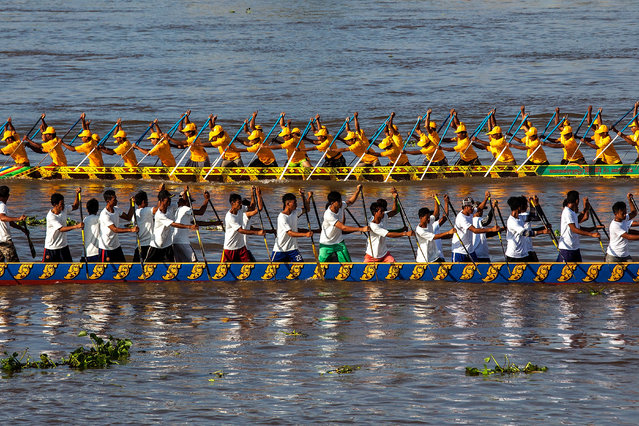
Boat crew members train on the waters of the Tonle Sap River on the morning of the first day of the Water Festival on November 13, 2016 in Phnom Penh, Cambodia. The yearly three-day Water Festival is one of the most important holidays in Cambodia and celebrates the end of the rainy season and the start of the rice harvesting. The Festival also coincides with the Tonle Sap river reversing course, which it does twice a year. Approximately 2 million people are expected to attend this year's festival, during which 259 boats and nearly 20,000 oarsmen will participate in the races. After a fatal stampede resulting in the death of some 353 people during the Water Festival in 2010, it has been cancelled four times over the past five years, with weather used as an official excuse. (Photo by Omar Havana/Getty Images)
Details
15 Nov 2016 11:26:00
A daredevil photographer is determined to capture London in a whole new light – by scaling the city’s many rooftops. Jacob Riglin, from Richmond Upon Thames, photographs the nation's capital from above – hanging from scaffolding, dangling his legs over the edge of buildings and looking down from perilous heights. Such images have gained the photographer, 20, an incredible fan base on Instagram, which has seen his follower count rise to more than 150,000. (Photo by Jacob Riglin/Caters News)

A daredevil photographer is determined to capture London in a whole new light – by scaling the city’s many rooftops. Jacob Riglin, from Richmond Upon Thames, photographs the nation's capital from above – hanging from scaffolding, dangling his legs over the edge of buildings and looking down from perilous heights. Such images have gained the photographer, 20, an incredible fan base on Instagram, which has seen his follower count rise to more than 150,000. He said, “I had always been interested climbing and getting that adrenaline rush from feeling on top of the world”. Here: Jacob looking out to the London skyline. (Photo by Jacob Riglin/Caters News)
Details
17 Oct 2015 08:05:00
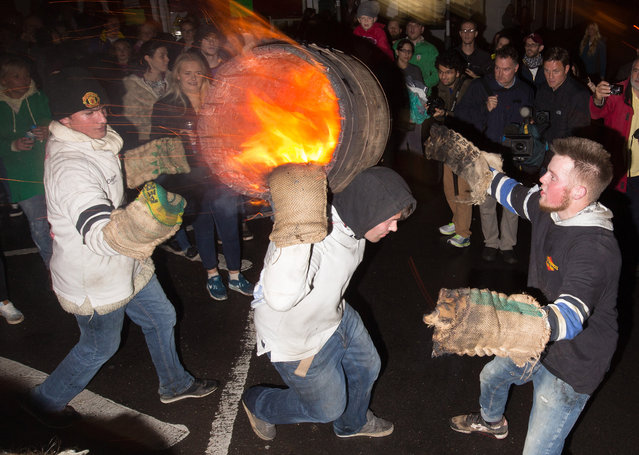
A boy runs with a burning barrel soaked in tar at the annual Ottery St Mary tar barrel festival on November 5, 2015 in Ottery St. Mary, England. The tradition, which is over 400 years old, sees competitors (who must have been born in the town to take part) running with burning barrels on their backs through the village, until the heat becomes too unbearable or the barrel breaks down, starting with junior barrels carried by children and continuing all evening with ever larger and larger barrels. (Photo by Matt Cardy/Getty Images)

A boy runs with a burning barrel soaked in tar at the annual Ottery St Mary tar barrel festival on November 5, 2015 in Ottery St. Mary, England. The tradition, which is over 400 years old, sees competitors (who must have been born in the town to take part) running with burning barrels on their backs through the village, until the heat becomes too unbearable or the barrel breaks down, starting with junior barrels carried by children and continuing all evening with ever larger and larger barrels. The event, which has been threatened with closure on previous years due to increasing public liability insurance costs, raises thousands of pounds for charity and attracts spectators from around the world. (Photo by Matt Cardy/Getty Images)
Details
07 Nov 2015 08:07:00
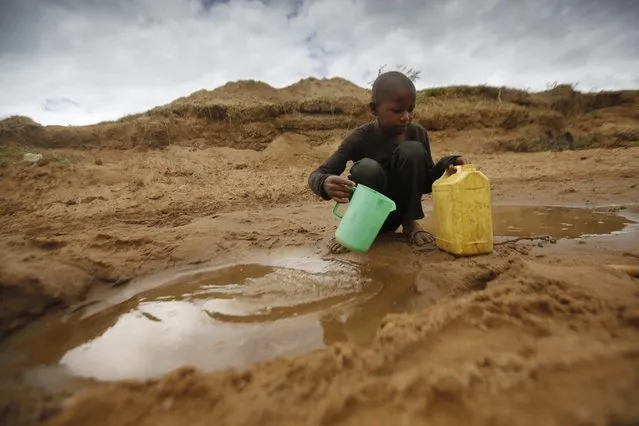
A young boy scoops water from a hand-dug well in the dry riverbed near Matinyani, in the semi-arid Kitui County in southeastern Kenya, 22 March 2015, the World Water Day. Residents of Kitui County and other arid and semi-arid areas of the country have been hard-hit by extremely poor rainfall this year while the government said in previous month that some 1.6 million people countrywide are facing acute starvation due to the drought and will need relief food over the next six months. (Photo by Dai Kurokawa/EPA)

A young boy scoops water from a hand-dug well in the dry riverbed near Matinyani, in the semi-arid Kitui County in southeastern Kenya, 22 March 2015, the World Water Day. Residents of Kitui County and other arid and semi-arid areas of the country have been hard-hit by extremely poor rainfall this year while the government said in previous month that some 1.6 million people countrywide are facing acute starvation due to the drought and will need relief food over the next six months. Residents of Matinyani say they haven't seen a drop of rain in nearly four months. Thousands of Kenyans in rural areas walk tens of kilometers just to fetch water to drink and to be used in their homes. According to an estimate by UNESCO (United Nations Educational, Scientific and Cultural Organization), 17 million people lack access to safe water in Kenya, where the drought is a perennial problem. (Photo by Dai Kurokawa/EPA)
Details
23 Mar 2015 11:01:00
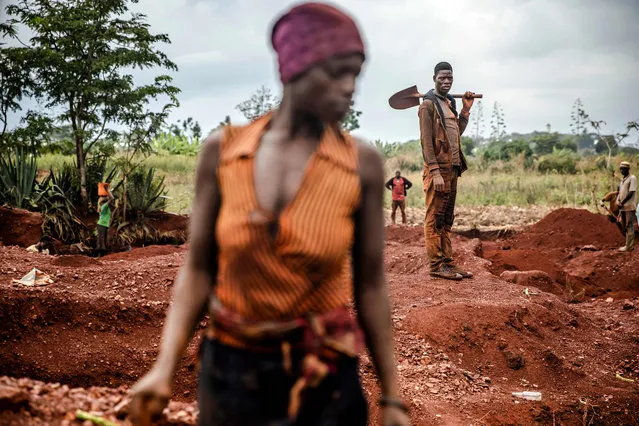
A gold miner observes from the distance how some women miners work at an open-pit gold mine in Nyarugusu, Geita Region, Tanzania on May 27, 2022. Tanzania is a land rich in minerals and one of the main gold producers in Africa, with gold representing more than 90% of the country's mineral exports. Artisanal and small-scale gold mining have culturally and historically relegated women's participation. The extractive sector in Tanzania has historically been a male-dominated industry with high levels of harassment, sеxual abuse, discrimination and misconceptions over women's involvement, and contributions following traditional beliefs. (Photo by Luis Tato/AFP Photo)

A gold miner observes from the distance how some women miners work at an open-pit gold mine in Nyarugusu, Geita Region, Tanzania on May 27, 2022. Tanzania is a land rich in minerals and one of the main gold producers in Africa, with gold representing more than 90% of the country's mineral exports. Artisanal and small-scale gold mining have culturally and historically relegated women's participation. The extractive sector in Tanzania has historically been a male-dominated industry with high levels of harassment, sеxual abuse, discrimination and misconceptions over women's involvement, and contributions following traditional beliefs. (Photo by Luis Tato/AFP Photo)
Details
13 Jun 2022 04:31:00
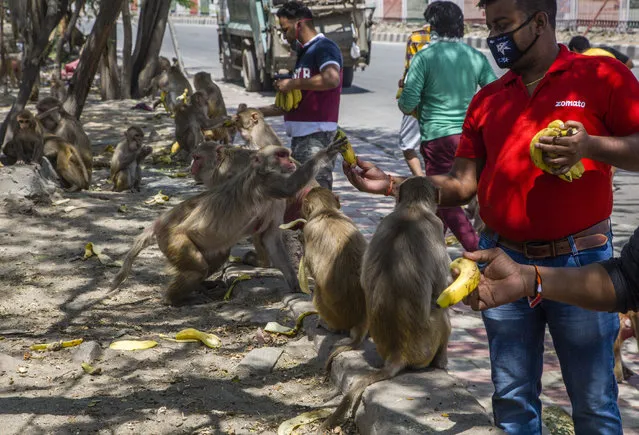
Men give bananas to monkeys gathered on the side of the road as India remains under an unprecedented lockdown over the highly contagious coronavirus (COVID-19) on April 08, 2020 in New Delhi, India. Wild animals, including monkeys, are roaming human settlements in India as people are staying indoors due to the 21-day lockdown. With India's 1.3 billion population and tens of millions of cars off the roads, wildlife is moving towards areas inhabited by humans. Wild animals in many countries have been seen roaming streets. A study says some 60 percent of the new diseases found around the globe every year are zoonotic, meaning they originate in animals and are passed on to humans. COVID-19 is a zoonotic disease that is suspected to have come from the wet markets of Wuhan, China. (Photo by Yawar Nazir/Getty Images)

Men give bananas to monkeys gathered on the side of the road as India remains under an unprecedented lockdown over the highly contagious coronavirus (COVID-19) on April 08, 2020 in New Delhi, India. Wild animals, including monkeys, are roaming human settlements in India as people are staying indoors due to the 21-day lockdown. (Photo by Yawar Nazir/Getty Images)
Details
12 Apr 2020 00:05:00
In this file photo taken on Sunday, August 2, 2020, Sviatlana Tsikhanouskaya, candidate for the presidential elections greets people waving old Belarus flags during a meeting to show her support, in Brest, 326 km (203,7 miles) southwest of Minsk, Belarus. Belarus’ authoritarian President Alexander  Lukashenko faces a perfect storm as he seeks a sixth term in the election held Sunday, Aug. 9, 2020 after 26 years in office. Mounting public discontent over the worsening economy and his government’s bungled handling of the coronavirus pandemic has fueled the largest opposition rallies since the Soviet collapse. (Photo by Sergei Grits/AP Photo)

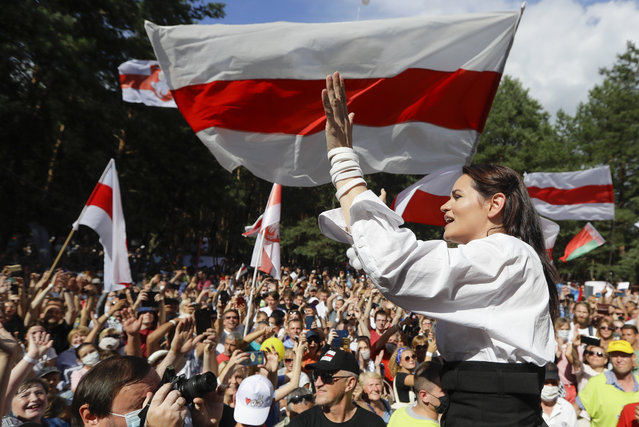
In this file photo taken on Sunday, August 2, 2020, Sviatlana Tsikhanouskaya, candidate for the presidential elections greets people waving old Belarus flags during a meeting to show her support, in Brest, 326 km (203,7 miles) southwest of Minsk, Belarus. Belarus’ authoritarian President Alexander Lukashenko faces a perfect storm as he seeks a sixth term in the election held Sunday, Aug. 9, 2020 after 26 years in office. Mounting public discontent over the worsening economy and his government’s bungled handling of the coronavirus pandemic has fueled the largest opposition rallies since the Soviet collapse. (Photo by Sergei Grits/AP Photo)
Details
10 Aug 2020 00:01:00
Aerial view over mud and waste from the disaster caused by dam spill in Brumadinho, Minas Gerais, Brazil, 26 January 2019. At least nine people have died and 300 are missing after a tailings dam burst at the Feijao mine in southeastern Brazil owned by Vale, the world's largest iron-ore producer, the Minas Gerais state government said. The dam in Brumadinho near Belo Horizonte broke on 25 January at around mid-day, unleashing a river of sludge that destroyed some nearby houses. (Photo by Antonio Lacerda/EPA/EFE)

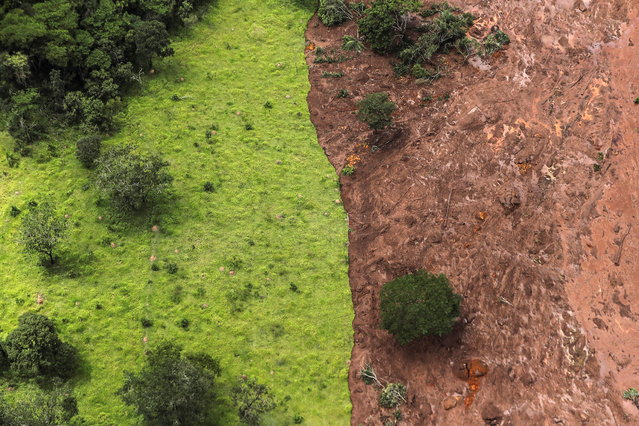
Aerial view over mud and waste from the disaster caused by dam spill in Brumadinho, Minas Gerais, Brazil, 26 January 2019. At least nine people have died and 300 are missing after a tailings dam burst at the Feijao mine in southeastern Brazil owned by Vale, the world's largest iron-ore producer, the Minas Gerais state government said. The dam in Brumadinho near Belo Horizonte broke on 25 January at around mid-day, unleashing a river of sludge that destroyed some nearby houses. (Photo by Antonio Lacerda/EPA/EFE)
Details
29 Jan 2019 00:03:00