Loading...
Done
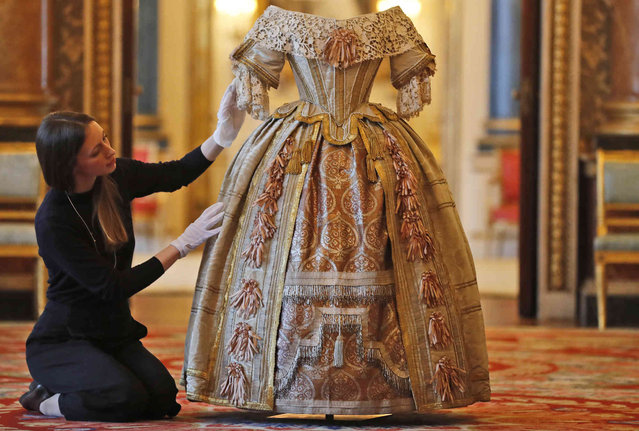
A member of the Palace staff arranges Queen Victoria's Stuart Ball costume which is part of an exhibition to mark the 200th anniversary of the birth of Queen Victoria (1819–1901) this year at Buckingham Palace in London, Tuesday, April 2, 2019. The exhibition, Queen Victoria's Palace at the Summer Opening of Buckingham Palace from 20 July – 29 September 2019, will tell the story of her 62-year reign and her life at Buckingham Palace, which began when she ascended to the throne in June 1837. (Photo by Frank Augstein/AP Photo)

A member of the Palace staff arranges Queen Victoria's Stuart Ball costume which is part of an exhibition to mark the 200th anniversary of the birth of Queen Victoria (1819–1901) this year at Buckingham Palace in London, Tuesday, April 2, 2019. The exhibition, Queen Victoria's Palace at the Summer Opening of Buckingham Palace from 20 July – 29 September 2019, will tell the story of her 62-year reign and her life at Buckingham Palace, which began when she ascended to the throne in June 1837. (Photo by Frank Augstein/AP Photo)
Details
04 Apr 2019 00:05:00
An Extinction Rebellion environmental activist couple getting married at an action site they are calling “The Beacon” on Westminster Bridge on October 7, 2019 in London, England. Primarily made up of London based activists the site is one of 12 situated around key Government locations in central London as actions are also predicted to occur in unto 70 cities around the world. The group aim to occupy the areas in central London for up to two weeks through non violent protest with an estimated 8 times as many people as their April protests which saw over 1,200 people arrested. (Photo by Ollie Millington/Getty Images)

An Extinction Rebellion environmental activist couple getting married at an action site they are calling “The Beacon” on Westminster Bridge on October 7, 2019 in London, England. Primarily made up of London based activists the site is one of 12 situated around key Government locations in central London as actions are also predicted to occur in unto 70 cities around the world. The group aim to occupy the areas in central London for up to two weeks through non violent protest with an estimated 8 times as many people as their April protests which saw over 1,200 people arrested. (Photo by Ollie Millington/Getty Images)
Details
10 Oct 2019 00:05:00
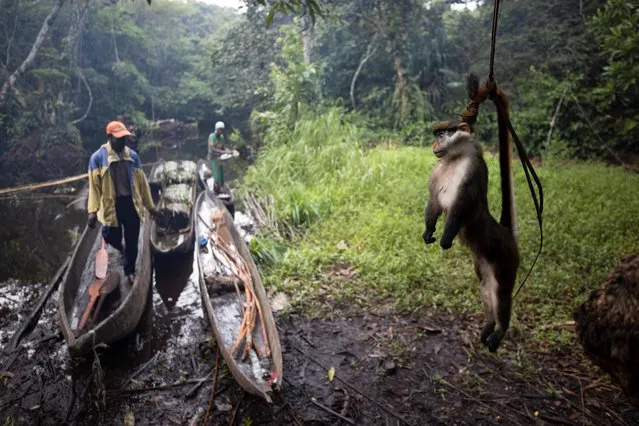
A dead red-tailed monkey hangs by its tail above the ground, in order to keep it away from ants, in the forest near the city of Mbandaka, Democratic Republic of the Congo, April 5, 2019. Bushmeat hunters are emptying Central Africa's forests at a high rate, researchers say. A growing appetite for wild meat in cities has ramped up the scale of hunting. Research shows around 6 million tonnes of bushmeat are sourced annually from the Congo Basin, whose forest spans across six countries and is second in size only to the Amazon. (Photo by Thomas Nicolon/Reuters)

A dead red-tailed monkey hangs by its tail above the ground, in order to keep it away from ants, in the forest near the city of Mbandaka, Democratic Republic of the Congo, April 5, 2019. Bushmeat hunters are emptying Central Africa's forests at a high rate, researchers say. A growing appetite for wild meat in cities has ramped up the scale of hunting. Research shows around 6 million tonnes of bushmeat are sourced annually from the Congo Basin, whose forest spans across six countries and is second in size only to the Amazon. (Photo by Thomas Nicolon/Reuters)
Details
14 Oct 2019 00:03:00
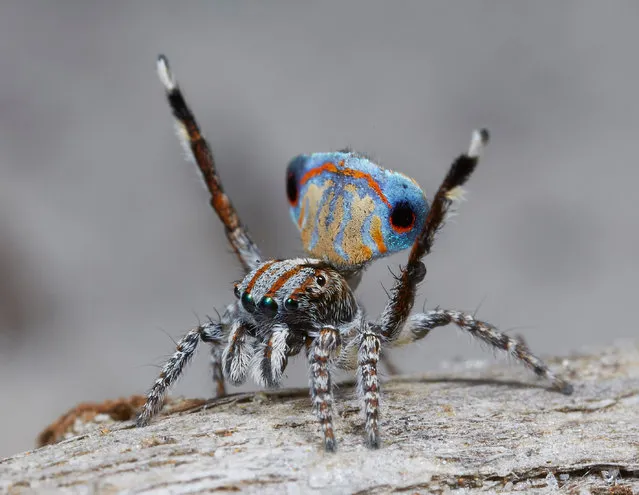
Several new species of peacock spider – just a few millimetres long and featuring extraordinary colours – have been discovered in Western Australia and South Australia. Jürgen Otto, a biologist from Sydney, has been researching the arachnids since 2005, and has gained a significant following online with his footage. He believes there are now 48 confirmed species of peacock spider within the Maratus genus, found across Australia but particularly in Western Australia – and many more awaiting confirmation. Here: Maratus Tasmanicus, one of seven new species of peacock spiders studied by the Sydney biologist Jürgen Otto. (Photo by Jürgen Otto)

Several new species of peacock spider – just a few millimetres long and featuring extraordinary colours – have been discovered in Western Australia and South Australia. Jürgen Otto, a biologist from Sydney, has been researching the arachnids since 2005, and has gained a significant following online with his footage. He believes there are now 48 confirmed species of peacock spider within the Maratus genus, found across Australia but particularly in Western Australia – and many more awaiting confirmation. Here: Maratus Tasmanicus, one of seven new species of peacock spiders studied by the Sydney biologist Jürgen Otto. (Photo by Jürgen Otto)
Details
30 May 2016 08:40:00
In this Tuesday, August 2, 2016 photo released by Xinhua News Agency, people stand on a platform as the Transit Elevated Bus TEB-1 conducting a test run after it unveiled in Qinhuangdao, north China's Hebei Province. The 72-feet long and 25-feet wide Transit Elevated Bus (TEB) powered by electricity can carry more than hundreds passengers, is designed to go over the normal traffic to help ease traffic congestion without having to dig new tunnels or build elevated rail tracks. (Photo by Luo Xiaoguang/Xinhua via AP Photo)

In this Tuesday, August 2, 2016 photo released by Xinhua News Agency, people stand on a platform as the Transit Elevated Bus TEB-1 conducting a test run after it unveiled in Qinhuangdao, north China's Hebei Province. The 72-feet long and 25-feet wide Transit Elevated Bus (TEB) powered by electricity can carry more than hundreds passengers, is designed to go over the normal traffic to help ease traffic congestion without having to dig new tunnels or build elevated rail tracks. (Photo by Luo Xiaoguang/Xinhua via AP Photo)
Details
04 Aug 2016 10:32:00
Gymnast Ahmad al-Sawas performs gymnastic moves near damaged buildings in the rebel-held Bustan al-Qasr neighbourhood of Aleppo, Syria March 26, 2016. As Syrian gymnast Ahmad al-Sawas watched his country fall apart, his Olympic dream collapsed too. The last national champion before the fighting began, he knew that supporting the anti-government side in the five-year-old civil war would prevent him from being selected for the Rio Games. “I chose to be an athlete who participates in the revolution”, said Ahmad, who trains where he can for two hours a day – be it on a mattress on a soccer field, in a local hall or somersaulting off a wall. (Photo by Abdalrhman Ismail/Reuters)

Gymnast Ahmad al-Sawas performs gymnastic moves near damaged buildings in the rebel-held Bustan al-Qasr neighbourhood of Aleppo, Syria March 26, 2016. As Syrian gymnast Ahmad al-Sawas watched his country fall apart, his Olympic dream collapsed too. The last national champion before the fighting began, he knew that supporting the anti-government side in the five-year-old civil war would prevent him from being selected for the Rio Games. (Photo by Abdalrhman Ismail/Reuters)
Details
05 Aug 2016 13:25:00
The Wadi al-Salam cemetery, Arabic for “Peace Valley”, is seen in Najaf, south of Baghdad, Iraq August 3, 2016. The world's largest cemetery, in Iraq's Shi'ite holy city of Najaf, is expanding at double its usual rate as Shi'ite militias bury their dead from the war against Islamic State. The Wadi al-Salam cemetery, Arabic for “Peace Valley” has a special place in the hearts of Shi'ite Muslims as it surrounds the Mausoleum of their first imam, Ali Bin Abi Talib, a cousin and son-in-law of Prophet Mohammad. (Photo by Alaa Al-Marjani/Reuters)

The Wadi al-Salam cemetery, Arabic for “Peace Valley”, is seen in Najaf, south of Baghdad, Iraq August 3, 2016. The world's largest cemetery, in Iraq's Shi'ite holy city of Najaf, is expanding at double its usual rate as Shi'ite militias bury their dead from the war against Islamic State. The Wadi al-Salam cemetery, Arabic for “Peace Valley” has a special place in the hearts of Shi'ite Muslims as it surrounds the Mausoleum of their first imam, Ali Bin Abi Talib, a cousin and son-in-law of Prophet Mohammad. (Photo by Alaa Al-Marjani/Reuters)
Details
24 Aug 2016 11:38:00
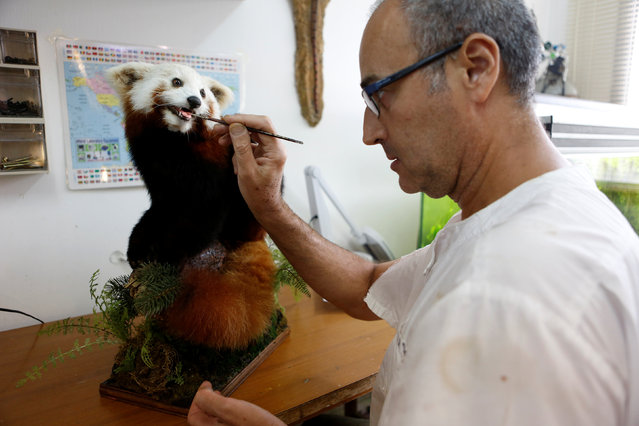
Igor Gavrilov, the main taxidermist of the Zoological centre at Tel Aviv University, works on a taxidermied animal, part of a collection which will be housed at the Steinhardt Museum of Natural History, a new Israeli natural history museum set to open next year in Tel Aviv, Israel June 8, 2016. Legions of insects, sea creatures and ancient fossils are lining up in a new museum shaped liked a giant Noah's Ark, telling the story of a crucial evolutionary byway across Israel. Experts say all humans and other animals had to pass through Israel on their first journey out of Africa into Europe and Asia. (Photo by Nir Elias/Reuters)

Igor Gavrilov, the main taxidermist of the Zoological centre at Tel Aviv University, works on a taxidermied animal, part of a collection which will be housed at the Steinhardt Museum of Natural History, a new Israeli natural history museum set to open next year in Tel Aviv, Israel June 8, 2016. Legions of insects, sea creatures and ancient fossils are lining up in a new museum shaped liked a giant Noah's Ark, telling the story of a crucial evolutionary byway across Israel. (Photo by Nir Elias/Reuters)
Details
25 Aug 2016 09:42:00