Loading...
Done
Then U.S. Army First Lieutenant Kirsten Griest (C) and fellow soldiers participate in combatives training during the Ranger Course on Fort Benning, Georgia, in this handout photograph taken on April 20, 2015 and obtained on August 20, 2015. When Griest and another woman completed the daunting U.S. Army Ranger school this week they helped end questions about whether women can serve as combat leaders, as the Pentagon is poised to open new roles, including elite Navy SEALs, to women in coming months. (Photo by Spc. Nikayla Shodeen/Reuters/U.S. Army)

Then U.S. Army First Lieutenant Kirsten Griest (C) and fellow soldiers participate in combatives training during the Ranger Course on Fort Benning, Georgia, in this handout photograph taken on April 20, 2015 and obtained on August 20, 2015. When Griest and another woman completed the daunting U.S. Army Ranger school this week they helped end questions about whether women can serve as combat leaders, as the Pentagon is poised to open new roles, including elite Navy SEALs, to women in coming months. The feat by Griest and First Lieutenant Shaye Haver followed a re-evaluation of the role of women after their frontline involvement in Iraq and Afghanistan and the end of a rule barring them from combat roles in 2013. (Photo by Spc. Nikayla Shodeen/Reuters/U.S. Army)
Details
21 Aug 2015 13:03:00
A fire-eater of the “Diables de Terrassa” performs during Sitges' little “Festa Major”, “Santa Tecla” in Sitges, Spain on September 19, 2016. This celebration brings together some of Catalonia’s most emblematic festive traditions. The central axis of the celebrations is the traditional parade, made up of “big-head” carnival figures and characters who dance to music played on different traditional instruments. One of the most popular events is the Correfoc or fire-running, which is also the closing event of the fiesta. The people run and jump over characters dressed up as devils and dragons, carrying fire. (Photo by Matthias Oesterle/ZUMA Press/Splash News)

A fire-eater of the “Diables de Terrassa” performs during Sitges' little “Festa Major”, “Santa Tecla” in Sitges, Spain on September 19, 2016. This celebration brings together some of Catalonia’s most emblematic festive traditions. The central axis of the celebrations is the traditional parade, made up of “big-head” carnival figures and characters who dance to music played on different traditional instruments. One of the most popular events is the Correfoc or fire-running, which is also the closing event of the fiesta. The people run and jump over characters dressed up as devils and dragons, carrying fire. (Photo by Matthias Oesterle/ZUMA Press/Splash News)
Details
20 Sep 2016 09:28:00
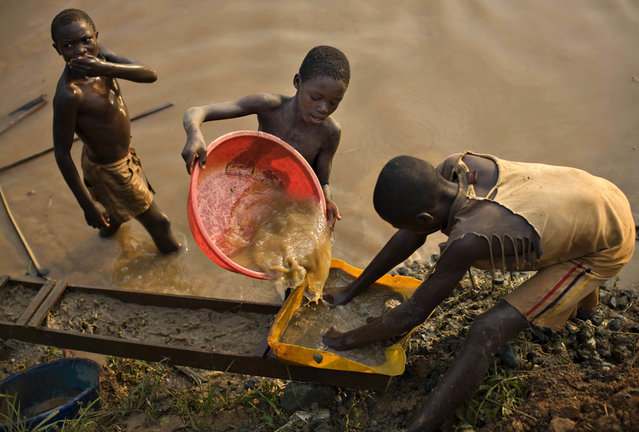
Boys pan for gold on a riverside at Iga Barriere, 25 km (15 miles) from Bunia, in the resource-rich Ituri region of eastern Congo February 16, 2009. Ituri is one of many areas of the country to have experienced bitter ethnic conflict between rival tribes in recent years. Massacres have left tens of thousands dead. It is this fighting that led U.S. authorities to take the unprecedented step of naming Congo in section 1502 of the Dodd-Frank financial regulation act, which says U.S.-listed companies that source gold, tungsten, tantalum and tin from Congo or its neighbours must assure the U.S. stock exchange regulator that their business is not helping fund conflict. (Photo by Finbarr O'Reilly/Reuters)

Boys pan for gold on a riverside at Iga Barriere, 25 km (15 miles) from Bunia, in the resource-rich Ituri region of eastern Congo February 16, 2009. Ituri is one of many areas of the country to have experienced bitter ethnic conflict between rival tribes in recent years. Massacres have left tens of thousands dead. It is this fighting that led U.S. authorities to take the unprecedented step of naming Congo in section 1502 of the Dodd-Frank financial regulation act, which says U.S.-listed companies that source gold, tungsten, tantalum and tin from Congo or its neighbours must assure the U.S. stock exchange regulator that their business is not helping fund conflict. (Photo by Finbarr O'Reilly/Reuters)
Details
12 Nov 2016 10:24:00
Wrestler known as Gio Malkriado (top) fights with a fluorescent tube with wrestler Ciclope during an extreme wrestling fight at a temporary wrestling ring inside a car wash in Tulancingo Hidalgo, Mexico October 8, 2016. When the time comes for the so-called Extreme Star Fight, six wrestlers climb into the ring. Once the fighting begins, anything goes. They bash each other with chairs and long neon lights, causing small explosions and scattering tiny pieces of glass everywhere. The fighters, about half of whom wear masks, even use plastic knives and forks to hurt their opponents. Quickly, blood begins to stain the faces of the combatants and the crowd goes wild, shouting even louder. The screaming and yelling goes on for some time as fans swear at the fighters who ignore them. (Photo by Carlos Jasso/Reuters)

Wrestler known as Gio Malkriado (top) fights with a fluorescent tube with wrestler Ciclope during an extreme wrestling fight at a temporary wrestling ring inside a car wash in Tulancingo Hidalgo, Mexico October 8, 2016. When the time comes for the so-called Extreme Star Fight, six wrestlers climb into the ring. Once the fighting begins, anything goes. They bash each other with chairs and long neon lights, causing small explosions and scattering tiny pieces of glass everywhere. (Photo by Carlos Jasso/Reuters)
Details
20 Nov 2016 11:13:00
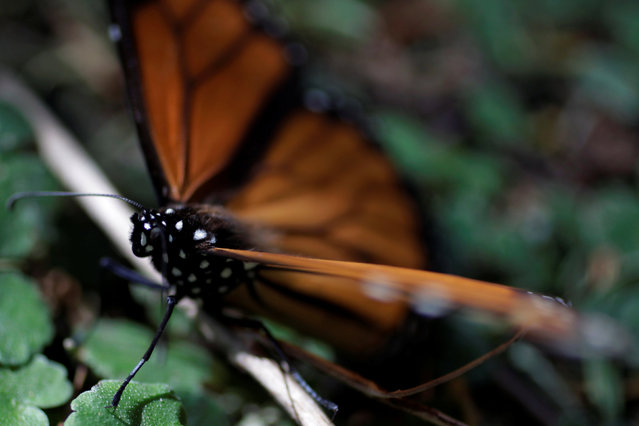
A monarch butterfly rests on the ground at the Sierra Chincua butterfly sanctuary on a mountain in Angangeo, Michoacan November 24, 2016. Angangueo is a town and municipality located in far eastern Michoacán state in central Mexico noted for its history of mining and its location in the Monarch Butterfly Biosphere Reserve. The Monarch Butterfly Biosphere Reserve is a World Heritage Site containing most of the over-wintering sites of the eastern population of the monarch butterfly. The reserve is located in the Trans-Mexican Volcanic Belt pine-oak forests ecoregion on the border of Michoacán and State of Mexico, 100 km (62 miles), northwest of Mexico City. Millions of butterflies arrive in the reserve annually. Butterflies only inhabit a fraction of the 56,000 hectares of the reserve from October–March. (Photo by Carlos Jasso/Reuters)

A monarch butterfly rests on the ground at the Sierra Chincua butterfly sanctuary on a mountain in Angangeo, Michoacan November 24, 2016. Angangueo is a town and municipality located in far eastern Michoacán state in central Mexico noted for its history of mining and its location in the Monarch Butterfly Biosphere Reserve. The Monarch Butterfly Biosphere Reserve is a World Heritage Site containing most of the over-wintering sites of the eastern population of the monarch butterfly. (Photo by Carlos Jasso/Reuters)
Details
26 Nov 2016 10:20:00
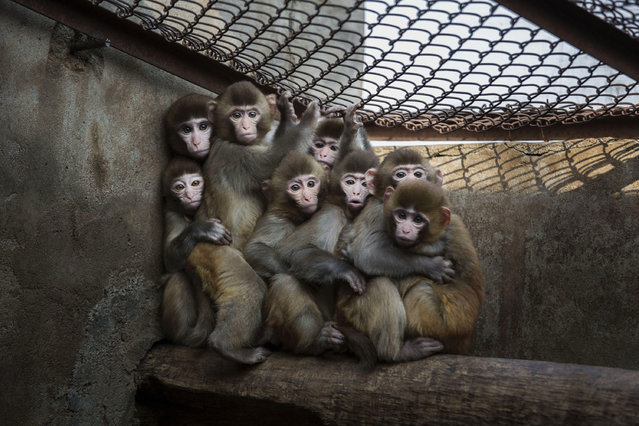
Macaque monkeys crowd together in their cage at a monkey farm on February 3, 2016 in Xinye county, Henan province, China. The area boasts a centuries-long and lucrative history of raising and training monkeys for performance. In Xinye, villagers are seeing an increase in business with the lunar calendar's “Year of the Monkey”. Farmers say most of the monkeys are bred and raised for domestic zoos, circuses, and performing groups, but add that some are also sold for medical research in China and the United States. Despite the popularity of the tradition, critics contend the training methods and conditions constitute animal cruelty. (Photo by Kevin Frayer/Getty Images)

Macaque monkeys crowd together in their cage at a monkey farm on February 3, 2016 in Xinye county, Henan province, China. The area boasts a centuries-long and lucrative history of raising and training monkeys for performance. In Xinye, villagers are seeing an increase in business with the lunar calendar's “Year of the Monkey”. Farmers say most of the monkeys are bred and raised for domestic zoos, circuses, and performing groups, but add that some are also sold for medical research in China and the United States. Despite the popularity of the tradition, critics contend the training methods and conditions constitute animal cruelty. (Photo by Kevin Frayer/Getty Images)
Details
31 Dec 2016 09:56:00
A dog sits in a plastic tub filled with water in Taipei, Taiwan, 28 July 2020. Betel nut seller Mr Luo, the dog's owner, said he puts his dog, a 12-year-old mixed breed called Ah Dai (Stupid), in a plastic tub filled with water whenever the weather gets hot. Ah Dai enjoys the bath and can sit in the basin for hours, according to Mr Luo. Luo has a dozen pairs of glasses for Ah Dai, so the dog wears different glasses every day and many tourists take photos of Ah Dai. (Photo by David Chang/EPA/EFE)

A dog sits in a plastic tub filled with water in Taipei, Taiwan, 28 July 2020. Betel nut seller Mr Luo, the dog's owner, said he puts his dog, a 12-year-old mixed breed called Ah Dai (Stupid), in a plastic tub filled with water whenever the weather gets hot. Ah Dai enjoys the bath and can sit in the basin for hours, according to Mr Luo. Luo has a dozen pairs of glasses for Ah Dai, so the dog wears different glasses every day and many tourists take photos of Ah Dai. (Photo by David Chang/EPA/EFE)
Details
15 Aug 2020 00:05:00
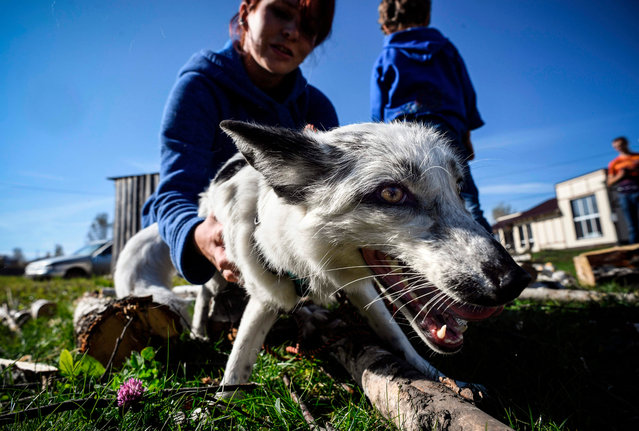
Tatyana Abramova, 33, plays with her home fox Plombir at her countryside house outside Siberian city of Novosibirsk on September 12, 2020. The official start of the Soviet experiment to better understand the domestication of animals by humans began in 1959, and was initiated by geneticists Dmitri Beliaiev and Lioudmila Trout on a farm in Akademgorodok, the scientific center of excellence in Siberia. Their primary objective was to domesticate foxes, to understand how the ancestor of wolves, another canine, evolved into a loyal and loving dog. And understand what this domestication tells us about the genetic evolution of species. (Photo by Alexander Nemenov/AFP Photo)

Tatyana Abramova, 33, plays with her home fox Plombir at her countryside house outside Siberian city of Novosibirsk on September 12, 2020. The official start of the Soviet experiment to better understand the domestication of animals by humans began in 1959, and was initiated by geneticists Dmitri Beliaiev and Lioudmila Trout on a farm in Akademgorodok, the scientific center of excellence in Siberia. Their primary objective was to domesticate foxes, to understand how the ancestor of wolves, another canine, evolved into a loyal and loving dog. And understand what this domestication tells us about the genetic evolution of species. (Photo by Alexander Nemenov/AFP Photo)
Details
25 Oct 2020 00:05:00