Loading...
Done


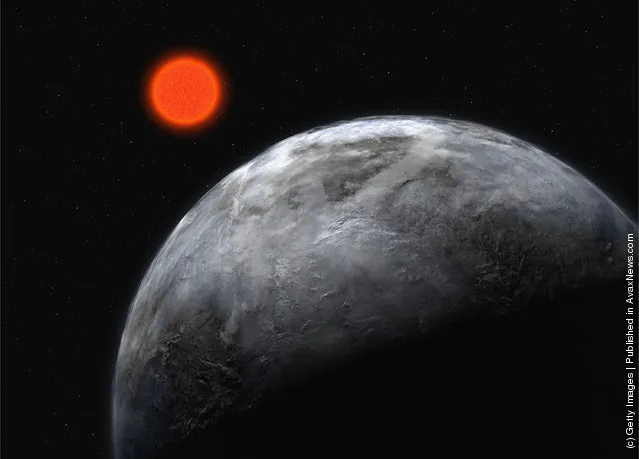
In this artist's impression supplied by the ESO (European Southern Observatory) on April 25, 2007, the planetary system around the red dwarf, Gliese 581, is pictured showing what astronomers believe is the most earth like planet found outside our solar system to date. Using the ESO 3.6-m telescope in Chile, astronomers have uncovered the planet which could have water running on its surface. The planet orbits the faint star Gliese 581, which is 20.5 light-years away in the constellation Libra. (Photo by ESO via Getty Images)
Details
12 Apr 2011 11:00:00
Charlize Theron attends the “Atomic Blonde” World Premiere at Stage Theater on July 17, 2017 in Berlin, Germany. (Photo by Alamy Stock Photo)

Cast member Charlize Theron attends the “Atomic Blonde” World Premiere at Stage Theater on July 17, 2017 in Berlin, Germany. (Photo by Alamy Stock Photo)
Details
23 Jul 2017 07:47:00
Singer Rihanna poses at amfAR's fifth annual Inspiration Gala in Los Angeles, California October 29, 2014. (Photo by Mario Anzuoni/Reuters)

Singer Rihanna poses at amfAR's fifth annual Inspiration Gala in Los Angeles, California October 29, 2014. (Photo by Mario Anzuoni/Reuters)
Details
30 Oct 2014 13:17:00
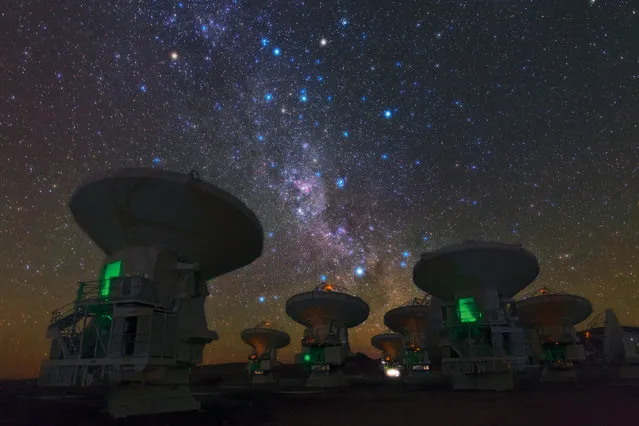
The antennas of the European Southern Observatory's Atacama Large Millimeter/Submillimeter Array, also known as ALMA, are set against the splendor of the Milky Way in this picture by Babak Tafreshi

The antennas of the European Southern Observatory's Atacama Large Millimeter/Submillimeter Array, also known as ALMA, are set against the splendor of the Milky Way in this picture by Babak Tafreshi. Construction of the full ALMA array is due to be completed in Chile's Atacama Desert in 2013, but the facility is already making scientific observations with a partial array of antennas. (Photo by ESO/B. Tafreshi/TWAN)
Details
03 Jun 2012 11:57:00
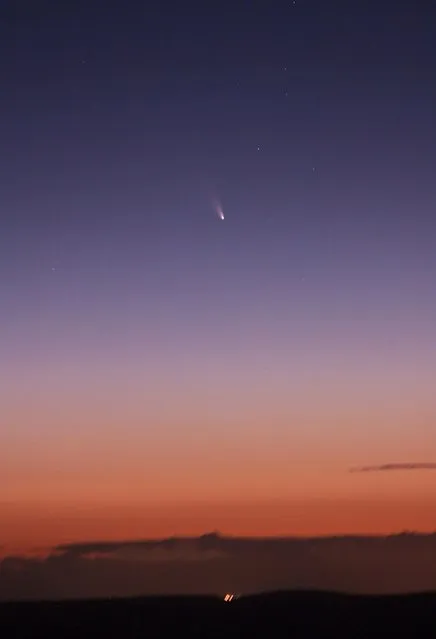
This image provided by NASA shoaws the comet PANSTARRS as seen from Mount Dale, Western Australia on March 5, 2013. According to NASA on March 10, it will make its closest approach to the sun about 28 million miles (45 million kilometers) away. As it continues its nightly trek across the sky, the comet may get lost in the sun's glare but should return and be visible to the naked eye by March 12. (Photo by AP Photo/NASA)

It’s time to start watching for Comet PANSTARRS, one of two comets to get excited about in 2013. Photo: This image provided by NASA shoaws the comet PANSTARRS as seen from Mount Dale, Western Australia on March 5, 2013. According to NASA on March 10, it will make its closest approach to the sun about 28 million miles (45 million kilometers) away. As it continues its nightly trek across the sky, the comet may get lost in the sun's glare but should return and be visible to the naked eye by March 12. (Photo by AP Photo/NASA)
Details
13 Mar 2013 08:03:00
Zhou Xiaoxuan, center, weeps as she speaks to her supporters upon arrival at a courthouse in Beijing, Wednesday, December 2, 2020. Zhou, a Chinese woman who filed a sexual harassment lawsuit against a TV host, told dozens of cheering supporters at a courthouse Wednesday she hopes her case will encourage other victims of gender violence in a system that gives them few options to pursue complaints. (Photo by Andy Wong/AP Photo)

Zhou Xiaoxuan, center, weeps as she speaks to her supporters upon arrival at a courthouse in Beijing, Wednesday, December 2, 2020. Zhou, a Chinese woman who filed a sexual harassment lawsuit against a TV host, told dozens of cheering supporters at a courthouse Wednesday she hopes her case will encourage other victims of gender violence in a system that gives them few options to pursue complaints. (Photo by Andy Wong/AP Photo)
Details
10 Dec 2020 00:05:00
A woman spreads out fish to dry at Ngapali Beach near a fishing village in Myanmar's western Rakhine State, Saturday, December 31, 2022. (Photo by Aung Shine Oo/AP Photo)

A woman spreads out fish to dry at Ngapali Beach near a fishing village in Myanmar's western Rakhine State, Saturday, December 31, 2022. (Photo by Aung Shine Oo/AP Photo)
Details
06 Jan 2023 05:12:00
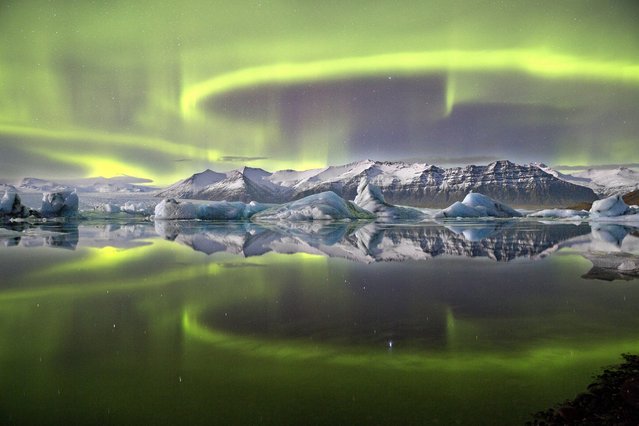
“Aurora over a glacier lagoon”. A vivid green overheaded aurrora pictured in Iceland's Vatnajokull National Park reflected almost symetrically in Jokulsrlon Glacier lagoon. A complete lack of wind and currrent combin in this sheltred lagoon scene to crete an arresting mirror effect giving the image a sensation of utter stillness. Despite theis there is motion on a suprising scale, as the loops and arcs of the aurora are shaped by the shifting forces of the Earth's magnetic field. (Photo by  James Woodend/The Astronomy Photographer of the Year 2014 Contest)

“Aurora over a glacier lagoon”. A vivid green overheaded aurrora pictured in Iceland's Vatnajokull National Park reflected almost symetrically in Jokulsrlon Glacier lagoon. A complete lack of wind and currrent combin in this sheltred lagoon scene to crete an arresting mirror effect giving the image a sensation of utter stillness. Despite theis there is motion on a suprising scale, as the loops and arcs of the aurora are shaped by the shifting forces of the Earth's magnetic field. James Woodend of Great Britain won the grand prize with the image, beating out more than 2,500 other entries. The Astronomy Photographer of the Year 2014 contest is judged by the Royal Observatory Greenwich and BBC Sky at Night magazine. (Photo by James Woodend/The Astronomy Photographer of the Year 2014 Contest)
Details
26 Sep 2014 13:39:00